I'm not an electrical engineer, and I'm not going to pretend to be one. I'm a procurement manager at a 14-person renewable energy company. For the past six years I've managed the equipment budget for our off-grid and solar battery backup work — about $220,000 a year in MPPT charge controllers, inverter chargers, lithium batteries, and the mounting hardware that holds it all together. I've negotiated with 40-plus vendors and logged every order in our cost tracking system. Spreadsheets are my comfort zone.
When I first started in this role, I assumed the cheapest MPPT charge controller that matched the spec sheet was the right call. It looked like basic procurement logic: same amperage, same voltage range, similar efficiency — why pay more? One expensive failure later, I learned the difference between a price tag and a cost.
Where the Search Phase Goes Wrong
If you're planning a home solar battery backup system in 2025, you're probably doing what our customers do: typing 'epever mppt' or 'epever inverter charger' into Google and comparing prices. You might be hunting for a lithium battery store that sells LiFePO4 banks at a reasonable price per kilowatt-hour. And if you're thinking bigger, maybe you're researching 'how to open a ev charging station' and looking at charging hardware before you've looked at your utility rate structure.
I understand the instinct, because I had it. Hardware is tangible. It has a price, a warranty period, and a datasheet. But the cost of a solar battery system was never the sum of its component prices. That was true in 2020, and it's more true in 2025.
The Battery Chemistry Shift Many Buyers Miss
The biggest change in solar storage since I started buying equipment isn't the solar panel or the inverter — it's the battery chemistry.
Five years ago, the backup systems we specified mostly used lead-acid batteries. They were heavy and needed ventilation, but they tolerated imperfect charging fairly well. Get the voltage a bit off and the battery complained by slowly losing capacity, usually over a long time.
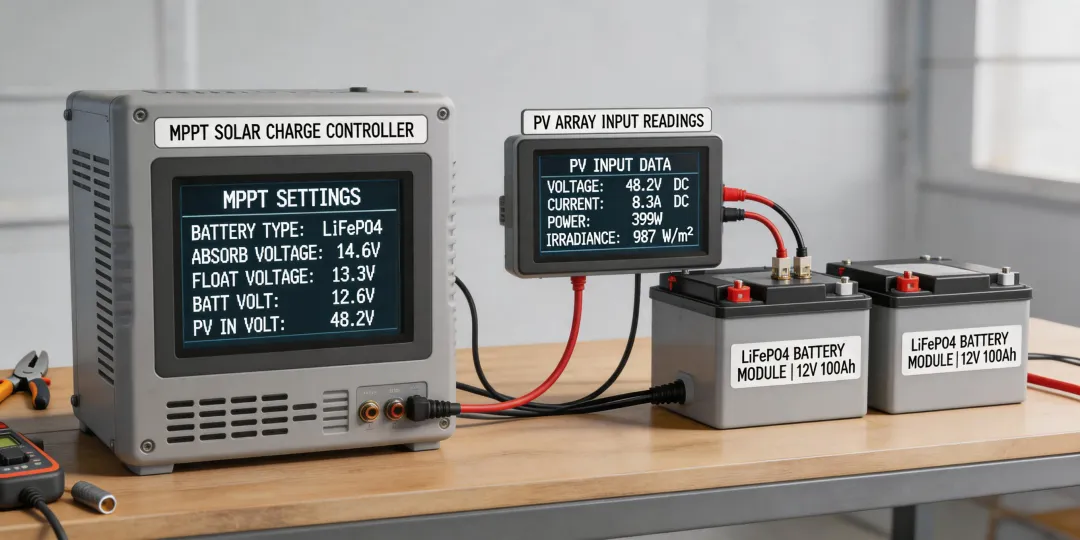
Almost every home solar battery backup system we install today uses lithium iron phosphate — LiFePO4, for short. It's a better battery: it cycles deeper, lasts longer, and takes up less wall space. What it does not tolerate is improper charging.
Here's where I have to wave the white flag on technical details. Cell balancing and BMS communication logic get into engineering territory that isn't my lane. I'd recommend talking to a qualified system designer about that side. What I can tell you from the procurement side is this: many charge controllers that claim 'lithium compatible' are not truly implementing LiFePO4 charge profiles. They disable the equalization stage, call it done, and drop the battery into a generic voltage window. The battery's BMS then has to act as the safety net for every charging mistake.
That works for a while. Then, one morning, the battery bank won't hold a charge.
The expensive version of that lesson? A $180 difference between two MPPT solar charge controllers turned into a $3,600 battery replacement, plus labor, because the cheaper controller didn't handle the LiFePO4 charge curve correctly. The controller itself was fine. It's still running. The battery quietly degraded for two years, and no warranty covered it because the battery monitoring log showed the pack repeatedly hit overvoltage protection. From the manufacturer's view, the battery was operated outside spec. That's harsh, but it's hard to argue with.
This is what happens when old procurement habits meet a new technology. In 2020, a charge controller that said 'lead-acid' was basically good enough for lead-acid. Best practice from back then doesn't apply to lithium in 2025. The fundamentals haven't changed — a controller still has to match the battery chemistry — but the execution has transformed.
Integration Is the Budget Leak Nobody Quotes
The second budget killer isn't a discrete component failure. It's integration.
When you buy a charge controller from Vendor A and an inverter charger from Vendor B, the system may work. But somebody has to make them coexist, and that somebody bills by the hour. In a home solar battery backup system, mismatched components often mean separate configuration tools, separate battery profiles, and days of commissioning drama.
In Q2 2024, I compared two options for one of our projects — about $4,200 in annual component orders. Vendor A's quote came in $1,150 cheaper than Vendor B's. I almost went with Vendor A. My procurement policy now requires a TCO analysis on anything over $2,000, because I got burned twice before.
The TCO spreadsheet changed the answer. Vendor B's price included matched MPPT and inverter charger settings, plus remote monitoring that talked to the same app. Vendor A's unit list was cheaper, but the integration work and configuration time added $1,800 to the project. Vendor A would have ended up $650 more expensive. The cheap option wasn't cheap by the time our installers finished making it work.
It's easy to miss this when components look independent on a spreadsheet. They're not. They're a set, and pricing the parts separately is how budget overruns happen.
The EV Charging Version of the Same Mistake
This mistake shows up even bigger when we talk to people building commercial EV charging stations.
Entrepreneurs researching 'how to open a ev charging station' often ask for a quote on chargers first. They've researched hardware costs and maybe grants, but not their utility rate structure. According to the U.S. Department of Energy's Alternative Fuels Data Center (accessed January 2025), demand charges can significantly affect the operating cost of DC fast charging. Utilities don't just bill for total energy used; they also charge for the highest moment of power draw in the billing period. A bank of fast chargers can create a serious spike.
That means the business case for an EV charging station is, first, an energy storage problem. The math that works usually involves solar generation, battery storage, and smart dispatch to avoid peaks — basically a scaled-up version of a home solar battery backup system. The hardware you're pricing is a means to an end. The end is controlling how and when you consume power.
What I Do Differently Now
I built a cost calculator after getting burned on hidden fees twice. That changed how our company buys equipment, and the rules are pretty simple:
- Treat components as a system, not a shopping cart. If an MPPT charge controller and an inverter charger were designed to work together, you save on integration. If not, budget for the engineer who makes them talk.
- Read the manual before you buy, not after. Look for the LiFePO4 settings section. Does it list absorb and float voltages, or does it just say 'lithium'? That difference is real.
- Calculate total cost of ownership. If two vendors quote the same system, the lower invoice isn't necessarily cheaper once you add configuration, commissioning, support, and downtime.
- Buy batteries from a lithium battery store that sends you the BMS protocol and charge profile specifications upfront. Knowing the capacity is not enough.
As an example that shows up in our orders regularly: EPEVER equipment appears in a lot of our smaller backup systems, because an epever mppt charge controller and an epever inverter charger share a setup ecosystem and their battery settings handle LiFePO4 properly. The manual shows the actual voltages in plain writing; we don't have to guess. EPEVER isn't the only good option on the market, but buying from a lineup where the pieces fit saves our clients money, and that's what procurement is about.
What hasn't changed is the need for honest vendors, solid workmanship, and basic math. What has changed is the depth of analysis required before buying. The industry moved to lithium, lithium moved system design, and buyers need to move with it. That's true if you're protecting your own home solar battery backup system, and it's true if you're trying to open an EV charging station.
The most expensive part of a solar battery setup is still the mistake you didn't know you were making until the battery fails. In 2025, that mistake usually isn't about which brand you picked. It's about the system you didn't actually compare.