Ask three installers which solar charge controller to buy and you’ll get three confident answers. Ask the buyer who processes the purchase order and you get a different question first: what are you protecting, and what does it cost if the controller stops working? That question changes the answer more than brand, wattage, or price.
I’ve been managing purchasing for our company’s remote power equipment since 2020—solar trailers, monitoring sites, backup power for tools and communications. I don’t design every system, but I do read manuals, compare spare parts, and justify costs to finance. EPEver Tracer MPPT controllers have become a common purchase for us. They are not the answer for everyone. If you’ve looked at a Harbor Freight solar charge controller, I get the appeal. Sometimes that low-cost controller is the right answer.
The real decision is not EPEver versus Harbor Freight. It’s matching the controller to one of three scenarios:
- You’re keeping a small battery topped up, and failure is an inconvenience.
- You’re building a system that needs good harvest, future expansion, or lithium-battery support.
- You’re buying for a remote, client-facing, or business-critical site where downtime has a cost.
Harbor Freight Solar Charge Controller: When It’s Enough
If the whole system is a small 12V setup—a 100W panel, a shed, a gate opener, or a float charger for a vehicle—a PWM controller is not embarrassing. Most Harbor Freight charge controllers are PWM. A PWM controller does not extract as much energy from a solar panel as an MPPT controller does, but on a tiny starter panel the difference is small.
The idea that “every solar setup needs MPPT” comes from an era when solar panels were expensive and MPPT was still new. In that world, losing 20-30 percent of a panel was real money. Today, a 100W panel is cheap. In my view, that changes the math. Not every project deserves an expensive controller.
I’m not recommending the Harbor Freight controller as an investment-grade part. I am saying it can be acceptable for a low-risk maintenance task. Not ideal for a serious off-grid system. Workable. One caveat: don’t put a cheap controller in front of an expensive battery. The controller’s main job is to protect the battery from overcharge and undercharge. If you connect a $300 battery to a $25 controller, protect it properly.
EPEver Tracer MPPT and the Lithium-Battery Question
Now we are in the situation where I usually order the EPEver Tracer MPPT. You have more than a 100W panel. You want the system to perform in partial sun. You may add another battery later. This is where MPPT earns the higher price.
What does lithium change?
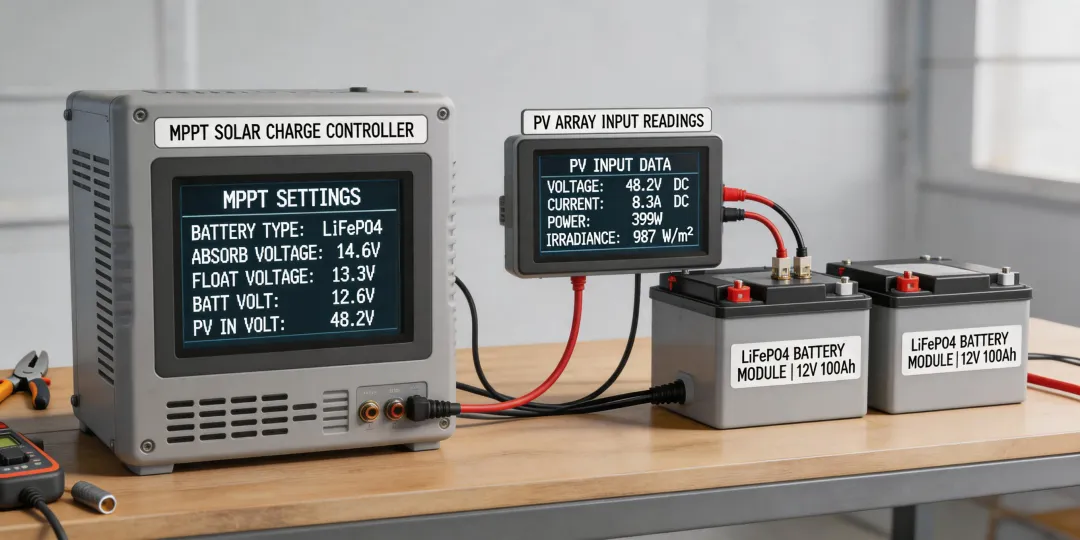
If you are asking “what is lithium battery?” because a storage vendor says lithium is better, focus on three things: usable capacity, cycle life, and charging profile. Most off-grid solar storage now uses LiFePO4, often called LFP. It is a lithium battery, but not the same lithium-ion polymer chemistry inside a phone. LFP can be discharged deeper than lead-acid, accepts charge faster, and usually lasts longer when the charging voltage is set correctly.
With lead-acid, you plan to use only about 50 percent of rated capacity. With LiFePO4, 80 to 90 percent is common. That difference often makes a lithium battery cheaper over its life. It also explains why a lithium battery changes the controller you choose.
Most of the battery storage investment news today is about large utility-scale projects, not 20A charge controllers. But the same investment has made smaller LFP batteries affordable. By 2024, I was routinely choosing LiFePO4 over AGM for new remote builds. In early 2025, the cost gap is closing enough that I calculate it instead of assuming lead-acid is cheaper.
Why the EPEver MPPT 20A is my usual starting point
EPEver’s Tracer MPPT line is not the priciest option, and it is not the cheapest. The EPEver MPPT 20A gives you a built-in display, several selectable battery chemistries, and adjustable charging voltages. The adjustable voltage is the important part. If the controller cannot be told to charge to the correct voltage for LiFePO4, the battery may never reach full state of charge or may be overcharged. That small setting is often what separates a battery that lasts from a battery that fails early.
Sizing a 20A MPPT is simpler than most spec sheets make it sound. On a 12V battery, 20A of charge current is roughly 260-280W of charge output. On 24V, it is roughly 520-560W. For many cabins, trailers, and telemetry boxes, that fits. If you need more current, step up to a 30A or 40A MPPT. If you need less and the system is non-critical, go back to the cheap PWM scenario.
When the Site Has a Deadline, Buy Certainty
The third scenario is where I get firm. If the solar controller powers a security trailer, a communications site, or an installation that requires a paid visit to repair, do not make a $20 product the weakest link. The cost is not the part. The cost is the drive, the missed uptime, and the rescheduling.
I learned this the expensive way. We tried to save about $45 on a controller for a remote water-quality monitor. Ten weeks later, the controller quit. The replacement was nearly free. The contractor trip, lost data, and site access were not. I still kick myself for not asking the project manager what one missed day was worth at that site. If I had asked, I would have ordered the EPEver MPPT from the start.
The way I see it, the extra money is not a rush fee or a brand tax. It is a certainty premium. A reliable controller gives you a predictable outcome. When you are buying around a deadline or a service commitment, predictability is the spec that matters. Uncertain “probably fine” pricing is never cheap if it fails once.
EPEver is not the only brand that can do this. Victron and Morningstar also make solid MPPT controllers. I have no interest in attacking them. For our inventory, EPEver has the right mix of readable manuals, lithium-capable settings, and support for common monitoring. When I need to verify something before issuing a purchase order, that documentation is what I rely on.
Three Questions to Find Your Scenario
This is how I decide when an engineer is not standing next to me:
- What happens if the controller stops charging next Tuesday? If nobody has to drive there, the risk is low. Buy according to price.
- Is the battery lithium, or could it become lithium within the next year? If yes, use an MPPT controller with a lithium or custom profile.
- Who has to install and troubleshoot the system? If it is not you, choose equipment with clear documentation and visible error states. A manual does more for a remote technician than an unmarked “smart” controller.
There is no universal “best” answer. If your setup is a convenience, a Harbor Freight charge controller can be enough. If your setup includes real solar production, lithium batteries, or a site where downtime matters, the EPEver Tracer MPPT line has become my default. To me, the question is not EPEver versus Harbor Freight. It is this: what actually happens when the controller stops doing its job?
Answer that first. The controller model will almost pick itself.