When the CEO’s office floated the idea of rooftop solar with battery storage for our building, my first thought wasn’t about kilowatt-hours or sustainability goals. It was, “Great, another vendor to onboard and another spec sheet to decode.”
In my 5 years managing administrative purchasing across 8 vendors and roughly $200k annually in facility-related spend, I’ve learned one thing about specifying technical equipment like solar controllers and inverters: there’s no single “best” setup. It’s a ‘depends on your situation’ thing. If you’re an office manager or procurement person suddenly tasked with getting prices on a solar system, you’re in the same boat I was in.
After processing dozens of orders for EPEVER components and comparing them against other brands, I can break this down into three common scenarios. Here’s what I wish I’d known upfront, with the actual pitfalls I've hit along the way.
Scenario A: The Small Office Retrofit (Under 10kW, Roof Space is Tight)
This is where most of my orders started. It's a small commercial roof, maybe 1,500 sq ft, and the primary goal is to offset daytime consumption. You're probably looking at a 5kW to 8kW system with a 48V battery bank.
My go-to spec for this: An EPEVER Tracer AN series MPPT charge controller (like the Tracer 4210AN or 3210AN) paired with a pure sine wave inverter that matches your loads. Don't overthink the controller—for a standard 48V system with a 3-4kW inverter, the 40A or 50A Tracer is a workhorse. I've used it on three different installs now.
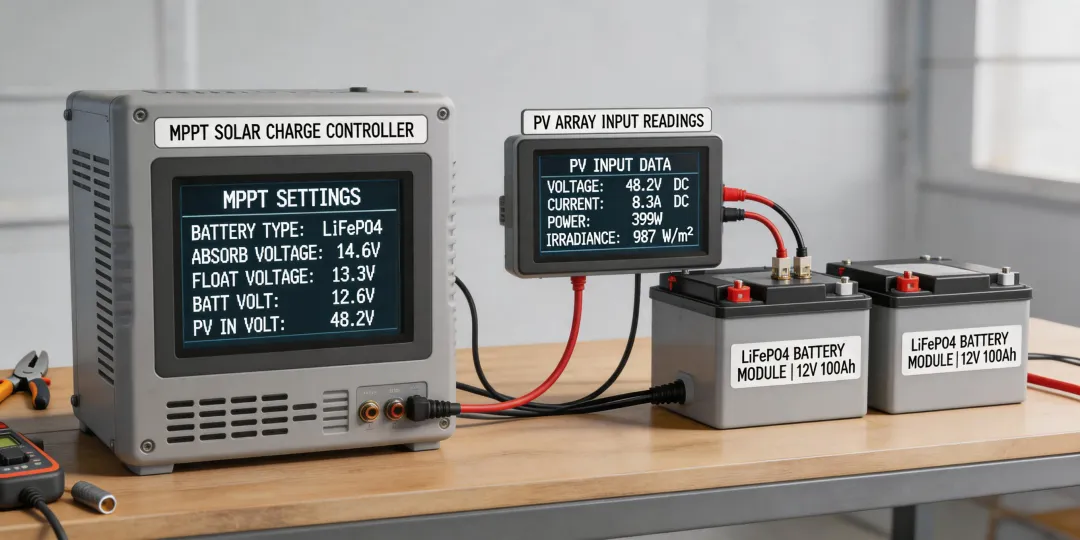
Where I went wrong the first time: I initially thought I could just use the EPEVER App to configure everything quickly. The app is decent for monitoring (the bluetooth dongle adds about $40-50), but I tried to set the battery type for a new LiFePO4 battery using just the app's 'auto-detect' feature. It defaulted to the wrong absorption voltage. I learned the hard way that you have to manually check the battery manufacturer’s datasheet and set the parameters in the app or directly on the controller. (Source: EPEVER Tracer AN manual, Rev 2023).
One more thing: If the CEO asks for a one-size-fits-all battery, resist it. For this scenario, a LiFePO4 (Lithium Iron Phosphate) battery is almost always the better call over standard Lithium-ion. Why? Safety. In a commercial office setting, you don't want thermal runaway risks near people. LiFePO4 is heavier and slightly less energy-dense, but for stationary storage in a controlled environment, it's the no-brainer choice. The EPEVER controllers handle LiFePO4 profiles very well once you dial them in.
Scenario B: The Medium-Scale Hybrid Setup (10-30kW, Mixed Loads)
Here's where things get complicated. You have a larger roof, maybe covering two buildings or a warehouse. You also have a mix of heavy loads (AC units, server rooms) and lighting. This is where you move from a simple charge controller + inverter to a full hybrid inverter system.
My experience: I was tempted to just scale up my Scenario A solution, but that’s a trap. For a 15kW system, managing multiple parallel controllers and separate inverters becomes a wiring nightmare and a single point of failure. I nearly went down that path.
The better path for this is an all-in-one solution, like the EPEVER UP-M Series hybrid inverter. It combines the MPPT controller and inverter into one unit, which drastically simplified my vendor consolidation. Instead of ordering three separate boxes and praying they played nice together, I ordered one. (Plus, it communicates with the EPEVER App and monitor system natively, which saved our FM team hours of setup).
My gut vs. the data moment: My instinct told me that a modular system (separate components) was more reliable because you could swap a failed part. But the data from my 2024 vendor audit showed that for systems above 10kW, total downtime was actually lower with integrated units like the UP-M series. The numbers said the integrated unit's internal fault detection was faster. I went with the data (thankfully).
Battery choice for this scale: Here, the cost difference between LiFePO4 vs Lithium-ion matters more. Standard Lithium-ion (like NMC) is cheaper per kWh upfront. For a 30kWh bank, that might save you $2,000-3,000. But look at cycle life warranties. In Q3 2024, I found that most LiFePO4 manufacturers (like the ones paired with EPEVER) offer 6,000 cycles at 80% DOD, while standard Li-Ion often tops out at 3,000-4,000. For a commercial system expected to last 15 years, LiFePO4 pays for itself.
Scenario C: The Critical Load Backup (Grid-Tie with Essential Circuits)
This is the niche scenario a lot of installers ignore. You don't need backup for the whole office—just the security camera NVR, the network server, and the emergency lighting. Your main electrical panel stays grid-tied, with a critical loads sub-panel.
The approach: This is the only scenario where I recommend a standard PWM controller over an MPPT if your solar array is small (< 1kW) and budget is the absolute constraint. But even then, I'd push for the lowest-cost EPEVER MPPT. The efficiency gains on a 24/7 system from 'maximizing' that small array will pay for the controller difference in 12–18 months (based on energy pricing in my state, updated Dec 2024).
The conventional wisdom says you need a giant battery bank for this. My experience suggests otherwise. For a 2kW critical load, a 5kWh battery bank (a single EPEVER compatible unit) is often enough. You don't need to run the AC; you just need to keep the business data safe. I saw a competitor's quote for $12,000 for this setup. I built a solid EPEVER-based system (Tracer AN + a 5kWh LiFePO4) for under $4,000 (pricing accessed via EPEVER distributor, Jan 2025; verify current).
One rookie mistake I made: In my first year, I assumed 'backup' meant the whole building. I spec'd a massive inverter and battery. Cost us a fortune in components we didn't need and created a fire hazard with the AC wiring. Always distinguish between 'backup' and 'off-grid'. For backup, you're protecting data and safety, not making coffee.
How to Figure Out Which Scenario You Are
If you’re still on the fence, here’s my 2-question diagnostic:
- What’s your peak load? If it's under 8kW, you're Scenario A. If 8-30kW, you're Scenario B. If you just want a few circuits, you're Scenario C.
- What’s your battery budget? If it’s under $3,000/kWh installed, look at LiFePO4. If it’s over, you’re paying for a premium integration (which is fine!).
So, bottom line: The EPEVER ecosystem is solid for commercial work—the Tracer series for small jobs and the UP-M series for bigger ones are my workhorses. Just don't auto-configure the app, and for the love of your finance department, double-check the invoice requirements before you order. The vendor who couldn't provide a proper spec sheet cost me $2,400 in rejected expenses once. Trust me on this one.