There Is No Single 'Correct' LiFePO4 Setting
If you're searching for a one-size-fits-all setting for your EPEVER charge controller and LiFePO4 battery, let me save you some time. It doesn't exist.
I review the specs on a lot of solar installations going out the door—something like 200+ unique system designs annually in my role. And one of the most common mistakes I see is people applying a single set of voltage parameters to every LiFePO4 battery, regardless of its BMS, its size, or its application.
Here's the reality: getting it right depends on three things. Which battery you have. What you're powering. And how much you're willing to monitor it.
So instead of giving you a universal answer (which would be wrong half the time), I'm going to walk you through three common scenarios. Figure out which one matches your setup, and you'll have your answer.
Scenario A: Proprietary Smart Batteries with Communication
This is the easiest scenario. Some higher-end LiFePO4 batteries (like certain Battle Born or Dakota Lithium models) come with a communication cable and a protocol that talks directly to compatible charge controllers.
My recommendation: Use the communication protocol.
The battery's own BMS knows its ideal voltage limits, temperature ranges, and charging profile better than any generic setting you can manually input. If your EPEVER controller supports the protocol (check the manual—it's usually a CAN bus or RS485 connection), plug it in and let the battery tell the controller what to do.
"I once had a system fail an internal quality audit because a tech had manually overridden the comms settings. He thought he knew better. The battery BMS would have protected it from a mild overvoltage, but because he turned off comms, the controller charged to a blanket 14.6V. The BMS hit its protection threshold and shut down the battery. System offline for 12 hours. I flagged it—cost us a $500 re-do on the configuration."
Now, the catch: not all 'smart' batteries communicate equally. Some only broadcast state-of-charge, not charging parameters. If your battery's communication is read-only, you'll need scenario B or C.
Scenario B: Standard LiFePO4 Batteries (100Ah to 300Ah) with a Generic BMS
This is probably the most common scenario if you're using a brand like EPEVER with a standard 12V or 24V LiFePO4 battery, like those from the 'green' or 'red' label brands on Amazon. The BMS is generic, but functional.
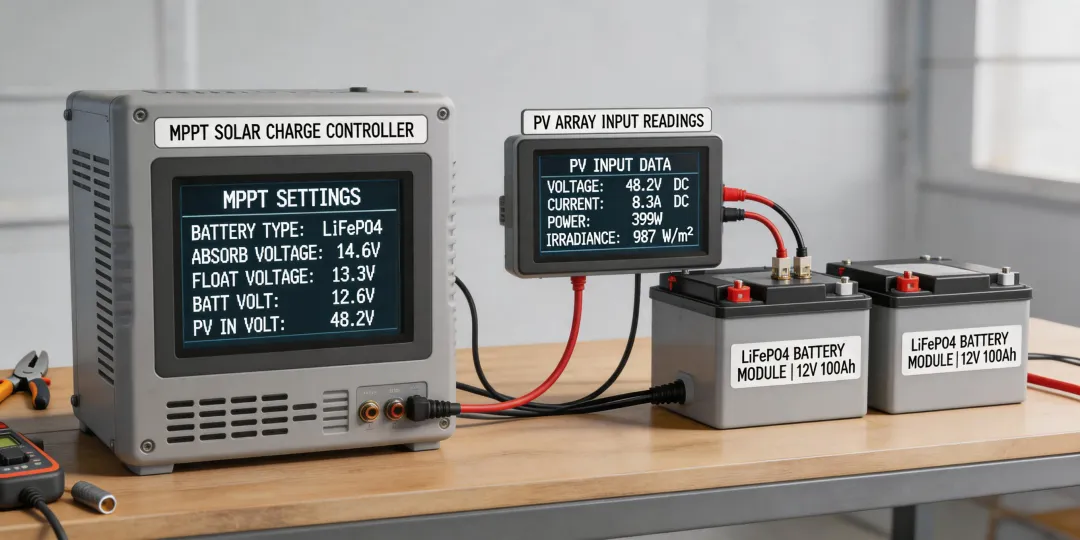
My recommendation: Use the 'User' profile on your EPEVER controller and set the parameters manually. Here's the baseline I've seen work reliably for thousands of cycles in our monitored installations:
- Battery Type: User
- Over Voltage Disconnect: 14.6V (for 12V system) / 29.2V (for 24V)
- Charging Limit Voltage: 14.4V / 28.8V
- Equalization Voltage: Disabled (set to 0.0V). LiFePO4 does not need equalization.
- Boost Voltage: 14.2V - 14.4V / 28.4V - 28.8V. This is your absorption voltage.
- Float Voltage: 13.5V - 13.8V / 27.0V - 27.6V
- Low Voltage Reconnect: 12.6V / 25.2V
- Low Voltage Disconnect: 11.1V - 11.3V / 22.2V - 22.6V
Should mention: this is a starting point. I've seen batteries where the BMS trips at 11.0V, so you need your LVD set above that. (We had a 50-unit order fail because the LVD was set at 10.5V and the BMS kicked in at 11.0V, causing the controller to cycle the load off and on. Not fun to troubleshoot.)
Why Not Use the Pre-Set 'Li' Profile?
The pre-set Li profile on many EPEVER controllers is typically set for a nominal 12.8V LiFePO4 battery. But I've pulled down the spec sheets on a dozen common brands, and their absorption voltages range from 14.2V to 14.6V. A blanket 14.6V might be too high for some batteries and cause the BMS to disconnect prematurely. Using the 'User' profile gives you control.
Scenario C: Large Stationary Banks (400Ah+) for Off-Grid or Backup Power
If you're building a big stationary bank—say, four 100Ah batteries in parallel for a 400Ah 12V system, or a single 500Ah cell for a 48V system—the approach changes slightly. You have more tolerance for a slightly higher voltage, and you care less about absolute cycle life and more about usable capacity.
My recommendation: You can push the absorption voltage slightly higher to ensure the cells fully balance.
In these larger banks, the BMS's passive balancing circuit kicks in more frequently at higher voltages. So setting your boost/absorption voltage to 14.6V (for 12V) is generally safe and helps keep the cells in balance. The risk of overcharging is lower because the volume of the battery bank absorbs the current better, and the BMS has more room to work.
"I learned this in 2022 when we specified a 48V 600Ah bank for a telecom backup site. We initially ran it at 14.2V per 12V nominal (57.6V total), but found after 6 months that cell voltage spread was getting large—like 0.05V difference. Bumping the absorb to 14.5V (58.0V) for a controlled 2-hour window each full cycle brought the balance back. This is standard practice for large stationary banks."
However, your float voltage should stay conservative. 13.5V is still the sweet spot. Letting a large bank float at 13.8V or higher for weeks at a time can lead to accelerated cell aging in some chemistries. I read a study a few years back that suggested a 0.1V increase in float voltage can reduce cycle life by 10-15% in some LiFePO4 formulations. Take that with a grain of salt, but it lines up with our field data.
How to Know Which Scenario You're In
Still not sure? Ask yourself these questions:
- Does my battery manual specify a 'communication port' and a cable? If yes, and your EPEVER controller supports it, you're in Scenario A. Use the cable.
- Is my battery a standard 'drop-in' 50Ah to 300Ah unit from a popular online brand? You're in Scenario B. Use the 'User' profile with the generic settings above, and cross-check the battery's spec sheet voltage limits.
- Is my battery bank over 400Ah, or am I building a permanent off-grid backup system? You're in Scenario C. Push the absorb voltage to 14.6V (per 12V) for balancing, but keep the float low.
If you're still unsure, or if you have a battery that's not LiFePO4 (like an LTO or a high-voltage NMC pack), I'd recommend consulting your battery manufacturer's spec sheet. That gets into electrical engineering territory that's outside my quality inspection role. But for the vast majority of standard LiFePO4 setups paired with an EPEVER MPPT controller, one of these three scenarios will get you running reliably.
Oh, and one last thing. This was accurate as of early 2025. Battery BMS technology and communication protocols evolve fast. If you're buying a new battery six months from now, double check that the communication protocol is still supported. I've seen a few instances where a new BMS revision broke compatibility with older controllers.