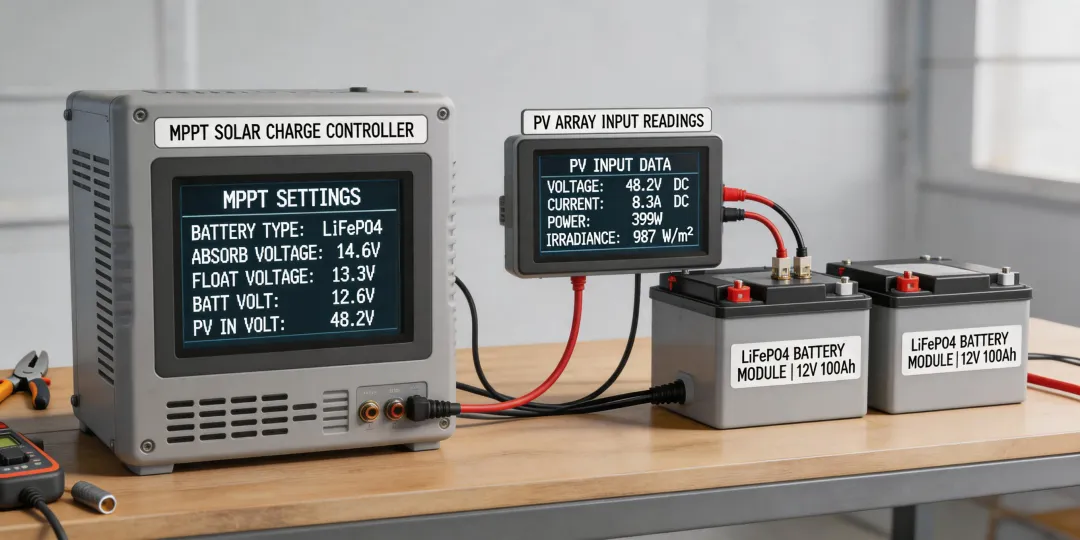
If you're looking at an EPEVER MPPT solar charge controller, you've probably read a few reviews that say 'it's great for small to medium systems.' That's not wrong, but it's not helpful either. The thing about solar charge controllers—especially MPPT ones—is that there isn't a single 'best' model for everyone. It depends on your panel setup, your battery chemistry, and what you're trying to do with the power.
After managing procurement for a company that does light-construction and mobile office retrofits, I've sourced these controllers for about 15 different installs over the last few years. I'm not an electrical engineer, so I can't get into the weeds of MOSFET topology or maximum input voltage calculations down to the last volt. But from a purchasing and practical application standpoint? I've seen what works, what doesn't, and where people typically make expensive assumptions.
Here's how to figure out which EPEVER MPPT controller makes sense for you.
Three Common Solar Scenarios
Almost every inquiry I've handled falls into one of three camps. They are:
- Scenario A: The Weekend Cabin Setup – Small panel (100W-300W), single 12V battery bank (often lead-acid or small LiFePO4). You just need lights, maybe a mini-fridge, and to charge a phone.
- Scenario B: The Mobile Workshop or RV Installation – Mid-range panels (400W-800W), 12V or 24V battery bank. You're running power tools, a laptop, a monitor, and a fan. You care a lot about efficiency.
- Scenario C: The Off-Grid Home Base – Bigger panels (800W-1200W+), 48V battery bank with significant LiFePO4 capacity. This is serious infrastructure—lights, appliances, a well pump, or a server rack.
I should note that this isn't a 'bigger is better' situation. If you're in Scenario A, buying the Tracer 8420AN is a waste of money and might actually be harder on your small battery bank.
How to Approach Each Scenario
Scenario A: Weekend Cabin (Small System, Simple Needs)
Here's where most people overthink it. If you have a 150W panel and a single lead-acid battery, you don't need the flagship model. In fact, using a very high-current controller on a tiny system can sometimes lead to insufficient charging current to properly 'finish' the absorption stage on a flooded battery. Not a deal-breaker, but suboptimal.
For this setup, the EPEVER Tracer AN series (like the Tracer 1206AN or 1210AN) is often more than enough. They're affordable, they have solid dust and moisture resistance for a cabin environment, and their MPPT efficiency is still good enough to pull an extra 15-20% over a PWM controller. You're not going to miss the extra features of the higher-end models.
The mistake I see here is people buying a 30A or 40A controller for a 100W panel because 'future-proofing.' The problem? A 30A MPPT controller on a 100W panel is never going to be pushed hard enough to operate in its high-efficiency sweet spot. You pay more, and you get less efficiency per dollar.
Scenario B: Mobile Workshop (Efficiency and Compatibility Matter)
This is where the EPEVER 30A MPPT controller shines. When you have 400-600W of solar on a van or trailer, every watt counts. You're running a fridge, charging tool batteries, and powering work equipment. The difference between 90% and 96% MPPT efficiency can mean an extra hour of runtime for your tools at the end of the day.
In this scenario, I'd recommend the EPEVER Tracer 3210AN or the Tracer 4210AN. They handle the current well, they can be programmed for different battery chemistries via the MT50 display or the PC software, and they have a good balance between price and features. You don't need the Bluetooth dongle that the higher-end models support, but the RS485 port is great if you want to connect it to a solar monitoring system.
One thing I learned the hard way: assumption failure. I once assumed that all LiFePO4 batteries have the same charging profile. They don't. I got a batch of batteries with BMS settings that preferred a slightly different absorption voltage. The default profile on the controller was 'close enough' for some, but not for others. I had to manually adjust the settings on the job site. So, if you're in this scenario and using LiFePO4, verify the voltage settings before you install. It takes 5 minutes but saves hours of debugging.
Scenario C: Off-Grid Home Base (System Integration and Reliability)
By the time you're building a 48V system with multiple 400W panels, you're probably not just buying a charge controller in isolation. You're looking at the whole ecosystem: controller, inverter, battery, monitor. This is where the EPEVER ecosystem makes sense because you can match the controller to an EPEVER inverter and lithium battery with pre-configured communication protocols.
For this, look at the EPEVER Tracer 6415AN or 8420AN. These are big, they require 6 AWG wire, and they can handle some serious input voltage (up to 150V or 200V depending on the model). A key feature here is the built-in real-time clock and data logging. If you're running a home base, you will want that data to understand your solar production and battery health.
Saved $400 on this one time by going with a cheaper controller that wasn't compatible with the inverter's communication protocol. The 'cheaper' controller couldn't talk to the inverter, so the inverter didn't know when to switch to grid power or when to absorb surplus. Ended up buying the EPEVER controller and selling the other one at a loss. The total cost of ownership of the 'cheap' option was actually higher.
I assumed 'same specifications' meant identical results across vendors—different communication protocol meant different results.
How to Know Which Scenario You're In
Still not sure? Here's a quick litmus test:
- Check your battery bank voltage. 12V means Scenarios A or B. 24V or 48V means you're likely in Scenario C.
- Calculate your maximum panel wattage. Under 400W? Scenario A. 400W-800W? Scenario B. Over 800W? Scenario C.
- What's your battery chemistry? If you're using old flooded lead-acid batteries from a car, you're probably in Scenario A. If you bought a $1200 LiFePO4 rack battery, you're in Scenario C.
And one more thing: don't let the 'future-proofing' trap get you. If you buy a controller that's too big for your current setup, you're just wasting money on features you can't use. If your needs grow later, you can upgrade then. The resale value of these controllers is decent because they're robust.
That's the honest take from someone who's ordered these for real projects. Pick your scenario, check the specs, and don't overthink it.