It Started With a Question I Thought I Could Answer
March 2024. I was staring at a load spreadsheet for a customer with a farmhouse, a Kia Niro Level 2 charger, and a very reasonable question: is a solar battery worth it? I gave my standard answer before looking at the data. That was mistake number one.
Quick background so you know where this is coming from. I'm the procurement manager at a 12-person off-grid solar integrator. I've managed our parts budget, roughly $180,000 a year, for six years. Every invoice goes into the same cost tracker. Every install gets a line item. I'm the person who asks whether the fancier MPPT controller is actually worth the extra $200. That's not a criticism of the equipment. It's just how my brain works. If the numbers don't close, I don't buy.
The Proposal That Almost Looked Right
The customer wanted two things: run the house mostly on solar, and charge the EV without pulling from the grid during peak times. The first design used an epever tracer 2210an 20a mppt charge controller, a LiFePO4 battery bank, and one of our standard inverters. On paper, it worked. The 20A controller was enough for the small array. The battery bank was two 48V 100Ah lithium packs. Nothing screamed wrong. But the customer was going to notice every time the car didn't get charged, and they'd never notice a float voltage. That should have been my first hint about where the real risk was.
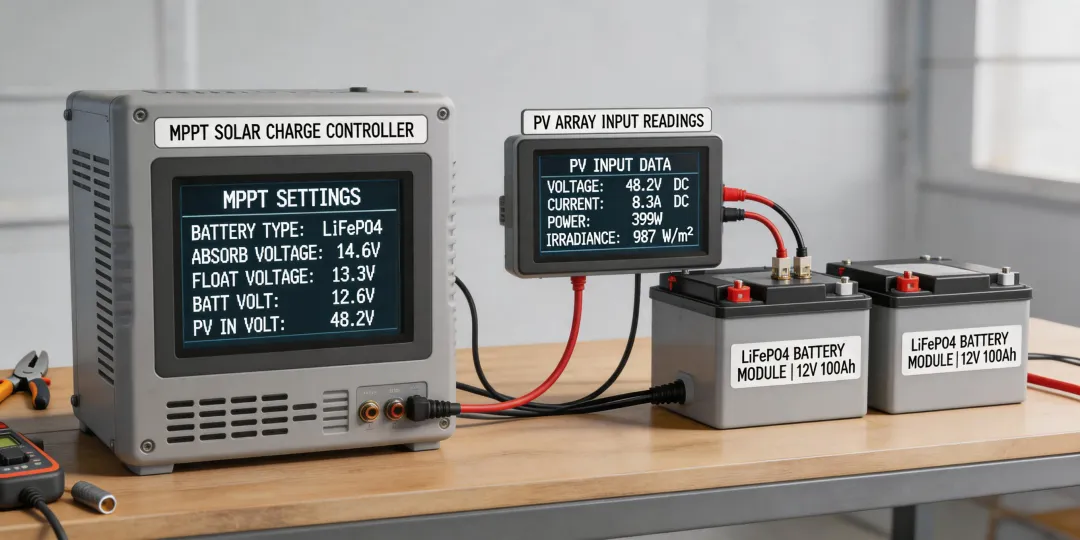
Then I checked the epever charge controller lithium settings. The default profile is lead-acid, and it includes a float stage. LiFePO4 batteries do not need float. Holding them at 13.8V forever can cause cell imbalance and shorten pack life. The Tracer 2210AN supports custom lithium profiles, but you have to disable float, set the right absorb voltage, and enable low-temperature cutoff in the software. We have a checklist for that. I approved the order without double-checking the settings. A senior installer caught it during pre-commissioning and fixed it in about ten minutes. That was mistake number two, and it was the luckiest near-miss we had all year. (Ugh, the classic false shortcut.)
The reason I missed it is embarrassing. I was busy comparing quotes from three suppliers. One offered a no-name controller for $110 less than the epever. I actually added it to the cart before I ran the TCO numbers. When I realized the no-name's lithium profile couldn't disable float, I deleted it. The epever cost more, but the battery it was protecting cost $2,200. A $110 savings that shortens a $2,200 asset is not savings. That's the kind of math I do every day, and I still almost got it backwards.
Wait, the Numbers Didn't Work. Then They Did.
Here's the part I really got wrong. My first TCO model said the battery wasn't worth it. Average solar production covered the house load, and the EV charger was a separate line item. I was about to tell the customer no. In early 2024, the utility was also talking about cutting net metering credits, which should have made me look deeper. I didn't. Not yet.
Then I looked at the hourly load shape. The Kia Niro Level 2 charger draws 7.2 kW. If the customer came home at 6 PM with an empty battery, that load would hit right after solar production ended. Without a battery, they'd buy that electricity at the utility's evening rate. With a battery, they'd pull from stored daytime solar. The difference was about $0.12 per kWh. Over 300 charging events a year, that starts to look like real money.
The lithium batteries added roughly $7,500 to the project cost. The payback, based on the EV charging pattern alone, was 8.4 years. That's under our 10-year threshold. So this time, yes, a solar battery was worth it.
Is a solar battery worth it every time? No. But it's tempting to think the answer is just a math question. It isn't. The math only works if the charge controller is sized correctly and the battery settings are right. Ten minutes of checking before shipping beats a $500 field visit and a battery that degrades two years early. Prevention, not cure.
The AC to AC Power Inverter Rabbit Hole
One more twist. The customer had seen a video about an ac to ac power inverter and asked if we could add one to the barn to make the air compressor cleaner. Our engineer spent twenty minutes explaining why not. The Level 2 charger and the compressor both run fine on 240V AC. An extra AC-to-AC conversion would add losses, add cost, and add another part that can fail. We took it out of the quote.
Look, I'm not against inverters. I'm against unnecessary boxes. That conversation reminded me that in this industry, the best savings are often the parts you don't buy. It also made me realize how many assumptions end up in a proposal. The customer asked a simple question, and we almost sold them a power converter they didn't need.
What I'd Do Differently
First, I'd check the lithium profile before ordering, not during commissioning. The 12-point checklist we now attach to every epever order has a line for battery chemistry. It feels like admin work until it catches a problem (note to self: that is exactly what I thought before this near-miss). We also write the custom settings on the outside of the box, because the install crew can't see the software file from the warehouse.
Second, I'd include the EV's worst case in the load calc, not the daily average. A 20% charge on a 64 kWh pack is a huge load. The numbers only work when the model respects that.
Third, I'd keep environmental claims boring. Per the FTC's Green Guides (ftc.gov), if you say a system is green, you need substantiation. So we put kWh, rates, and payback years in the proposal instead of adjectives. That forced us to argue with real numbers.
I don't have hard data on how many solar batteries are sold just because someone wanted to feel independent. But based on our 60-ish off-grid projects, my sense is that batteries make sense for about a third of residential requests, especially when EV charging is involved. My experience is based on small off-grid systems in the Northeast. If you're doing a large commercial array or you live somewhere with 1:1 net metering, your answer may be different.
For us, the epever tracer 2210an 20a mppt ended up going to a cabin project. The customer's system used a larger controller that could handle the bank. No waste. No rework. And I now have a defensible answer to 'is a solar battery worth it': it's worth it when the numbers, the load profile, and the configuration all agree. Otherwise, keep asking questions.