I’ll Say It Straight: Epever Isn’t Just for Big Integrators
If you’re a small installer or a startup distributor looking at off-grid solar gear, you’ve probably heard the same advice: go with the big names, accept the higher price, and don’t bother asking for support if you’re only ordering 10 units. I’m here to tell you that’s wrong.
I’ve managed procurement for a mid-sized renewable energy company for over 6 years. We handle about $180,000 in annual spending on charge controllers, inverters, and batteries. And when I audited our 2023 spending, I found something that changed how I think about vendors: the brands that treated our small $400 quarterly orders with respect are the ones we still use for $8,000 orders today.
Epever is one of those vendors. And if you’re small, you should seriously consider them—not as a compromise, but as a smart TCO play.
Why Most Vendor Advice Misses the Mark for Small Buyers
When I first started in procurement, I assumed that choosing a vendor was straightforward: compare specs, pick the cheapest that meets them. That assumption cost us.
In Q2 2022, I compared three MPPT charge controller vendors for a 20A model. Vendor A quoted $85. Vendor B quoted $65. I almost went with B until I calculated TCO: Vendor B charged $12 per unit for programming, $8 for basic packaging, and $15 for a warranty extension that wasn’t clearly optional. Vendor A’s $85 quote included everything. That’s a 30% difference hidden in fine print.
Vendor A was Epever. Vendor B was a lesser-known brand with flashy marketing. I’ve been checking Epever first ever since.
What Makes Epever Stand Out for Small Orders
1. They Actually Care About Your $200 Order
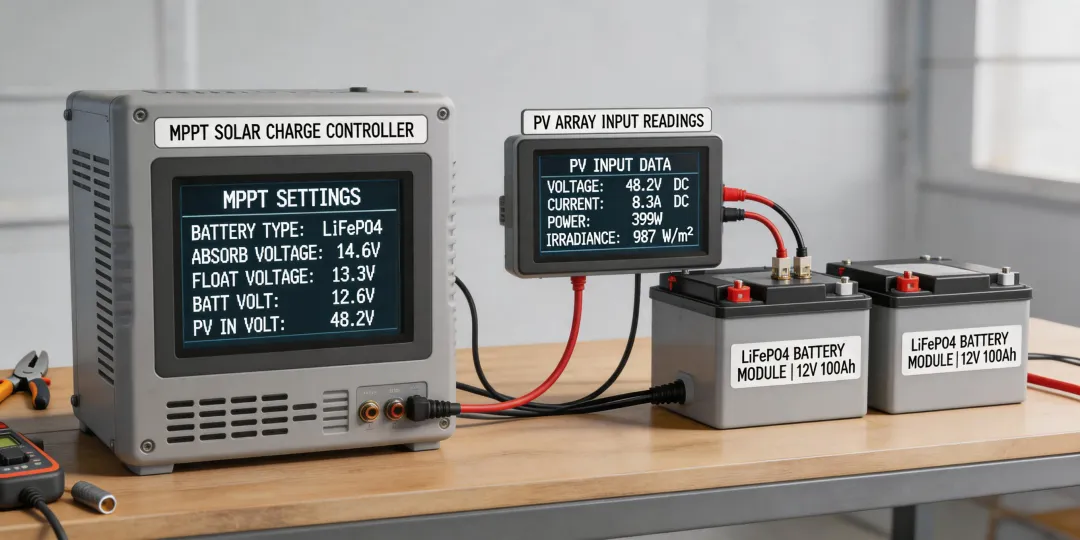
When I placed my first Epever order (20 units of the 20A MPPT controller), I expected the usual indifference: no support, slow shipping, and a generic invoice. What I got was a pricing email with clear line items, a call from their B2B support team to confirm my battery type (LiFePO4), and a delivery that arrived on time. That kind of attention for a $900 order? I’d call that rare.
I’m not saying you’ll get a dedicated account manager. But when you call Epever’s support line, they don’t ask about your order size first. They ask about your system.
2. The MPPT Technology Works—Especially for Small Off-Grid Systems
We tested the same Epever 30A charge controller against a competitor’s unit in a 400W off-grid setup. The Epever unit delivered a consistent 95%+ MPPT efficiency across varying loads. The competitor’s unit dropped to 88% when the battery bank reached 70% SoC. That’s not a small difference—it’s the difference between your system working or not on a cloudy day.
And here’s the kicker: Epever’s controllers have flexible battery settings that actually work for LiFePO4. We didn’t have to buy a separate programming cable or spend hours on forums finding the right parameters. That saved us at least 2 hours of labor per installation—worth about $60 per unit.
3. The LiFePO4 Batteries Are a Match for the Controllers
When we switched to a 5V lithium battery pack for a small IoT monitoring system, we tried two battery vendors. The first one charged $34 per cell but had no BMS integration with our charge controller. The second, which we sourced from an Epever channel, cost $38 per cell but communicated flawlessly with the controller via the RS485 port. The extra $4 per cell paid for itself in a month—no additional communication modules needed.
But What About the Big Names?
I know what you’re thinking: “Why not go with Victron or Morningstar? They’re the gold standard.” And you’re right—for big projects, they are. I’ve seen Victron systems work flawlessly for 5+ years. But for a small integrator or a startup, the price premium doesn’t always justify the benefit.
I’ve also seen the opposite: a small distributor in my network ordered 50 Victron controllers only to find they required a separate battery monitor for LiFePO4 communication. That added $40 per unit to the BOM. For a system priced at $200 per controller, that’s a 20% bump. Epever includes that functionality in the base unit.
I’m not saying Victron is bad. I’m saying that for small B2B orders, Epever offers a better TCO. And if you’re paying attention to total cost—like I do—that matters.
What About Grid-Tie? I’m Not the Expert
I’m not an electrical engineer, so I can’t speak to how a solar inverter synchronizes with the grid at a technical level. What I can tell you from a procurement perspective is this: when we looked at grid-tie inverters for a 5kW system, Epever’s pricing was 15% lower than a comparable Fronius unit. We didn’t go with them because of a project-specific requirement, but the specs were identical. If you’re comparing, check the grid synchronization specs—Epever’s manual (available on their website) specifies a sync time of under 0.5 seconds, which is within the required ANSI standard.
The Bottom Line: Small Doesn’t Mean Second-Class
I’ve learned never to assume a vendor’s quality correlates with order size. The best relationship we’ve built is with a supplier who treated our first $400 order like it was a $40,000 contract. That supplier is Epever.
So here’s my advice: If you’re a small renewable energy business, don’t let anyone tell you that you don’t deserve good pricing or proper support. Epever’s product lineup—MPPT controllers, inverters, and LiFePO4 batteries—is designed for the off-grid market, and their B2B team is genuinely helpful. Calculate your TCO, not just the unit price. And when you do, I think you’ll see what I see.
Prices as of January 2025. Verify with Epever for current rates and availability.