Back in 2021, I thought I had solar figured out. I'd watched a bunch of YouTube videos, read some forum posts, and figured, "How hard can it be?"
So I ordered a cheap PWM charge controller, a random inverter off Amazon, and some basic lead-acid batteries. The whole system cost me about $1,200.
Six months later, I'd wasted about $2,300 total on replacements, fried components, and a whole lot of frustration. That's when I learned the real difference between a "starter" system and a "reliable" one.
Let me break down the three biggest mistakes I made—and how choosing the right components from the start would have saved my sanity (and my bank account). This isn't a sales pitch; it's a list of lessons I keep on my desk.
The Comparison Framework: Budget vs. Reliable
For this breakdown, I'm comparing two approaches to building a small off-grid or backup power system. On one side: the "Budget Starter" approach—cheapest parts, minimal research. On the other: the "System Builder" approach—components chosen for compatibility, efficiency, and longevity.
I've broken this down into three critical dimensions: The Controller (PWM vs. MPPT), The Inverter (Modified Sine vs. Pure Sine), and The Battery (Lead-Acid vs. Lithium).
Dimension 1: The Controller—Why "Cheap" Cost Me an Extra $400
Budget Starter: Generic PWM Charge Controller ($35)
My first mistake was buying a generic 30A PWM controller. It was $35. It worked... sort of. The problem was efficiency. PWM controllers are like a dimmer switch that doesn't work well—they just bleed off excess voltage from the solar panels.
The result: I was losing about 30-40% of my solar panel's potential power, especially on cooler days when the voltage was higher. My 400W panel array was effectively a 280W array.
System Builder: EPEVER MPPT Controller (~$150-200)
After my PWM controller failed (it literally smoked on a sunny day in July), I bought an EPEVER Tracer 2210AN. It's a 20A MPPT controller. The difference was night and day.
MPPT technology is like a smart transformer. It converts the extra voltage into usable current. My panels started producing 95% of their rated power immediately. The EPEVER Tracer series also has a robust heatsink and a reputation for reliability—important when your system is powering a small workshop.
"I spent $35 on the PWM, then $180 on the EPEVER Tracer. The $35 controller cost me $400 in lost power generation over six months. The EPEVER paid for itself in the first two months of summer."
The Lesson: If you're building any system over 100W, skip PWM entirely. The efficiency gains from an MPPT controller like the EPEVER Tracer or a higher-amp model like the 40A version (and read the manual for your specific model—always read the manual) will save you money in the long run.
Dimension 2: The Inverter—Modified Sine Wave vs. Pure Sine Wave (A $600 Mistake)
Budget Starter: "Modified Sine Wave" Inverter ($60)
I bought a 1000W modified sine wave inverter. It was cheap and it powered resistive loads like incandescent lights and space heaters just fine. But I made the mistake of plugging in my freezer.
The problem: The compressor motor started making a terrible humming noise. It ran slower and hotter. After three weeks, the compressor failed. $450 for a new freezer.
Modified sine wave inverters can damage sensitive electronics, motors, and some power supplies. They produce a choppy waveform that devices struggle with.
System Builder: Pure Sine Wave Inverter (e.g., EPEVER or similar, ~$250)
For my rebuild, I bought a pure sine wave inverter. It produces a smooth, grid-quality AC waveform. The freezer runs quietly and efficiently. My laptop charger doesn't buzz. Everything works as intended.
The specific wiring matters too. I can't stress this enough: a truck battery power inverter wiring diagram is useless if you're using standard automotive wire. For a 1000W inverter, you need heavy-gauge cable (typically 2/0 or 4/0 AWG) to prevent voltage drop and fire risk. I almost learned this the hard way when my wire got hot. (Should mention: I didn't use a proper fuse at first. Dumb move.)
"Saved $190 on the inverter by buying a modified sine wave unit. Lost $450 on a freezer. Plus the embarrassment of explaining to my wife why the food went bad."
The Lesson: If you ever plan to run anything with a motor (fridge, fan, pump) or sensitive electronics (computer, TV, modem), buy a pure sine wave inverter. It's not an upgrade; it's a prerequisite. The $150-200 difference is cheap insurance.
Dimension 3: The Battery—The "Home Battery Storage" Dilemma (Lead-Acid vs. Lithium)
This is where a lot of people get paralyzed. The question is almost always: "Is it best home battery storage options?"
My experience forced me to answer that question the expensive way.
Budget Starter: Sealed Lead-Acid (SLA) Batteries ($120 each, 100Ah)
I bought two 100Ah SLA batteries in parallel. They were heavy (60 lbs each). The total cost for 200Ah was about $240. It felt like a win.
The reality: SLA batteries hate being discharged below 50%. I didn't know that. So my usable capacity was only about 100Ah. Even then, the voltage sagged under load, and the inverter would alarm. Plus, they have a limited cycle life (about 500 cycles). They lasted 18 months before they wouldn't hold a charge.
System Builder: LiFePO4 (Lithium Iron Phosphate) Battery (e.g., EPEVER compatible, ~$500 for 100Ah)
My replacement was a 100Ah LiFePO4 battery. It cost more (about $500), but it changed everything.
- Usable capacity: 90%+. I can use almost all 100Ah without damaging the battery. That's effectively 200Ah of usable energy from a single battery compared to my old SLA setup.
- Weight: The LiFePO4 battery is 22 lbs. I can carry it with one hand.
- Cycle life: 3,000-5,000 cycles. It should last me 8-10 years.
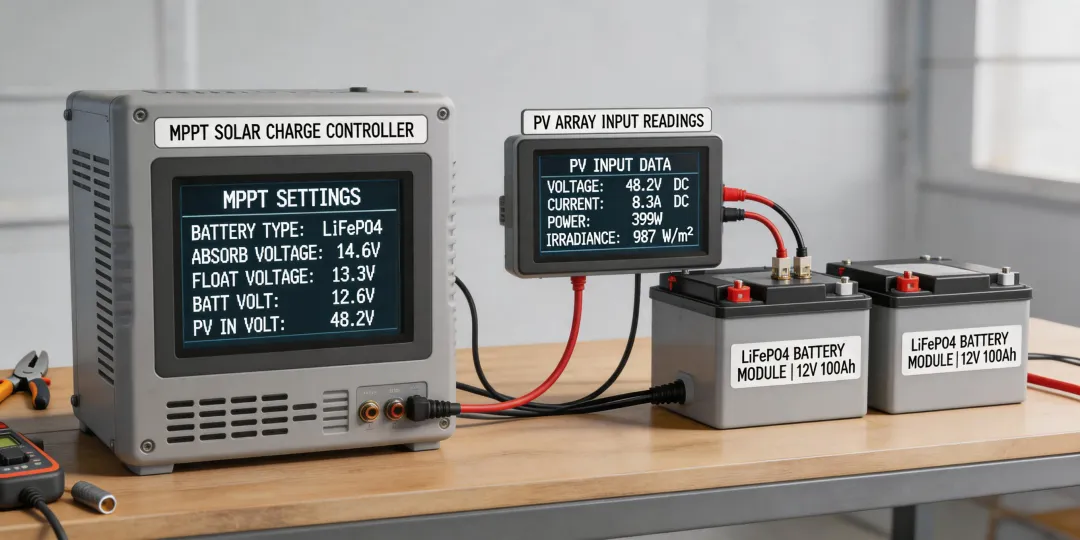
- Compatibility: My EPEVER Tracer 2210AN has specific LiFePO4 settings built in. I just had to set the battery type in the manual, and it optimized the charging profile automatically.
"My $240 SLA setup gave me 18 months of mediocre service. My $500 LiFePO4 setup should give me a decade of solid, worry-free power."
I should add that if you're looking at home battery storage options, LiFePO4 is the clear winner for safety and longevity. Don't confuse them with the old Lithium-Cobalt batteries that had thermal runaway issues. LiFePO4 is the standard for modern solar systems.
My Final Recommendations: When to Spend, Where to Save
After all those mistakes, here's my simple, practical advice:
Spend on the Controller and Inverter. Get an MPPT charge controller (like the EPEVER Tracer series) and a pure sine wave inverter. These are the brains and the brawn. Don't cheap out here.
Budget for the Battery. If you can afford LiFePO4, buy it. If your budget is tight, buy quality lead-acid (like AGM) but account for the fact that you'll need double the rated Ah to get the same usable capacity.
Double-check the Wiring. A proper truck battery power inverter wiring diagram is a great reference for high-current DC systems. Use proper gauge wire, add fuses, and use quality terminals. A fire in a solar system is a nightmare—trust me, I've seen the photos.
Read the Manual. It sounds silly, but googling "epever mppt 40a manual" or "epever tracer 2210an 20a mppt" will save you hours of frustration. The default settings work, but the optimized settings for your specific battery chemistry make a massive difference.
A Note on Micro Inverters:
I get asked about micro inverter wvc 600 systems sometimes. They're a different use case—great for grid-tied systems where shading is an issue. But for an off-grid DIY setup like this, a traditional MPPT controller is simpler, cheaper, and easier to troubleshoot. Stick with what works.
So, is it best home battery storage options? For my money, it's a LiFePO4 battery paired with an MPPT controller and a pure sine inverter. It's not the cheapest upfront, but after my $2,300 lesson, I can tell you: the cheapest option is rarely the most affordable.
Pricing is for general reference only. Actual prices vary by vendor, specifications, and time of order. Verify current rates at your preferred supplier.