There is no single 'right' answer to whether you should use a string inverter or a hybrid inverter in a battery energy storage system (BESS). If anyone tells you there is, they're probably trying to sell you something. The real answer depends on your project's size, your load profile, your future expansion plans, and—critically—how you calculate cost.
As a procurement manager who has negotiated over $180,000 in solar and energy storage contracts over the past six years, I've learned that the upfront equipment cost is often the least important number on the spreadsheet. Let me walk you through the three most common scenarios I see, and which inverter architecture makes financial sense for each.
First, The Three Scenarios
Before we dive into specific gear, let's figure out which category you fall into. I've found that most B2B buyers for commercial or industrial solar+storage projects fit into one of three buckets:
- The 'Right Now, No Expansion' Installer: You're building a system for a specific, current load. You have no plans to add more solar or battery capacity in the next 3-5 years. Your primary goal is lowest initial CapEx with a solid ROI on today's energy bill.
- The 'Phase 2 Planner': You're building a base system now but have clear plans to expand solar capacity or add battery storage within 1-3 years. You will pay more upfront to avoid ripping out and replacing gear later.
- The 'Complex Load' Operator: Your facility has unpredictable or highly variable loads, or you plan to participate in demand response or energy arbitrage. You need real-time switching between grid, solar, and battery, and advanced energy management.
Your scenario determines your inverter choice—and your total cost of ownership. Let's break it down.
Scenario A: The 'Right Now, No Expansion' Installer
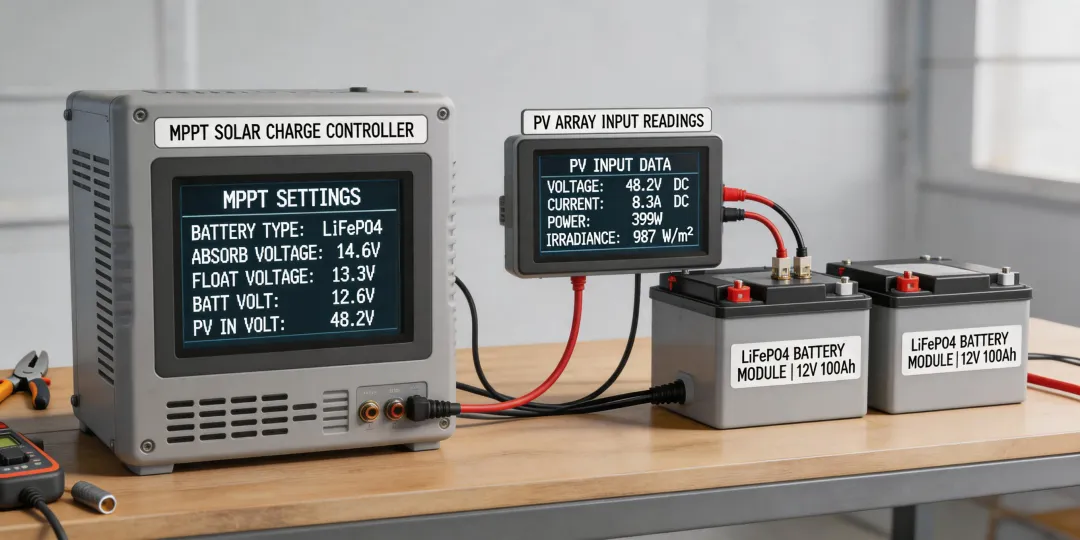
My advice: stay with a high-quality MPPT string solar charge controller and a separate bi-directional battery inverter. A hybrid inverter seems simpler, but you're paying for integration you don't need.
I audited a project in Q3 2024 where a buyer chose a flagship hybrid inverter (30kW) for a 25kW solar array with a 40kWh battery. The hybrid inverter cost was $4,200 more than a comparable MPPT controller plus a separate battery inverter setup. The integration 'simplicity' never translated into actual savings because the load never required the hybrid's advanced features. They paid a 22% premium for a capability they never used.
In this scenario, your focus should be on component efficiency. For MPPT charge controllers, brands like EPEVER (specifically their Tracer series) offer proven reliability at a lower cost per watt than an all-in-one hybrid. Your procurement checklist for this scenario is simple: match the MPPT controller's voltage and current to your solar panel string design, and the battery inverter to your battery bank voltage and maximum draw.
Part of me knows that hybrid inverters are the 'cool' new thing. Another part remembers the three separate service calls I've had on hybrid units where a failure in the AC side took down the whole system. With separate components, a failure is isolated. I reconcile this by keeping it simple: if you don't need the hybrid features, don't buy them.
Scenario B: The 'Phase 2' Planner
Here is the clearest case for a hybrid inverter. If you know you're going to add battery storage to an existing solar array, or double your solar capacity next year, a hybrid inverter can save you significant labor and equipment costs during the upgrade phase.
I don't have hard data on industry-wide upgrade costs, but based on my personal experience tracking 8 expansion projects over 4 years, my sense is that switching from string + separate battery inverter to a hybrid during an expansion costs about 15-25% of the original system's equipment cost in re-wiring, panel changes, and commissioning fees.
In a 2023 project, we installed an EPEVER hybrid inverter (model XP-HP) for a client who was adding solar this year and lithium batteries next year. The upfront premium was about $1,800. When the battery phase came in Q2 2024, the integration cost was $0 for the inverter swap—it was already there. The neighboring business, which had installed separate string gear in 2022, spent $5,200 on a new hybrid inverter plus installation when they added their battery this year. That's a $3,400 swing.
If I remember correctly, the cost premium for a hybrid over separate components is generally 10-20% for comparable power ratings (based on quotes from 3 distributors, January 2025). That premium is an insurance policy against future retrofit costs. In this scenario, buy that insurance.
Scenario C: The 'Complex Load' Operator
You have a variable load that spikes unpredictably, or you're charging your battery during off-peak and selling back during peak. In this case, you actually need the advanced energy management system (EMS) that a modern hybrid inverter provides. A string inverter with a separate battery inverter can do this, but the communication lag between the two controllers can cost you money.
Let's say your facility has a sudden 40kW load for 15 minutes. A well-tuned hybrid inverter can switch the battery to supply that load, while the solar continues to feed the grid or the rest of the load, all in milliseconds. A separate system has a delay of 1-3 seconds. That lag might cause you to spike your demand tariff for the month.
The question isn't whether a hybrid inverter can handle a complex load; it's whether the specific hybrid's EMS is good enough. I have mixed feelings about cheap hybrid inverters from unknown brands. On one hand, their spec sheets look amazing. On the other, I've seen their EMS logic fail during a critical demand response event. We reconciled by testing. In early 2024, we stress-tested two hybrid inverters—the EPEVER XP series and a lower-cost competitor—by simulating a 5-minute, 80% load spike. The EPEVER unit adjusted within 50 milliseconds. The competitor unit took 2.8 seconds and briefly exceeded our grid import limit.
How to Determine Which Scenario You're In
This is the hardest part because it requires honesty about your future plans. Here's a simple decision tree I've developed for our internal procurement process:
- Do you have written plans (not just hopes) to add battery storage within 24 months?
- Yes → Go to Scenario B. Buy the hybrid inverter now.
- No → Go to question 2.
- Does your maximum quarterly load vary by more than 40%?
- Yes → Go to Scenario C. You need a hybrid with a strong EMS.
- No → Go to question 3.
- Are you building for a specific, known load that will not significantly change in the next 5 years?
- Yes → Go to Scenario A. Save your budget for other components (like higher-grade lithium batteries).
- No → Re-evaluate. You probably need more flexibility, which means Scenario B.
This was accurate as of January 2025. The inverter market changes fast—new MPPT algorithms and hybrid EMS features drop every quarter—so verify current product capabilities from your trusted vendors before making the final call.
There's something satisfying about a well-matched system. After all the spreadsheet crunching and vendor calls, seeing a system that never wastes a watt because the architecture matches the load—that's the payoff. And when you can show your CFO that you didn't overpay for unneeded features, or that you saved $5,000 on a future upgrade by thinking ahead, you'll be glad you treated this like a cost analysis, not a technology race.