It started with a number that looked too good to be true
Back in Q2 2023, I was tasked with sourcing components for a 3kW off-grid solar setup at our field office. We needed an MPPT charge controller, an inverter, and a battery bank. Simple enough.
I got quotes from five vendors. The first three were within $200 of each other. Vendor four came in at $4,200 for a complete kit — inverter, controller, everything. But vendor five? They quoted $3,450. Almost $800 cheaper.
I almost went with them.
In my 6 years of managing procurement budgets (about $180,000 in cumulative spending across solar components alone), I've learned that the lowest quote is rarely the cheapest in the long run. But $3,450 against $4,200? That's an 18% difference. I thought I'd found a deal.
I didn't.
What the surface numbers didn't tell me
From the outside, it looked like vendor five just had better operational efficiency. Lower overhead, maybe. The reality was they were hiding costs in the fine print.
The kit included an EPEVER 20A MPPT charge controller (good brand, solid unit), a no-name inverter, and four 100Ah lead-acid batteries. I checked the specs: the controller was fine, the battery bank was adequate, but the inverter had a peak efficiency rating of 85%. Most decent inverters hit 93-96%.
Here's the thing: that efficiency difference doesn't show up on the invoice. It shows up in your battery bank dying two years early because it's working harder to compensate for the inverter's losses. It shows up in your solar panels producing less usable power because the controller can't work optimally with a mismatched inverter.
I'd made this mistake before. In my first year as a procurement coordinator, I approved an order of 30 PWM controllers because they were $12 cheaper per unit than the MPPT equivalents. That decision cost us $600 in replacement units within 18 months when customers complained about poor charging performance in partial shade.
That was the first time I learned that "standard" doesn't mean the same thing to every vendor.
The moment I realized it wasn't a deal at all
I built a total cost of ownership spreadsheet. It took me about 45 minutes and saved me probably $4,000.
Here's what the comparison looked like for the off-grid system:
- Vendor 5's kit ($3,450): $3,450 upfront + $1,200 in battery replacement (year 3 instead of year 5) + $600 in lost solar yield (85% vs 95% inverter efficiency over 5 years) + $150 in shipping fees they didn't disclose upfront = $5,400 effective cost
- Vendor 4's kit with EPEVER components ($4,200): $4,200 upfront + standard battery replacement (year 5) + no solar yield loss (matching EPEVER controller + quality inverter) + free shipping = $4,200 effective cost
That's a $1,200 difference — not in vendor 5's favor.
I called vendor 4 and asked if they could swap the generic inverter for an EPEVER model instead. They could, but it added $320 to the quote. Still cheaper than vendor 5's total cost of ownership.
"5 minutes of verification beats 5 days of correction. The 12-point checklist I created after my third mistake has saved us an estimated $8,000 in potential rework."
Why EPEVER earned a permanent spot in my vendor list
Look, I'm not saying EPEVER is the only option. But what I've found over years of tracking invoices is that their ecosystem approach actually reduces hidden costs.
When you pair an EPEVER MPPT charge controller with an EPEVER inverter and an EPEVER lithium battery (or even a compatible third-party battery with confirmed settings), you eliminate compatibility risks. Those risks aren't theoretical — I've seen installs where a mismatched controller and battery caused the system to go into protection mode twice a week during peak production hours. That's lost energy. That's wasted investment.
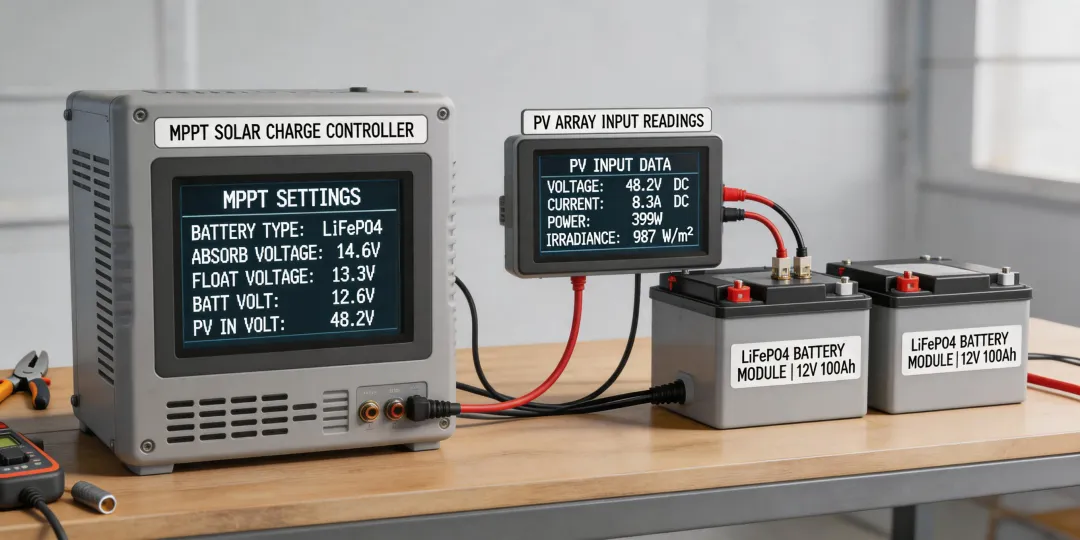
The EPEVER Tracer 4210AN controller, for example, has a max PV input voltage of 150V and supports both sealed and flooded lead-acid batteries, as well as LiFePO4. That's flexible enough for most 48V off-grid systems. And because EPEVER publishes detailed LiFePO4 settings for common battery brands, you're not guessing — you're following a verified configuration.
In Q2 2024, we switched our field office system to a full EPEVER setup: the 4210AN controller, a 24V/3000W inverter, and a 200Ah lithium battery. Total cost of components: $3,850. We installed it in a single day because everything was compatible out of the box. No returns, no troubleshooting, no panic calls to tech support.
What I wish someone had told me when I started
The general rule I follow now is: buy the system, not the components.
That means treating the charge controller, inverter, and battery as a single investment with a shared lifespan. If one piece fails or underperforms, the whole system suffers.
If you're sizing a home battery system, here's what I'd recommend (and what I now include in every procurement policy I write):
- Start with the battery chemistry — LiFePO4 is the clear winner for cycle life and safety. Lead-acid is cheaper upfront but costs more per cycle over 5 years.
- Size the charge controller to the array — A 20A MPPT controller handles about 300W at 12V or 600W at 24V. Don't oversize the panels without checking the controller's max input voltage.
- Match inverter capacity to peak load — A 3kW inverter handles about 25A at 120V. But some appliances have surge loads (motors, pumps) that can double that draw for seconds.
- Verify LiFePO4 settings before purchase — Not all charge controllers support the correct absorption voltage for lithium batteries. EPEVER controllers do, but some budget brands don't.
I've seen too many people buy a "cheap" kit only to realize the charge controller doesn't support their battery's BMS settings. Then they have to buy an additional device — or worse, run the battery outside its safe voltage window. That's not just expensive; it's a fire risk.
The bottom line
In my procurement spreadsheet, I track every order. Every invoice. Every return. And I've logged enough data to know that the cheapest option today is rarely the cheapest option six months from now.
When I finally chose the EPEVER-based system for our field office, I wasn't paying $4,200 for a controller and an inverter. I was paying $4,200 for a system I could trust not to fail during a critical operation, for batteries that would last their full rated cycle life, and for a vendor relationship that would support me if something went wrong.
That vendor 5 quote for $3,450? I'm glad I didn't take it. The $750 I saved upfront would have cost me $1,200 in lost time, replacements, and energy waste.
Prices as of Q2 2024; verify current rates with vendors.