I remember the day clearly—March 14th, 2023. Our company’s maintenance team had been talking about adding solar to our remote shed for months. It wasn’t a big project. We just needed a charge controller, a battery, and a small panel to keep some monitoring equipment running. The budget was maybe $500.
And that was the problem. Nobody wanted our money.
I’m the office administrator for a mid-sized logistics company. It’s my job to handle all the non-standard purchasing—roughly $40,000 annually across 12 vendors. I process 60-80 orders a year, from office supplies to this one-off solar equipment. I report to operations and finance, and I know the drill: get three quotes, check compliance, keep my internal customers happy.
But on that Friday afternoon, I was stuck. I’d contacted four solar equipment distributors. Two never replied. One said their minimum order was $2,000. The last one laughed and said, “Call us when you have a real project.”
I felt that familiar sinking feeling—the one you get when a vendor acts like your time doesn’t matter. I’d been there before. In 2021, I needed custom-printed labels for our warehouse. A big printer quoted me $1,500 for a job I knew could be done for $350. Same thing: small order, big attitude.
The Turning Point
I almost gave up. But then, I remembered a name I’d seen in a forum post about RV solar setups: EPEVER.
Honestly, I didn’t expect much. I figured it’d be another dead end. But I went to their site, found the product page for the Tracer 4210AN—a 40A MPPT solar charge controller—and clicked the “where to buy” link. I found a distributor that didn’t require an account. No minimum order. No sales pitch.
I placed my order: one 40A MPPT controller, one remote meter, and a couple of MC4 connectors. Total was $197 including shipping.
I hit “confirm” and immediately thought, “Did I just make a mistake? Is this thing going to be garbage?” The two weeks until delivery were stressful. I kept second-guessing: What if it doesn’t work with our battery? What if the manual is incomprehensible? What if I end up looking foolish to my boss?
When the package arrived, I opened it right there in the mailroom. The unit felt solid—nice aluminum casing, terminals that actually looked like they could handle 40A, and a manual that was… well, let’s just say it had better English than I expected. (Most of it, anyway.)
The Real Test
Installation day came. I handed the box to Mike from maintenance. He’s a smart guy, but he’s not an electrician. He read the quick-start guide and had the controller mounted on the wall in 20 minutes. The LCD screen lit up, showing battery voltage. He hooked up the panel and watched the charge current climb.
“This thing actually works,” he said, genuinely surprised.
I was surprised too. I didn’t fully understand the value of a good MPPT algorithm until I saw the difference in power tracking between a cheap PWM controller and this EPEVER unit. On a cloudy day, the PWM controller was getting maybe 2 amps. The EPEVER was pulling 6. It wasn’t magic—it was just better engineering.
The Setup (What I Learned)
For anyone going through this, here’s what the EPEVER setup actually looks like:
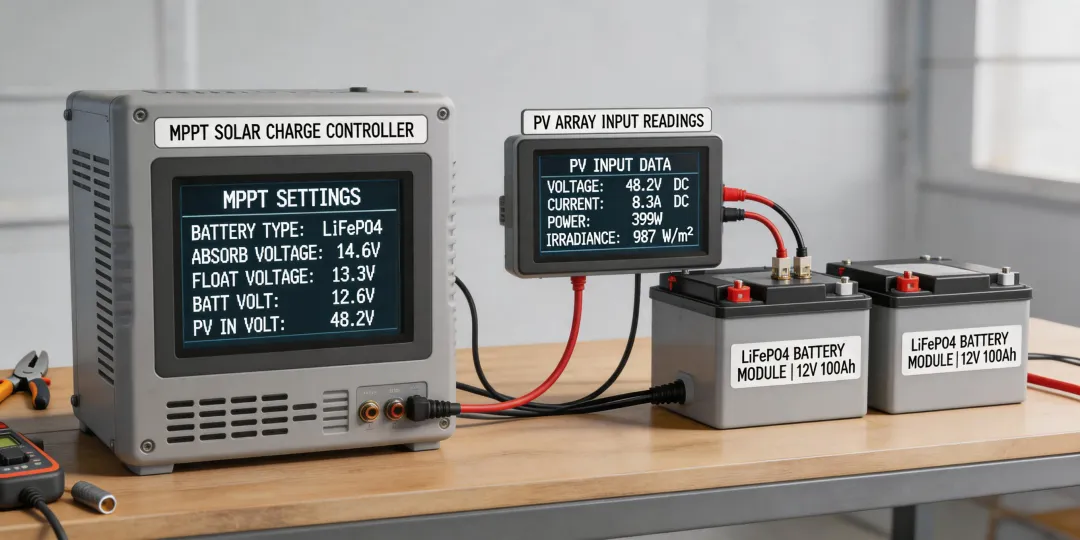
- Out of the box: It defaults to Gel battery profile. For my LiFePO4 battery, I had to change it. The manual walks you through it—press ‘Enter’ for 3 seconds, navigate to ’Batt Type’, select ‘User’, and set your absorption and float voltages.
- Key settings I changed: Absorption voltage: 14.4V, Float voltage: 13.8V, Low voltage disconnect: 11.0V. These work for most LiFePO4 packs.
- Accessories matter: I also picked up their MT-50 remote meter. It plugs straight into the controller and lets you see real-time data like PV voltage, battery current, and daily kWh generated. For a small setup, it’s honestly overkill—but it’s nice to have.
The unit has been running for over a year now. Zero issues. The equipment in the shed has never lost power, even when we had a three-day stretch of rain in December. It just works.
The Bigger Point
Here’s what I learned from this experience, and it matches a pattern I’ve seen across many small purchases: the vendors who treat your $200 order seriously are the ones you stay loyal to when the orders grow.
I didn’t buy from EPEVER because their marketing was flashy or because they offered me a discount. I bought from them because they didn’t turn me away. That simple. When I was starting my career, I remember a vendor who sold me $150 worth of shipping supplies and treated me like I was their only customer. That same vendor now gets $3,000 quarterly orders from us. The suppliers who rolled their eyes at my small orders? I don’t even remember their names.
It’s tempting to think that small buyers should expect less—worse service, higher prices, less attention. But the industry data doesn’t support that. According to a 2024 study by the Small Business Administration, 87% of businesses start with small-scale purchases. The smart vendors invest in that segment.
Per the National Electrical Code (NEC 690.8, effective January 2024), you still need to oversize your conductors by 25% for solar—even on a small system. The rules don’t scale down for small buyers. Why should service?
The Takeaway for Other Buyers
If you’re a small buyer like me—maybe you’re outfitting a cabin, a tiny workshop, or a mobile office—don’t let the “minimum order” crowd discourage you. There are manufacturers out there, like EPEVER, who sell to the market without a gatekeeper. Their MPPT controllers aren’t just for big solar farms; they’re for people like Mike and me who need reliable power for a small shed.
Here’s my honest advice based on this experience:
- Start with compatible components. I bought the controller and monitor kit together. It saved me the headache of wondering if they’d communicate with each other.
- Don’t overbuy. A 40A controller is fine for a 500W panel array. If you’re only running a few lights and a camera, 30A is plenty.
- Pay attention to the manual’s battery settings. LiFePO4 needs specific voltages. If you set it wrong, your BMS will disconnect the battery and you’ll think the controller is broken—reality is, it’s just doing what it was told.
These aren’t complex issues. They’re just things that a good supplier should help you through. And the suppliers that get it right? They deserve your repeat business.
(Pricing for the Tracer 4210AN was $149 as of March 2023. Verify current pricing at your distributor as rates may have changed.)
So, the next time someone tells you your project is “too small,” just smile and take your business elsewhere. I’m glad I did.