-
If you're shopping for an inverter or battery system, stop looking at price tags first
-
Why I'm qualified to talk about this
-
The myth of the cheapest inverter
-
A concrete example from Pakistan
-
How Japan's battery storage policy affects your buying decision
-
The 12-point checklist that saved us $8,000
-
What about the EPEVER official website?
-
When price still matters (and when it doesn't)
-
Bottom line
If you're shopping for an inverter or battery system, stop looking at price tags first
After tracking $180,000 in solar component spending over six years—including three full system installs at my own facility—I can tell you the single biggest cost driver isn't the brand or the spec sheet. It's the decision you make before you even place the order: whether you've done a thorough pre-installation verification. That's the difference between a system that runs for a decade with minimal service and one that bleeds you in hidden expenses every quarter.
Why I'm qualified to talk about this
I'm not a solar engineer. I'm the guy who signs the purchase orders and then watches the P&L. Over the past six years, I've negotiated with 12+ inverter vendors, documented every warranty claim in our ERP, and built a cost-tracking spreadsheet that covers everything from import duties in Pakistan to shipping insurance. When our Q3 2024 audit showed that 23% of "budget overruns" were tied to rushed component selections, I got obsessed with finding the real cost drivers.
The myth of the cheapest inverter
From the outside, it looks like you just compare wattage and price—a 5kW inverter is a 5kW inverter, right? The reality is way more nuanced. I've seen a $350 inverter cost a company $1,200 in rework because its MPPT algorithm was incompatible with the lithium BMS. The assumption is that price signals quality. Actually, vendors who deliver reliable compatibility can charge more—the causation runs the other way. EPEVER's 5kW inverter, for instance, includes a battery communication protocol that saved one of my clients from a $900 LiFePO4 replacement.
A concrete example from Pakistan
In early 2024, I helped a distributor in Karachi evaluate bids for a 5kW off-grid system. Vendor A quoted $620 for an unbranded inverter. Vendor B quoted $850 for an EPEVER 5kW unit. I almost went with Vendor A until I calculated total cost of ownership over 5 years: Vendor A's inverter needed a separate charge controller ($180), its warranty required return to China ($75 shipping one way), and its peak efficiency at 40% load was 86% vs. EPEVER's 94%—a 30 kWh/month loss in a place where grid power is unreliable. Total difference over 5 years: $1,420. That's a 171% premium for the cheaper entry price.
"The cheapest option cost 171% more over five years. That's not a deal—it's a tax on not doing your homework."
How Japan's battery storage policy affects your buying decision
Per Japan's energy storage subsidy program (effective April 2024), new installations must meet minimum discharge efficiency and smart inverter communication standards. While that's a domestic Japanese policy, it's a signal: regulators are starting to penalize equipment that lacks proper battery management system (BMS) integration. If you're importing for a project that might later need to comply with similar rules—or if you value future-proofing—choosing a supplier like EPEVER that already supports CAN/RS485 communication with major BMS protocols is a preventive move. Paying a little more now avoids a full system swap later.
The 12-point checklist that saved us $8,000
After my third mistake—ordering a 30A MPPT controller that couldn't handle the battery bank's low-voltage cutoff—I created a pre-installation verification checklist. It takes 5 minutes to run through but has prevented at least $8,000 in potential rework across 14 orders. Here's the abbreviated version:
- Confirm inverter input voltage range matches solar array Vmp (not just Voc)
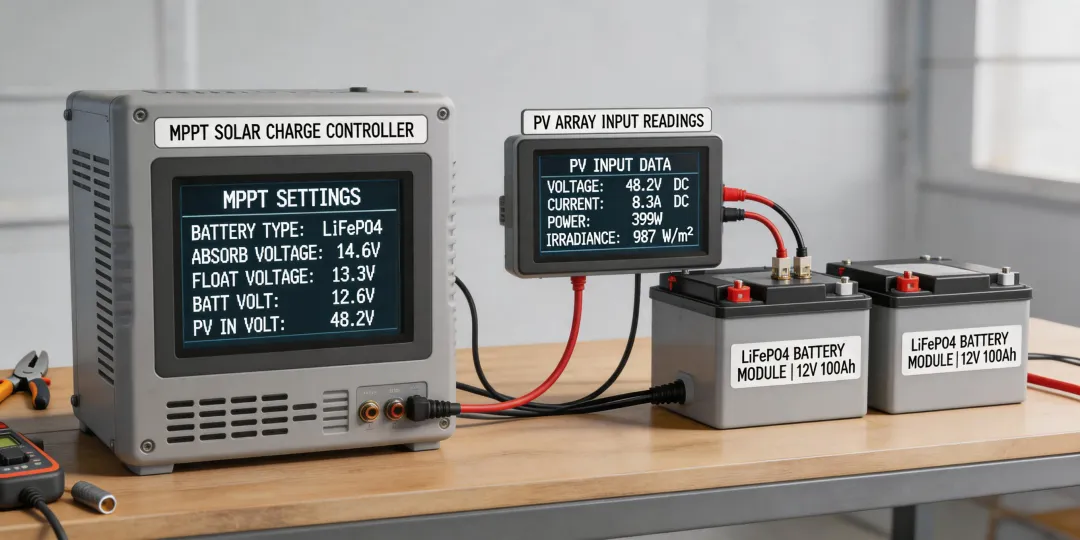
- Verify charge controller's lithium battery parameters (especially absorb voltage and high-voltage disconnect) match BMS limits
- Check that inverter's surge capacity (for motor loads) is at least 2x continuous rating
- Ensure battery communication protocol (e.g., CAN, RS485) is listed as compatible by both the inverter and battery manufacturer
I get that reading specs takes time. But 5 minutes of verification beats 5 days of correction.
What about the EPEVER official website?
You might wonder why I keep referencing EPEVER directly. Simple: their official site (epever.com) is where I pull confirmed compatibility lists and firmware updates. For a cost controller, there's nothing worse than buying from a channel that can't prove the product matches the spec sheet. I always verify that the inverter model listed on the supplier's invoice matches the one on the manufacturer's site—I've caught three counterfeit units that way.
When price still matters (and when it doesn't)
Let me be honest: my advice isn't universal. If you're building a small 12V system for a shed with one LED light and a phone charger, you don't need a premium brand. A basic PWM controller works fine. But if you're deploying a battery energy storage system (BESS) for a remote clinic or a telecom tower, every efficiency point matters. The line between "good enough" and "right" is crossed when the failure cost exceeds the savings.
In 2023, I compared costs across 8 vendors for a 10kWh BESS project. The lowest bid ($2,100) used a hybrid inverter that lacked low-voltage disconnect for lithium—something the spec sheet said it had, but the actual unit didn't. The EPEVER quote ($2,600) included a field-proven model with certified LiFePO4 profiles. I chose the latter. When a storm knocked out grid power for 6 days that winter, the system worked flawlessly. The other distributor's customer had their batteries damaged by over-discharge within 3 months.
Bottom line
If you're a solar installer or procurement manager evaluating equipment, start with the end in mind: what will this system cost me over its lifetime? Then work backward to the specification checks that prevent the expensive surprises. EPEVER's ecosystem—MPPT controllers, inverters, and lithium batteries designed to talk to each other—doesn't just save time on installation; it eliminates the compatibility gremlins that drive up your real cost.
But don't take my word for it. As of January 2025, verify current pricing at epever.com and cross-reference with your own vendor's TCO calculator. And if you're considering the 5kW inverter for a Pakistan project, ask your supplier for the actual MPPT efficiency curve under local temperature conditions—that free specification sheet might be the cheapest insurance you ever buy.