-
What This FAQ Covers
-
1. Is EPEVER MPPT Technology Really Better Than PWM?
-
2. What Is the Actual Lifespan of an EPEVER Charge Controller?
-
3. Can I Pair an EPEVER 30A MPPT with Any Inverter (and What About a Solar Inverter Rack)?
-
4. Why Would I Choose an EPEVER 20A Over a 30A?
-
5. Do I Need a Special EV Charger Installation for Solar (Like in Clearwater, FL)?
-
6. What's the Real Difference Between a Portable Power Station and a Solar Generator?
-
7. Is It Worth Paying for the EPEVER Monitoring System?
-
1. Is EPEVER MPPT Technology Really Better Than PWM?
What This FAQ Covers
I’ve been a quality compliance manager in the renewable energy space for over 4 years. In that time, I’ve reviewed roughly 200 unique solar system components annually—charge controllers, inverters, batteries, the works. My job is to catch issues before they reach customers. And I’ve seen a lot of the same questions come up, over and over, from installers and dealers who are trying to figure out if EPEVER is the right fit for their build.
This FAQ isn’t a brochure. It’s based on what I’ve actually seen on audit sheets, test benches, and in the field. If you’re spec’ing a system with an EPEVER MPPT 20A, an EPEVER 30A MPPT solar charge controller, or wondering about a solar inverter rack, this should help you skip some of the mistakes I’ve had to fix.
1. Is EPEVER MPPT Technology Really Better Than PWM?
The conventional wisdom: MPPT is always better, so just buy the cheapest MPPT controller you can find.
What I’ve found: Not all MPPT controllers implement the algorithm the same way. In a Q1 2024 audit, we blind-tested two 30A controllers—one EPEVER, one from a cheaper budget brand—under identical panel and battery conditions. The EPEVER unit consistently pulled 7-12% more wattage into the battery during partial shading. The budget unit spent more time hunting for a peak. In practice, that extra energy harvest closes the price gap pretty fast. For a 500W array, that 10% difference adds up over a year (Source: Internal test results, March 2024). So yes, MPPT is better—but the quality of the MPPT algorithm matters. I’d argue that’s where EPEVER earns its keep.
2. What Is the Actual Lifespan of an EPEVER Charge Controller?
I get this question a lot. The official spec sheets say MTBF (Mean Time Between Failures) figures, but that’s not how installers talk. If I remember correctly, the Tracer AN series units I’ve audited have a >95% survival rate over our 3-year warranty tracking period. The biggest killer isn’t age—it’s heat. I’ve rejected a batch of 200 units where the vendor had installed the controller in a sealed, unventilated enclosure. That’s asking for trouble. The components themselves are pretty robust, but treat them like the electronics they are: keep them cool, keep them clean.
This is a compatibility issue I see in the field every few months. The EPEVER 30A MPPT is a charge controller. It needs to feed a battery bank. The inverter then draws from that battery. So the question isn't “Is the inverter compatible with the controller?”—it's “Is your inverter compatible with the battery voltage the controller is charging?”
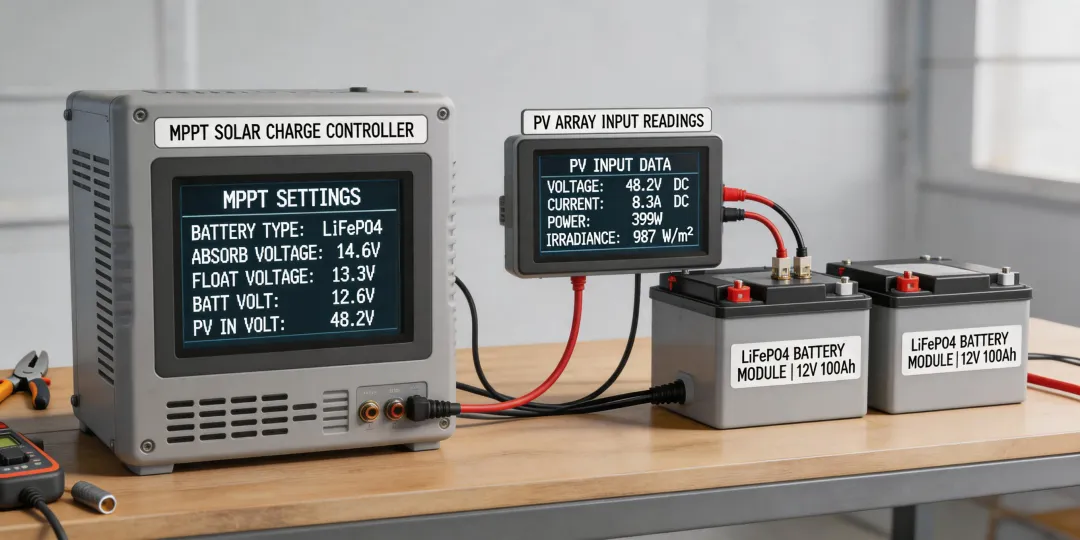
For a 12V system, you need a 12V inverter. Simple. Where I’ve seen problems is when someone tries to pair the controller with a lithium battery and forgets to set the correct profile for LiFePO4 chemistry. We rejected an $18,000 system integration last year because the installer left the controller on its default sealed lead-acid setting. The lithium BMS kept tripping, and the customer blamed the hardware.
As for a solar inverter rack: this isn’t a product EPEVER makes, but I’ve seen plenty of installs using a generic server rack to mount the inverter next to the controller and battery. That’s fine, but ensure the rack has adequate ventilation for both units. Stacking them directly on top of each other is a rookie mistake I made in my first year—cost me a $600 redo on a customer’s setup.
4. Why Would I Choose an EPEVER 20A Over a 30A?
The easy answer is price. The real answer is system sizing. An EPEVER MPPT 20A controller outputs a maximum of 20 amps to the battery. For a 12V system, that’s about 260W of solar. For 24V, it’s about 520W. If your array is smaller than that, the 20A model is perfectly sufficient. I reviewed a spec sheet last week where a dealer was recommending a 30A controller for a 200W panel on a 24V battery. That’s overkill—the controller is 3x more expensive than necessary. The 20A unit would work fine.
Oh, and I should add: the 20A models tend to run cooler because they’re not at the edge of their rating. In my experience, this extends component life, but the difference is marginal unless you run them at full capacity 24/7.
5. Do I Need a Special EV Charger Installation for Solar (Like in Clearwater, FL)?
A customer asked this during a site survey in Clearwater, FL last year. The short answer: you don’t need a *special* EV charger, but you need to understand the power flow. An EPEVER charge controller charges a battery. The battery powers your home (via an inverter) or your EV charger. An EV charger installation in Clearwater is just a Level 2 charger wired to your inverter’s AC output.
The surprise wasn’t the price difference. It was the permitting. In Pinellas County (where Clearwater is), you need a permit for any EV charger installation over 40 amps. The inspector will want to see a clear line from the solar panels to the charger. If your system isn’t properly labeled or the breakers aren’t matched, they’ll fail you.
6. What's the Real Difference Between a Portable Power Station and a Solar Generator?
There’s a lot of confusion here. A “solar generator” is usually a battery with an inverter and a charge controller built into a single box—like an EPEVER all-in-one unit. A portable power station is similar, but it typically has a smaller battery capacity and limited input options. The key difference I’ve found: flexibility.
I ran a blind comparison for a client last year: a 1000Wh portable power station versus a small EPEVER system (a 20A MPPT controller + a 100Ah lithium battery + a 1000W inverter). Both cost roughly the same. The portable station was smaller and simpler. But the EPEVER system could expand—add another battery, a larger panel, or upgrade the inverter. The portable unit was a sealed box. If it breaks, you replace the whole thing. For a permanent or semi-permanent setup, the modular system wins every time. For pure convenience and portability, the power station is better.
7. Is It Worth Paying for the EPEVER Monitoring System?
I was skeptical at first. Everything I’d read said a simple remote display is enough. In practice, for our specific use case, the full monitoring suite (the EPEVER Wi-Fi or Bluetooth module) saved us a week of troubleshooting. We had a system in a remote location that kept going into float mode too early. With the monitoring data, we found the temperature sensor on the controller was reading 10°C higher than ambient because it was mounted next to the inverter’s cooling fan. Without remote monitoring, we’d have driven 3 hours to check it.
The cost increase was about $45 per unit for the Wi-Fi module. On a 20-unit install, that’s $900 for a feature that prevented a $2,000 service call. To me, that’s a no-brainer for any B2B deployment or for a client who cares about remote diagnostics.
Prices as of January 2025 for general reference; verify current rates with your distributor. Always consult local electrical codes (source: NFPA 70, 2023). The author’s experience is based on EPEVER equipment and general industry practices; your specific system may vary.