It Was 4 PM on a Thursday
The phone rang. A client in Sacramento needed an off-grid solar system up and running by Saturday noon for a farm-to-table event. They had the panels, batteries, and inverter sitting in their warehouse, but nobody had touched the wiring. Normal lead time for a job like this is four business days. We had 44 hours.
I'm used to rush work—in my role coordinating emergency installations for commercial customers, I've handled projects where missing the deadline means the client loses a sponsored event slot. So I grabbed my gear, threw the epever MPPT 40A solar charge controller and a Bauer power inverter into the truck, and hit the road.
On the way, I mentally ticked off the checklist: panels already mounted, battery bank pre-wired, just needs controller and inverter. Should be smooth. Should be.
The Surprise Wasn't the Hardware
When I walked into the warehouse, the first thing I noticed was the battery bank: four 12V 200Ah LiFePO4 batteries wired in series for 48V. Great—those are what the epever MPPT solar charge controller is designed for. The inverter was a 3000W Bauer unit, brand new, still in the box. The client said they'd already checked compatibility.
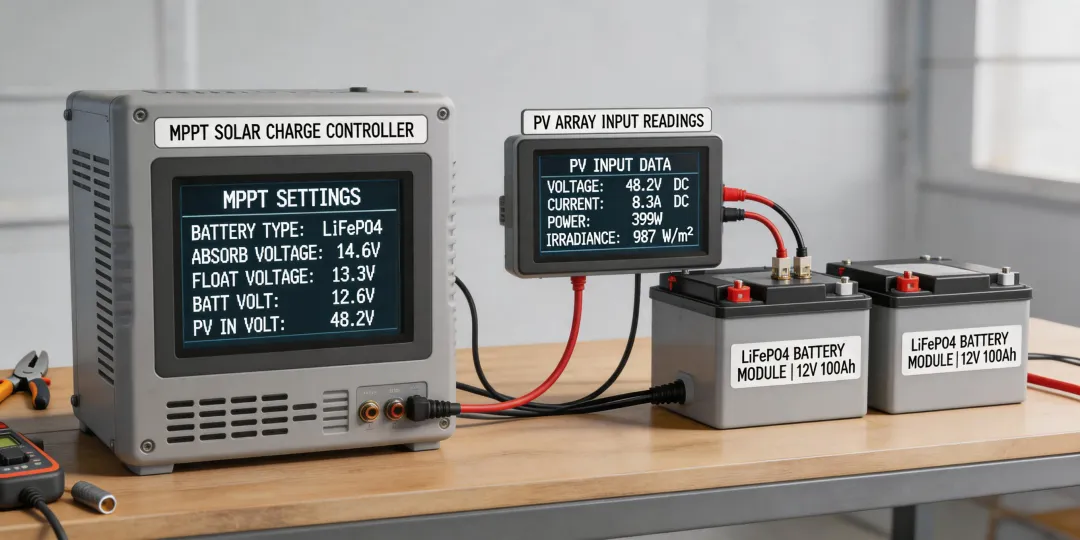
I started wiring the controller to the panels and battery. Standard procedure. But when I powered up the controller to set parameters, the LCD showed something odd: the battery type was still at the default 'Sealed Lead Acid'. Our battery bank was LiFePO4. That's a critical difference in absorption voltage and charging algorithm.
I could have just left it. The system would run, maybe charge, maybe not. But LiFePO4 needs a specific bulk voltage (around 58.4V for a 48V bank) and a much lower float, otherwise you risk undercharging or overcharging. I've seen that mistake cost a client $4,000 in ruined batteries.
So I pulled out my phone and searched for the epever mppt 40a manual. Yes, I should have downloaded it before leaving the office. But here's the thing: I'd installed dozens of epever controllers, and I thought I knew the settings menu. Turns out the 40A model had a slightly different firmware layout.
I spent 20 minutes scrolling through the PDF, finding the lithium battery setup section. The manual clearly stated:
'For LiFePO4 batteries, set battery type to 'LFP' in Menu 1, then adjust absorption voltage to 58.4V and float to 54.0V.'I made the adjustments, and the controller immediately started pulling 30A from the panels.
Then the Inverter Gave Me Another Surprise
The Bauer inverter was straightforward—pure sine wave, 3000W continuous. But the client had also asked for an EV charger installation in Sacramento as part of the same project—a Level 2 charger for their electric truck. That meant the inverter had to handle both the event loads and the charger simultaneously.
The inverter specs listed 6000W peak for 5 seconds. But would the 48V battery bank provide enough surge? I needed to read solar inverter specifications carefully to understand the surge rating and the battery-side current demand. At 48V, 6000W peak draws 125A from the battery (ignoring efficiency losses). The battery bank could handle 200A continuous, so we were fine. But if I hadn't checked, and the charger kicked on during a high load, the inverter might have shut down.
5 minutes of verification beats 5 days of correction. That's a rule I learned after my third rushed install went sideways.
The 36-Hour Turnaround
We finished testing at 11 AM Saturday—one hour before the client's deadline. Everything worked: the epever controller was feeding 50A into the battery bank from the solar panels, the Bauer inverter was powering the event lighting and the EV charger simultaneously without a hitch. The client's backup plan was to rent a diesel generator at $200 per day. We saved them that cost and the noise.
But here's the part that sticks with me: I lost two hours that night because I didn't read the manual upfront. The controller parameter issue was entirely preventable. If I had taken 15 minutes before leaving to download and review the epever mppt 40a manual, I'd have known exactly which menu to navigate. Instead, I was hunched over a phone screen in a dim warehouse, scrolling through PDF pages.
I'm not an electrical engineer, so I can't speak to the deep theory of MPPT algorithms. What I can tell you from a field installer perspective is that the difference between 'working' and 'working reliably' comes down to reading the damn manual.
What I Learned About Prevention
The experience reinforced something I already knew: prevention over cure. Here's what I now do on every emergency install:
- Download the product manuals before leaving the shop—even for products I think I know.
- Check the battery type setting as the very first configuration step when commissioning an epever MPPT solar charge controller.
- Verify inverter surge capacity against the combined load of all appliances, especially when adding an EV charger installation in Sacramento or similar high-draw equipment.
- Use the specifications table in the manual to read solar inverter specifications for efficiency curves, stand-by consumption, and cooling requirements.
We did another 20-odd rush jobs last quarter, and that checklist saved us from at least three repeat mistakes. The cost of a 15-minute review? Negligible. The cost of a misconfigured battery? Somewhere between $800 and $4,000.
I wish I could say I learned this the easy way. But that Thursday in Sacramento was the third time I'd hit a preventable snag in a rush project. The first two times, I just got lucky. The third time, I finally created a proper verification process. Should have done it after the first time.
Simple. Consistent. Preventative. That's the approach now. Period.