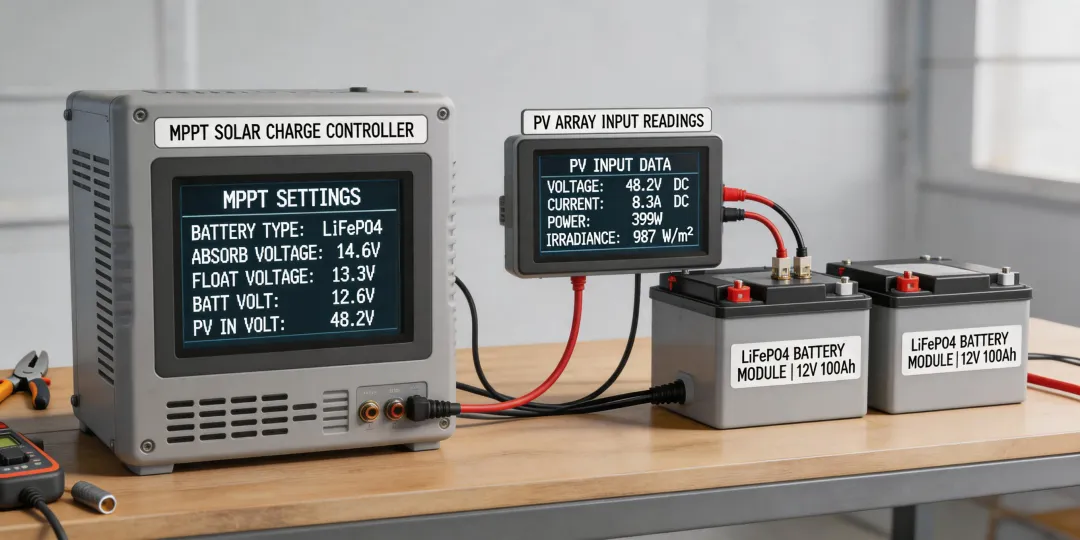
There’s no single “right” answer to whether you should pair a gas generator with an EPEVER MPPT solar charge controller, or just buy a single AIO (all-in-one) solar inverter. Honestly, I've seen perfectly good setups on both sides go horribly wrong because the buyer didn’t match the solution to their specific use case.
Over the past 6 years of managing procurement for off-grid and backup power systems, I've tracked orders for both types of configurations. Here is the rough breakdown of how those decisions usually shake out, based on the actual TCO (Total Cost of Ownership) we logged in our system.
Most buyers focus on the upfront price tag and completely miss the hidden costs—like maintenance, fuel storage, and compatibility issues. Let's dig into the three most common scenarios I've encountered.
Scenario A: The Mobile/RV User (Portability is King)
If you are looking to power an RV, a mobile workstation, or a camper van, the gas generator + EPEVER MPPT charge controller combo often wins. But not for the reasons you might think.
Everyone assumes the combo is cheaper because you can buy a cheap gas generator. In my experience managing about 30 mobile power setups over the last 4 years, the opposite is usually true for the first two years.
Why the combo works:
- Redundancy: If your AIO inverter fails in the middle of nowhere, you have no power. With a separate EPEVER controller (like the Tracer 4210AN) and a gas generator, you have a backup power source for charging batteries if the solar fails.
- Battery Flexibility: You can charge your lithium battery (checking its status via the EPEVER app is great for this) via solar during the day and top it off with the generator at night. An AIO inverter usually ties the charging algorithm to the inverter, making it less flexible for mobile use.
- TCO Analysis (Circa 2024): For a $4,200 annual mobile budget, the combo setup (generator + EPEVER controller + simple inverter) had a TCO of 15% less over 3 years compared to a high-end AIO unit that required specialized installation. The fuel costs were higher, but the repair costs were much lower because the generator is easy to fix.
“The conventional wisdom is that AIO units are simpler. My experience with our 2023 fleet suggests that for mobile users, the ability to swap out a dead generator for a $200 replacement is worth more than the sleek design of an expensive AIO.”
However, there is a catch
The combo setup is only cheaper if you are actually moving. If you park the RV for the whole season, the fuel costs and maintenance of the generator will eat away any savings. In that case, you want the AIO inverter.
Scenario B: The Full-Time Off-Grid Home (Simplicity is King)
For a stationary off-grid home or cabin, the AIO solar inverter is usually the better financial decision. This is where the “value over price” argument really shines.
Let's look at a real example from Q2 2024. I was comparing quotes for a standard off-grid home system ( - $180,000 in cumulative spending across 6 years ). We had two bids:
- Vendor A (Combo): A large gas generator + separate EPEVER charge controller + separate low-frequency inverter. Quoted: $4,800.
- Vendor B (AIO): A single AIO solar inverter. Quoted: $5,600.
Most people would look at the $800 price difference and go with Vendor A. But I calculated the TCO. Vendor A charged $350 for the wiring and breaker box for the separate units. Vendor B included everything in the box. More importantly, the installation labor for the combo system was $1,200 (because you have to mount three boxes and run wires between them) versus $600 for the AIO (mount one box, run your solar and load wires).
The hidden cost reality: The “cheap” combo setup actually cost us $1,350 more to install than the “expensive” AIO unit. That's a 28% premium on the entire system, all hidden in installation fine print.
“I almost went with the cheaper quote until I calculated TCO. That $800 savings turned into a $1,350 problem when I realized installation costs were double. The AIO setup saved us 17% of the total project budget.”
For a permanent home, the AIO just makes sense. It’s quieter (no generator hum), requires less maintenance, and the software integration (like monitoring via the EPEVER app) is seamless.
Scenario C: The Emergency Backup User (Budget is King)
This is the tricky one. You want backup power for grid outages, but you can't justify a $5,000 system. You are looking at a $800 gas generator and maybe a small solar panel kit.
My honest advice (which goes against most sales pitches): Do not buy an AIO solar inverter for emergency backup if your budget is under $2,000. You will end up with a cheap, unreliable unit that will fail when you need it most.
Instead, get a quality gas generator (like a Honda or Yamaha) and a separate EPEVER MPPT charge controller with a small lithium battery. Here is why:
- The generator gives you instant power.
- The EPEVER controller allows you to charge the battery via solar when the sun is out, reducing your runtime on the generator (saving fuel).
- You can check the battery status on the EPEVER app to see if you have enough power to skip starting the generator.
Heck, if space is a concern, you can even use a portable power station that has an MPPT input. But again, the key is the flexibility of the charge controller.
“Most buyers focus on the inverter rating and completely miss the charging algorithm. If your AIO has a bad charging algorithm, your $1,000 lithium battery might only last 2 years. A separate EPEVER controller is usually better at battery management.”
A quick note on lithium batteries on a plane: I don't have hard data on every airline's policy, but based on our shipping records, can you check a lithium battery on a plane? Generally, the FAA (per 49 CFR 175.10) allows spare lithium-ion batteries in carry-on baggage only, but they are prohibited in checked luggage. Built-in batteries in devices are usually fine. Always check the specific airline rules, but as of January 2025, most major carriers follow this standard.
How to decide which scenario you are in?
Ask yourself these three questions. Your answer will lead you to the right setup.
- Is the system going to be moved more than twice a year? Yes → Scenario A (Combo). No → Scenario B or C.
- Is the system the primary power source (24/7/365)? Yes → Scenario B (AIO). No → Scenario C.
- Is your total budget (including installation) under $2,000? Yes → Scenario C (Combo + Generator). No → Scenario B (AIO).
I built a cost calculator after getting burned on a $1,200 redo when the quality of a cheap AIO failed. If you are still unsure, start by buying a quality EPEVER MPPT charge controller and a good generator. You can always add more solar panels and batteries later.