-
The Surface Problem: What Is Charge Voltage for LiFePO4 Battery, Really?
-
Where Group 31 12V 100Ah LiFePO4 Battery Reviews Fall Short
-
The Deeper Problem Is Not a Single Number
-
An EV Charging Station Coimbatore Tamil Nadu Project Taught Me the Real Cost
-
What These Mistakes Cost
-
What We Do Now: EPEver Tracer MPPT Settings for LiFePO4
-
So, What Is Charge Voltage for LiFePO4 Battery?
I'm the office administrator for a 140-person renewable energy installation company. I handle equipment purchasing for off-grid projects—about $2.8M a year across 30-plus vendors—and I report to both operations and finance. That means I'm the one who gets called when a charge controller setting is wrong and a battery won't wake up. Usually it's my fault.
The question that keeps coming up is: what is charge voltage for LiFePO4 battery? It looks like a spec lookup. In our work, it's never just a spec lookup.
The Surface Problem: What Is Charge Voltage for LiFePO4 Battery, Really?
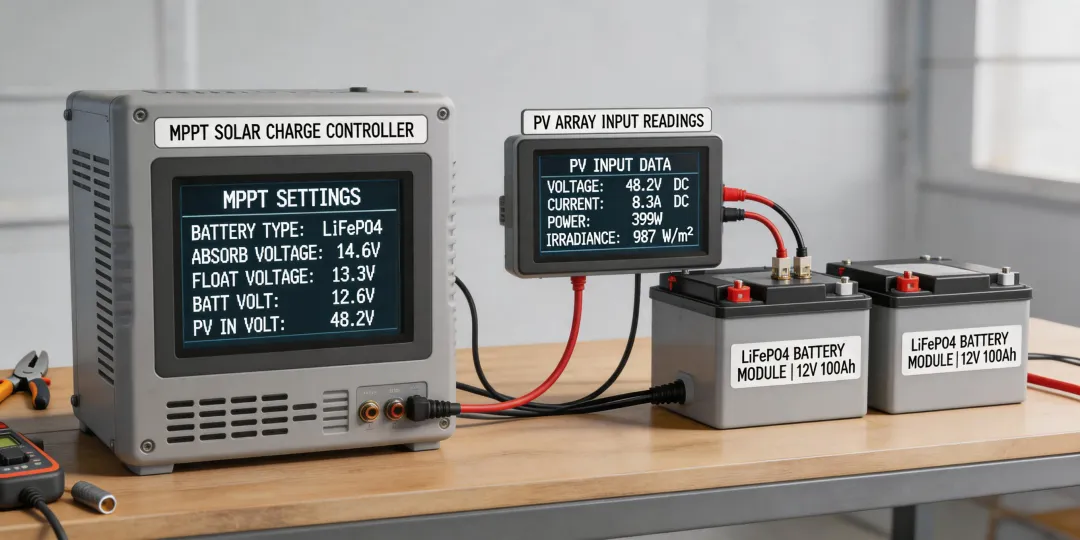
For a nominal 12V (4S) LiFePO4 battery, the absorption/boost voltage is normally 14.2–14.6V. Float voltage is usually 13.6–13.8V. If the controller has a separate equalization setting, turn it off. LiFePO4 does not get equalized.
That's the short answer. But if you stop there, you'll probably end up with a battery that's charged to 'full' on paper and unable to do real work.
Where Group 31 12V 100Ah LiFePO4 Battery Reviews Fall Short
When someone asks for my take on Group 31 12V 100Ah LiFePO4 battery reviews, I say the same thing: reviews tell you about shipping damage, terminal quality, and customer service. They rarely tell you the BMS charge specs. I've seen a highly rated Group 31 battery specify a max charge current of 30A while another equally rated one allows 50A. If your EPEver Tracer MPPT solar charge controller is pushing 40A, the first battery will keep cutting out.
The reviews are useful. They're just not enough. A battery with a 4.5-star average can still be a nightmare if the vendor can't confirm the exact charge profile.
The Deeper Problem Is Not a Single Number
Here's the part that took me too long to understand. The 'charge voltage' on a LiFePO4 battery is a range, and the right end of that range depends on:
- Your battery's BMS design.
- Ambient temperature.
- How many cells are in the pack (4S for nominal 12V, not 3S).
- Whether the controller has a lithium profile or needs a user-defined profile.
Our default is an EPEver Tracer MPPT solar charge controller. According to the EPEver Tracer AN user manual, the controller lets you set battery type to 'User' and adjust boost and float voltages. That's the setting we actually use.
But voltage is only half the equation. The charge current limit actually matters just as much. A 100Ah LiFePO4 can often accept high current, but not every BMS approves. If the controller's output is higher than the battery's max charge current, the BMS will disconnect. Then the controller sees an open circuit, voltage might jump, and people start blaming solar charge controllers.
An EV Charging Station Coimbatore Tamil Nadu Project Taught Me the Real Cost
A friend who runs a small solar-powered EV charging station in Coimbatore, Tamil Nadu, called me last year. He had installed a 12V 100Ah LiFePO4 bank with an EPEver Tracer and couldn't understand why the charger kept dropping into float before the battery was full. I asked what voltage he set. He said, 'I left it on default gel, because the seller said it was a drop-in replacement.'
It took two more days, a replacement BMS communication board, and a lot of local electrician hours before the system worked. The EV charging station Coimbatore Tamil Nadu project was offline at a time when a local driver really needed it. This wasn't a battery failure. It was a settings failure.
I have mixed feelings about 'drop-in replacement' lithium claims. On one hand, the convenience is real. On the other, 'drop-in' only works if the charge source is actually configured for lithium.
What These Mistakes Cost
Let me count the cost of a bad LiFePO4 charge voltage setup:
- Lost solar generation while the battery sits underused.
- Service call hours that nobody budgets for.
- Vendor blame games between the battery brand and the controller brand.
- A delayed commissioning that triggered a penalty in our case.
In my first year, I made the classic spec error: I assumed a 100Ah battery would accept whatever charge current the controller pushed. Cost me a warranty claim and a very awkward phone call with the installer.
We didn't have a formal sign-off process for battery parameters when I started. The third time a battery underperformed, I finally created a parameter verification checklist. Should have done it after the first.
What We Do Now: EPEver Tracer MPPT Settings for LiFePO4
For most of our fixed off-grid sites, this is the checklist:
- Set the EPEver Tracer MPPT solar charge controller battery type to 'User' (or LFP, if your model has it).
- Enter the battery's recommended boost/absorption voltage, usually 14.4V. If the battery spec says 14.2–14.6V, start at the middle.
- Set float voltage to 13.8V, or the value in your battery datasheet. Do not equalize.
- Set the charge current limit below the battery's max charge current, not the controller's max output.
- Confirm that low-temperature charging is handled by the BMS. The BMS should be the one to block charging below its configured limit.
- Write the final settings inside the enclosure. (Note to self: we forget this every time we skip it.)
This worked for us, but we're a fixed installation with predictable sun. If you're running a mobile EV charging station or a system that sees freezing nights, the calculus might be different. Your battery's BMS and your controller version are the final authority.
So, What Is Charge Voltage for LiFePO4 Battery?
Usually 14.4V bulk and 13.8V float. But the better question is: does your EPEver Tracer MPPT solar charge controller know your battery's real limits? And does your vendor support you when it doesn't? That's where the real value is.
In my experience managing purchases for this kind of equipment, the lowest quote has cost us more in more than half the cases. Not always because the product is bad. Often because the vendor doesn't provide enough technical detail. The Group 31 12V 100Ah LiFePO4 battery that's $60 less might have a BMS with a weird charge current limit. The 'value' battery isn't a value if it shuts down your EV charging station.
Honestly, I'm not sure why some battery vendors quote conflicting charge voltages for the same chemistry. My best guess is they're using generic cell data instead of testing the assembled battery with the BMS. If someone from a battery company has insight, I'd love to hear it.