I'm not going to start with a 'best solar setup' because there isn't one. The right choice depends on whether you're wiring your own RV, buying hardware for a client's cabin, or trying to fix an existing system that underperforms. I've made expensive mistakes in all three situations, and I've kept a record so I don't repeat them.
I'm an off-grid solar integrator handling B2B orders for six years. I've personally made and documented 14 significant mistakes, totaling roughly $28,000 in wasted budget. Now I maintain our team's checklist to prevent others from repeating my errors.
This article walks through the three scenarios I see most often: small self-built systems, professional installs, and upgrades to existing solar power. I'll cover EPEver charge controllers, 300W car power inverters, Longi bifacial solar panels, and what battery energy storage actually costs as of January 2025.
The mistake that changed how I spec MPPT controllers
In 2019, I ordered ten EPEver Tracer 30A MPPT controllers for a 24V mini-grid project. I sized each array at 1,200W. The MPPT seemed like the right fit because we had good wire routing and the spec sheet said '30A'. It wasn't enough.
A 30A MPPT controller limits the charge current going out to the battery, not the wattage coming from the panels. On a 24V bank, 30A is roughly 860W at absorption voltage. We were feeding over 1,000W from the array in good sun, so the controller clipped everything above its limit. We promised a minimum daily yield, and we missed it. The fix cost about $2,300 in extra labor plus the pain of telling a client the system wasn't performing.
The mistake wasn't EPEver. The mistake was my math. That's it. Simple. Since then, I check the charge current limit before I look at panel wattage.
There is no one-scenario answer
The reason you're getting conflicting advice about EPEver Tracer MPPT controllers, 300 watt car power inverters, Longi bifacial solar panels, and battery storage cost is that people are answering for different situations. I'll keep this to three. More would be over-engineering; fewer would hide real differences.
Scenario A: You're building a small system for yourself
This is the RV, cabin, boat, or emergency backup project. You own the system, you can debug it on weekends, and a mistake costs you time more than money.
For this scenario, a 300 watt car power inverter has one narrow job: running small electronic and resistive loads from a vehicle's 12V outlet. It is not a solar inverter, and it is not a renewable energy system. A customer once asked me if a 300 watt car power inverter could run a mini fridge. It can't, not reliably. The inverter will trip before the fridge starts, and the 12V socket connection often melts first. Worse than expected. Use a real inverter and a properly sized battery bank if you need to run loads for more than an hour.
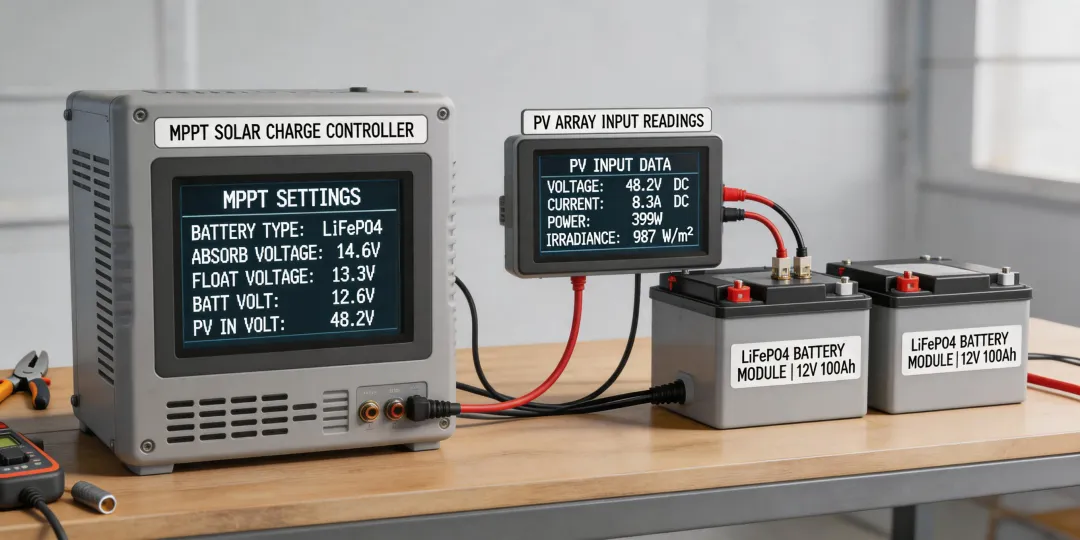
For solar charging, an EPEver Tracer MPPT controller in the 30A class is a reasonable sweet spot for a small 24V system. An EPEver 30A MPPT is my usual pick for a 24V cabin system because it has enough current for lights, a fridge, and a laptop charger, and it lets you set LiFePO4 charge profiles.
Longi bifacial solar panels are a separate decision. They pay for themselves only when the rear side sees reflected light. On a ground mount over white gravel or snow, you might gain 5 to 15 percent. On a dark RV roof or a south-facing house roof, the extra cost is hard to justify. I'd rather buy standard monofacial Longi panels and spend the difference on a better charge controller.
What is the cost of battery energy storage system here? For a small 5kWh LiFePO4 bank with a BMS, plan on $1,500 to $2,500 in parts. If you want an integrated all-in-one battery and charger, it goes higher. If a quote seems too low, check the continuous discharge current and the BMS brand. The BMS is the part that prevents a lithium battery from becoming a problem.
Scenario B: You're an installer or distributor buying for clients
I need to say this plainly: value over price is how I evaluate components. I keep a spreadsheet of every significant hardware order. In the last 27 orders I tracked, the lowest quote cost us more in 18 of them. Not because the parts always failed, but because the missing documentation, slower shipping, and lack of technical support ate the savings. I don't have a peer-reviewed study; I have a spreadsheet. One site visit covers the $50 discount on a controller.
For professional off-grid installs, EPEver Tracer MPPT controllers are a solid default for budget-conscious residential projects. They have adjustable settings, LiFePO4 presets, and a wired remote display that doesn't require the customer to install an app. I want to say our first batch of Tracer 30A units cost around $115 each, but don't quote me on that. The support is what makes it worth more than a no-name controller.
The EPEver 30A MPPT works for typical 12V and 24V cabin systems when you respect the charge current limit. For 48V systems or larger arrays, I step up to a 60A or 100A EPEver MPPT rather than overworking a smaller unit. It's the same lesson I paid for in 2019, applied at a larger scale.
For panels, I will use Longi bifacial solar panels if the client has a ground mount with a reflective surface. On a roof, bifacial is often a waste of the premium. I don't have a problem with the product. I have a problem with paying for yield that isn't physically there.
Battery energy storage system cost for a professional project needs to be transparent. For a 10 to 15 kWh LiFePO4 storage system, my material quotes usually run $5,000 to $9,000 before labor. As of January 2025, global lithium-ion pack prices are reported around $115 per kWh by BloombergNEF, but that's a pack price, not an installed system price. Add BMS, enclosure, breakers, cabling, freight, distributor margin, and a warranty, and the installed cost lands much higher. If a quote looks like it's below component cost, ask what's not included. Usually it's the BMS and the configurable inverter protections.
Scenario C: You're upgrading an existing system
This is a different problem. You already have a solar setup, but it isn't performing. Start with a load audit. If the battery bank is too small, adding more solar panels will not fix it. If the battery bank is fine but charging is slow, an MPPT upgrade might help.
A 300W car power inverter has no place as a permanent component in a solar system. I once spent two hours troubleshooting a 12V trailer setup that used one for the fridge. The fridge tripped the inverter every time the compressor started. It wasn't a battery problem or a solar problem. It was an equipment mismatch. A lesson learned the hard way.
If you already own an EPEver Tracer MPPT and you need more charging capacity, consider adding a second controller instead of replacing the first. On a 24V system, two 30A controllers are often cheaper than one 60A controller, and they give you redundancy if one fails. I've done this on three projects so far. At least, that's been my experience with small off-grid systems.
For battery storage cost in a retrofit, expect around $800 to $1,500 per installed kilowatt-hour in the U.S. as of late 2024. If local incentives apply, subtract 20 to 30 percent from the net cost. But don't buy a battery solely because incentives make it cheap. Buy it because the system's load profile actually needs storage.
What is the cost of battery energy storage system, one more time
I've given ranges in each scenario, but the direct answer is: it depends on system size, voltage, equipment quality, and labor. A complete battery energy storage system for an off-grid home is usually $1,000 to $1,500 per kilowatt-hour installed. A simpler DIY battery bank can be less, especially if you already have a compatible inverter and charger. A grid-tie backup system with an automatic transfer switch will be at the upper end.
I'm not a battery chemist, so I can't speak to cell degradation curves at a molecular level. What I can tell you from an integrator's perspective is that the BMS matters more than the brand name on the cell. A good BMS is worth $200 of peace of mind. A missing or cheap BMS is how a 'bargain' battery becomes an expensive fire risk. That said, we've only tested long-term degradation on a handful of installations, so treat my experience as data, not gospel.
How to know which scenario you're in
If you're still unsure, answer these three questions.
- Who owns the consequence? If it's you and you can debug on a Saturday, you're in Scenario A. If a client is waiting and invoices are running, you're in Scenario B.
- What does a wrong call cost? A wrong charge controller size on an RV costs $100 and an afternoon. The same mistake on a 30-panel mini-grid cost me $2,300 and a damaged reputation. Different mistakes require different caution.
- Are you optimizing for the first invoice or the five-year operating cost? If it's your own system, you can accept some inefficiency. If you're a professional, the cheapest component is only cheap until the second site visit.
The checklist that would have saved me $28,000
- Check the MPPT controller's charge current rating against the battery voltage before choosing a panel array size.
- Verify the maximum PV input voltage with the cold-temperature Voc of the panels. Check the manual, not the marketing.
- Set the battery profile before connecting the battery. For LiFePO4, use the voltage specs from the battery manufacturer.
- Don't wire a 300W car power inverter into a solar system as a permanent inverter. It is a temporary accessory.
- For bifacial modules, calculate the albedo and shade pattern before paying the premium.
- For every battery storage quote, line item the cells or modules, BMS, enclosure, inverter, wiring, breakers, shipping, labor, and warranty. If the quote is a single lump sum, ask for the breakdown.
Pricing and product details in this article reflect what I knew as of January 2025. The solar and storage market moves fast. Verify current EPEver Tracer MPPT specifications and distributor prices before you place your order.