-
Is Epever worth it for small orders, or is it only for big commercial projects?
-
Epever 20A MPPT vs Epever 12V 24V MPPT 30A: which should I quote?
-
Can an Epever controller charge a LiFePO4 24V 20Ah battery safely?
-
Nickel vs lithium battery: what’s the cost truth for off-grid?
-
Why do people ask about the Schumacher 750 watt power inverter manual?
-
What hidden costs should I budget for in an Epever-based system?
I manage purchasing for a 12-person off-grid solar company. I track every order in our cost system, and I have a total-cost-of-ownership spreadsheet that I use on every quote. These are the questions our installers and customers actually ask.
Is Epever worth it for small orders, or is it only for big commercial projects?
Look, I get this. When I first started buying solar gear, I assumed the bigger brands didn’t care about a $250 order. A few years later I learned the opposite: the distributors who treated my small orders seriously are the ones I still use for $10,000 orders. The Epever 20A MPPT and the Epever 12V 24V MPPT 30A are standard stock for us. We quote them on tiny cabins, RV systems, and water-pump jobs. Small projects need the same technical support as large ones. Today’s $200 order is tomorrow’s $20,000 project—if you don’t ignore the person on the other side of the quote. That is why our procurement policy no longer has a minimum order for Epever gear.
Epever 20A MPPT vs Epever 12V 24V MPPT 30A: which should I quote?
When I first started quoting Epever, I assumed the 20A controller was just a cheaper 30A with the same settings. That’s not how MPPT sizing works. The Epever 20A MPPT handles smaller solar input; the Epever 12V 24V MPPT 30A handles more. On a 12V system, a 20A unit is roughly a 260W output limit; a 30A unit is around 390W. On 24V, those numbers roughly double. I pulled the Tracer AN datasheets in January 2025, but I’d still check the maximum PV input voltage before ordering—especially if the installer wants to oversize the array. The wake-up call came in May 2024 when I spotted a quote with a 30A controller on a single 250W panel. Overkill. Wasted margin. The 20A would have done the job at about $30 less.
Can an Epever controller charge a LiFePO4 24V 20Ah battery safely?
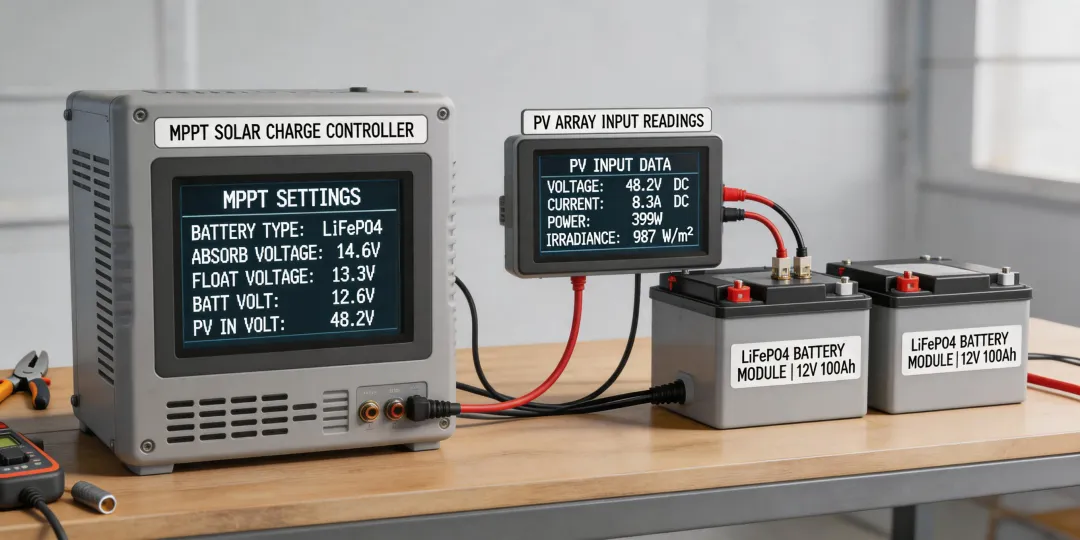
Yes, but the battery still needs its own BMS. The Epever battery-type menu lets you choose LiFePO4, or you can set absorption and float voltages manually. For a LiFePO4 24V 20Ah pack, I’d quote the Epever 20A MPPT and set charge current around 10A if the BMS allows. A 30A controller works too, but at 30A you’re charging that 20Ah pack at 1.5C, which is aggressive for most LiFePO4 cells. The controller doesn’t know the battery capacity. You have to program it. Here’s the thing: the BMS is the primary safety device, not the charge controller. If you rely on the controller alone, you’re asking for trouble.
Nickel vs lithium battery: what’s the cost truth for off-grid?
Real talk: the nickel vs lithium battery comparison stops being useful at the checkout counter. I used to think nickel batteries were the budget option because the purchase price is lower. Then I started tracking lifecycle costs in our procurement system. LiFePO4 costs more upfront, but it lasts several times longer and gives you more usable capacity per cycle. From manufacturer data we’ve collected, a NiCd bank might deliver 800–1,500 cycles; a LiFePO4 bank with a proper BMS is often rated for 3,000–5,000 cycles. If I remember correctly, our old nickel bank cost around $0.32 per cycle; the current LiFePO4 bank is closer to $0.11 per cycle. The “nickel is safer” idea comes from an era when lithium-ion cells had thermal problems. LiFePO4 is a different chemistry. It still deserves a proper BMS, but don’t dismiss it on old assumptions.
Why do people ask about the Schumacher 750 watt power inverter manual?
Because inverters get bought used, inherited, or pulled from a shelf without the print manual. I have a rule: every inverter in our jobs gets a PDF manual saved in the project folder before installation. The Schumacher 750 watt power inverter manual, for instance, includes the wire gauge and fuse ratings you need. Skip that step and you’ll be searching through a blurry folder at 6 p.m. on site. We prefer Epever inverters on our off-grid builds because they share the same ecosystem as the charge controllers. But Schumacher is fine for grid-backup work. The brand matters less than following the wiring instructions—and if you can’t find the manual, don’t wing it. Download the PDF and read the grounding section twice.
What hidden costs should I budget for in an Epever-based system?
I built a cost calculator after getting burned on hidden fees twice. The biggest line people miss is the communication accessory: if you need a remote meter or Wi-Fi module, inventory it separately. Add overcurrent protection, battery temperature sensor, and the programming cable if you don’t want to scroll through the LCD. When I compared three distributor quotes in December 2024, the cheapest unit had the highest total once freight and VAT were added. Example: one 30A controller was $89, plus $15 shipping, $12 programming cable, and $24 tax. Total: $140. The next distributor was $109 all-in with the cable included. That’s a $31 difference on a small order—enough to flip your margin if you weren’t tracking total cost. Total cost of ownership, not unit price.