-
What does MPPT stand for in a solar charge controller?
-
Which EPEver Tracer MPPT solar charge controller manual should I download?
-
EPEver inverter charger or separate inverter and charge controller?
-
What should I look for in a car AC power inverter?
-
How do I compare GoodWe solar inverter installation quotes?
-
Why is charge controller current more important than panel wattage?
-
Is paying extra for an EPEver controller delivery worth it?
If you're searching for an EPEver Tracer MPPT solar charge controller manual, trying to decide on an EPEver inverter charger, or just wondering what MPPT stands for in a solar charge controller, this is the right place. I coordinate off-grid solar orders for installers, and a lot of those orders are urgent. Over the past eight years, I've handled 200+ rush shipments for clients who needed gear yesterday. One thing I've learned stands out: on a deadline, the 'probably fine' option is the most expensive option you can choose.
What does MPPT stand for in a solar charge controller?
MPPT stands for Maximum Power Point Tracking. It is not a marketing phrase; it's a control algorithm that keeps a solar panel operating at its peak power point as sunlight, temperature, and shading change.
A solar panel has a voltage-current curve, and the point where it produces the most power shifts all day. A PWM controller simply connects the panel to the battery, and the panel voltage gets pulled down to battery voltage. An MPPT controller continuously adjusts the operating point so you get more usable power from the same panel.
According to the EPEver Tracer AN series manual, MPPT efficiency reaches up to 98%. That matters most in cold weather, when panel voltage runs high and the controller can convert that extra voltage into charging current. Bottom line: MPPT is the technology you want on a modern solar setup.
Which EPEver Tracer MPPT solar charge controller manual should I download?
Search by your exact model number, not by series name. An EPEver Tracer 4215AN manual is not the same as a 1020AN manual, and the wrong one will make you chase settings that don't exist. The model number is printed near the QR code on the side of the controller.
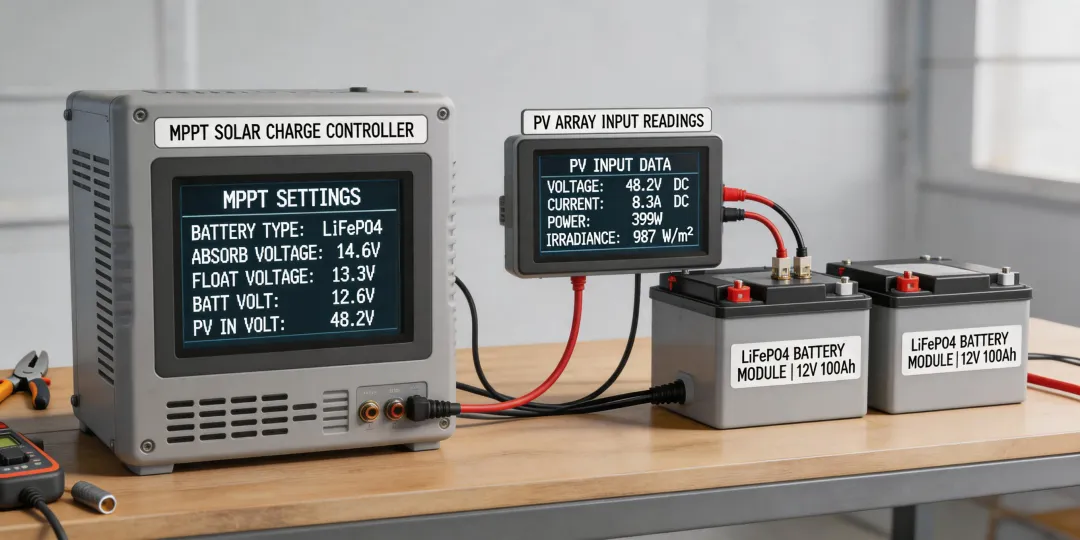
Once you have the correct EPEver Tracer MPPT solar charge controller manual, set the battery type first. The Tracer series supports lead-acid, gel, AGM, and LiFePO4. If you're using lithium batteries, don't leave the default lead-acid profile in place. Select the lithium profile or enter the charging voltage from your battery datasheet.
What most people miss is max PV voltage. For example, the Tracer 4215AN has a maximum solar input voltage of 150V (note to self: this is the spec I check first on every last-minute replacement). Open-circuit voltage rises in cold weather, and if you exceed the limit, you can damage the controller. Read the manual's sizing table before you wire the array, not after.
EPEver inverter charger or separate inverter and charge controller?
An EPEver inverter charger combines a pure sine wave inverter and a battery charger in one enclosure. When you have shore power or a generator, it charges the battery and passes AC through to your loads. When you don't, it inverts DC from the battery into AC. For an RV, van, or small off-grid cabin, that means one unit to install, one display to read, and fewer cable connections to check.
If you already own a good charge controller and a separate inverter, you don't need to switch. But if you're starting from zero, an inverter charger can save space and simplify wiring. Just make sure the charger side matches your battery chemistry and the inverter side can handle your surge loads.
Here's the part people overlook: everyone asks 'how many watts?' The better question is 'how long can it handle a surge?' A refrigerator compressor can pull two or three times its running watts for a moment. If the spec sheet only says 'peak power', ask for the continuous rating. A slightly larger inverter is way less painful than replacing a unit that trips on startup.
What should I look for in a car AC power inverter?
For a car AC power inverter, the three specs that matter most are continuous watts, surge watts, and output waveform. A 300W inverter will run a laptop, a small TV, or a fan. It won't run a microwave that draws 1000W, no matter what the box says.
Modified sine wave inverters cost less and work fine for simple resistive loads or tools. Pure sine wave inverters are safer for computers, medical devices, and anything with a digital motor controller. If the inverter is powering something you can't afford to fry, pure sine wave is a no-brainer. If you're planning to run a CPAP machine through an outage, don't buy a no-name modified sine inverter just because it's cheap.
When you look at an EPEver car power inverter, check the datasheet for the continuous output rating. A '2000W peak' rating might mean only 1000W continuous. And if you're ordering before a trip, pay for expedited shipping if needed. The cost of arriving without an inverter is way higher than the cost of overnight freight.
How do I compare GoodWe solar inverter installation quotes?
Comparing GoodWe solar inverter installation quotes is all about scope. From the outside, it looks like vendors just charge different hourly rates. The reality is the scopes are often different. One quote may include the AC distribution box, isolators, cabling, labor, permits, and commissioning; another quote may be hardware only.
In quote sets I reviewed in Q4 2024, 5kW GoodWe hybrid installations ranged from roughly $1,800 to $3,200 depending on scope and region (verify current pricing). The lowest line item was not the lowest total cost once I added missing items.
Ask for an itemized quote. Make sure every quote uses the same inverter model, same battery interface, and same warranty terms. Clarify lead time and whether the quote includes monitoring setup or as-built drawings. And ask about shipping lead time. A quote that gets you the inverter a week after your crew leaves isn't an installation quote; it's a doorstop. Then compare total installed cost, not the headline price.
The same logic applies to EPEver equipment. A cheaper charge controller quote without the LCD display, temperature sensor, and proper battery cables becomes expensive after rework. The cheapest quote has a way of becoming the most expensive.
Why is charge controller current more important than panel wattage?
Most buyers focus on panel wattage and completely miss the controller's maximum charge current. The rated charge current tells you how much current the controller can deliver to the battery, and that limit determines your usable solar output.
For example, a 20A MPPT controller on a 12V battery system can deliver roughly 260-300W of charging power under real operating conditions. You can connect 400W of panels, but the controller will cap the charge current at 20A. On a 24V battery bank, the same controller can handle roughly double because voltage is twice as high.
An EPEver Tracer 20A may be right for a small cabin, while a 30A or 40A model gives you room to expand. Read the manual's sizing table so you match panel wattage, PV voltage, and battery voltage to the controller's limits. That one habit saves you a ton of headaches later.
Is paying extra for an EPEver controller delivery worth it?
If you're on a deadline, yes. What you're paying for is certainty, not just speed. The risk isn't 'will it arrive a day late?' The risk is what happens if it arrives late. In March 2024, a client paid $85 to overnight an EPEver MPPT controller after their old unit failed on a Monday. Ground shipping would have taken four days. The project site needed the solar running to keep an off-grid water pump active, and the backup generator rental for those extra days was $320.
On another job, I had about an hour to pick a shipping option before the courier cutoff. Normally I'd compare several vendors, but there was no time. I went with the distributor who had shipped for us 23 times in two years without missing a single one. More importantly, I asked whether they actually had stock on the shelf. They did, and the sealed unit went on an overnight truck that same evening. The rush fee was $50. Missing the project start would have cost a lot more.
After a few 'estimated delivery' surprises in 2023, our company now requires a 48-hour buffer on every date-critical order. It has saved us more than once. Shipping and rush-fee pricing changes, so verify current rates before you budget, but don't pretend time has no value. On a deadline, a slightly higher price for reliable delivery is a rational choice, not an overreaction.