The phone call that rewired my checklist
I got the text at 2:17 a.m. in November 2023. The ranch manager wrote: 'No power. Inverter says battery low voltage. Generator won't start either.' That text changed how I think about Epever LiFePO4 settings. And it forced me to write down every mistake I had made before that night.
Quick background: I've been a system integrator handling off-grid solar orders for six years. I've personally made—and documented—11 significant mistakes, totaling roughly $14,000 in wasted budget. Now I maintain our team's pre-install checklist. This is the story behind checklist item #7.
Choosing Epever (and not reading the label)
In late 2021, a customer in eastern Oregon asked us to design a 5kW off-grid system for a ranch. The main house had a big fridge, a workshop with power tools, and a gate opener that kept draining batteries. (Should mention: the gate opener was an afterthought, and that's its own story.) But battery energy storage system components matter more than brand names, and we chose Epever for the core hardware: an Epever 5kW inverter/charger, an Epever Tracer MPPT charge controller, and a 48V 200Ah LiFePO4 battery bank.
The battery label said 'batterie LiFePO4 48V 200Ah' — the French wording made me smile. I didn't pay enough attention to 'LiFePO4.' I saw 'lithium' and moved on. Honestly, that's where the whole thing started to unravel.
What 'lithium compatible' actually means
The Epever controller had a battery type labeled 'Lithium.' I selected it, set the float voltage, and didn't think about it again. In my first year (2019), I made the classic newbie mistake of trusting presets. Three years later, I was doing it again.
The old question—lithium-ion vs LiFePO4—came up after that night. Here's what I now know: LiFePO4 is a specific type of lithium-ion chemistry. Its cells sit at about 3.2V nominal, not 3.6V or 3.7V like NMC cells. The charge voltage is lower. The discharge curve is flatter. A generic 'lithium' profile is a guess, and guessing on a battery bank this size is expensive.
We didn't have a BMS communication cable between the Epever controller and the battery. The controller was running blind. Battery energy storage system components—the battery, BMS, inverter, charge controller, breakers—each had its own idea of 'empty.' They have to agree on thresholds; this system didn't.
The night everything went dark
For roughly two years, the system ran fine. The inverter handled the workshop loads, the charge controller kept the bank full, and the ranch manager didn't call. I started to think I had overcomplicated the whole thing. Then the November 2023 text came.
We showed up the next morning. The inverter had no output. The battery display showed 'BMS disconnect,' which I had never actually seen in the field. My first thought was that the battery was bad. It was not.
What happened was a threshold mismatch. The Epever inverter's default low-voltage cutoff is designed for lead-acid batteries, so it kept drawing current down to a voltage that the LiFePO4 BMS considered empty. The BMS disconnected to protect the cells. In effect, the two devices were playing a tug-of-war with no communication cable between them. The loser was the whole system. I didn't fully understand the difference between 'lithium' and 'LiFePO4' until that bank shut down at 2 a.m.
Had 3 hours to decide before the ranch manager's backup generator ran out of fuel. Normally, I'd have bench-tested the fix first. There was no time. I called Epever support—actually, I called twice because my hands were shaking—then walked the manager through changing the battery mode from 'Lithium' to 'User.'
The Epever Inverter Review Part
So, the Epever inverter review part: the inverter itself was good. It handled two years of ranch life, cloud storms, and a freezer full of meat. The screen was clear, the fan noise was tolerable, and the overload protections worked. What got us wasn't the hardware; it was the settings. If you buy an Epever inverter and expect it to work with LiFePO4 out of the box, you'll probably have a bad time. It's not plug-and-play. It's do what the manual says, plus what the battery datasheet says.
The Epever manual says to use 'User' mode for non-standard batteries. It doesn't tell you which values to enter. That's what the battery datasheet is for. I didn't read it closely enough. (Mental note: never skip the datasheet again.)
The fix, and the Epever LiFePO4 settings that worked
We got the system back online that afternoon. The settings that fixed it are not magic. They're just values the battery manufacturer specifies for this pack. If you're setting up a 48V LiFePO4 bank, the exact numbers depend on your battery's cell chemistry and BMS. But the logic is the same.
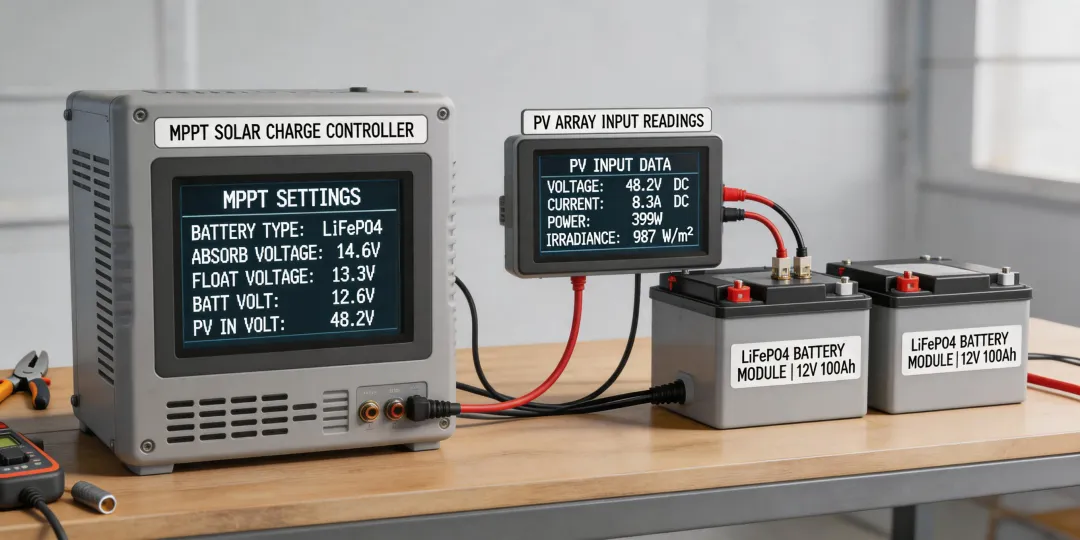
- Battery type: User, not the generic Lithium preset.
- Boost/absorption voltage: around 57.6V for a 48V LiFePO4 bank.
- Float voltage: around 54.4V. Don't leave it at the lead-acid default.
- Equalization: disabled. LiFePO4 doesn't need it.
- Low voltage disconnect: 46.4V (or whatever number is at least 1–2V above the BMS cutoff).
- Low voltage reconnect: around 48V, so the system doesn't cycle on and off.
I want to say these were the exact values we used, but don't quote me on that. Check the battery data sheet before trusting any number from an article. The battery datasheet called for 57.6V and 54.4V, and that's what we set. This list saved us a ton of time afterward—when we set up a cabin in 2024, it took 15 minutes, not two days.
The first twelve hours of that outage were expensive and stupid. We replaced the battery monitor because it showed impossible numbers. We swapped a busbar because the heat-shrink looked wrong—it wasn't. Oh, and I ordered a new charge controller overnight before noticing the controller was actually fine. It sat on the shelf until a later project. That part still stings. What I should have done first was simple: pull the BMS data, write down the inverter's voltage thresholds, and compare them.
People still ask whether lithium-ion vs LiFePO4 matters for a project like this. It does. LiFePO4 sits at a lower voltage per cell, has a flatter discharge curve, and tolerates a lot of abuse. That's why it's a good default for off-grid battery banks. But 'lithium-ion compatible' on an inverter is not the same as 'optimized for LiFePO4.' The inverter needs to know the boundaries.
That night cost about $1,200 in service calls, express shipping, and a replacement battery monitor we didn't actually need. Plus a client who watched me sweat in his shop for two days. Afterward, I wrote a one-page battery settings sheet and put it in every system we commission. We've caught 47 potential errors using that checklist in the past 18 months. This one—checking LiFePO4 thresholds before energizing—is item #7, and it's the one I think about most.
Bottom line
The Epever gear earned its place in our standard lineup. But an Epever inverter review that only talks about the hardware misses the real point. The hardware is only as reliable as the settings around it. For LiFePO4, that means using User mode, disabling equalization, setting absorption/float for the actual cells, and making sure every component sees the same bottom before the BMS has to make the call for them.
As of January 2025, that checklist is still in use. It's now a boring part of every install, which is exactly how I like it. If I could go back to late 2021, I wouldn't skip the datasheet. I'd set the Epever LiFePO4 settings on day one, then sleep through the night. The 2 a.m. text taught me that lesson the hard way.