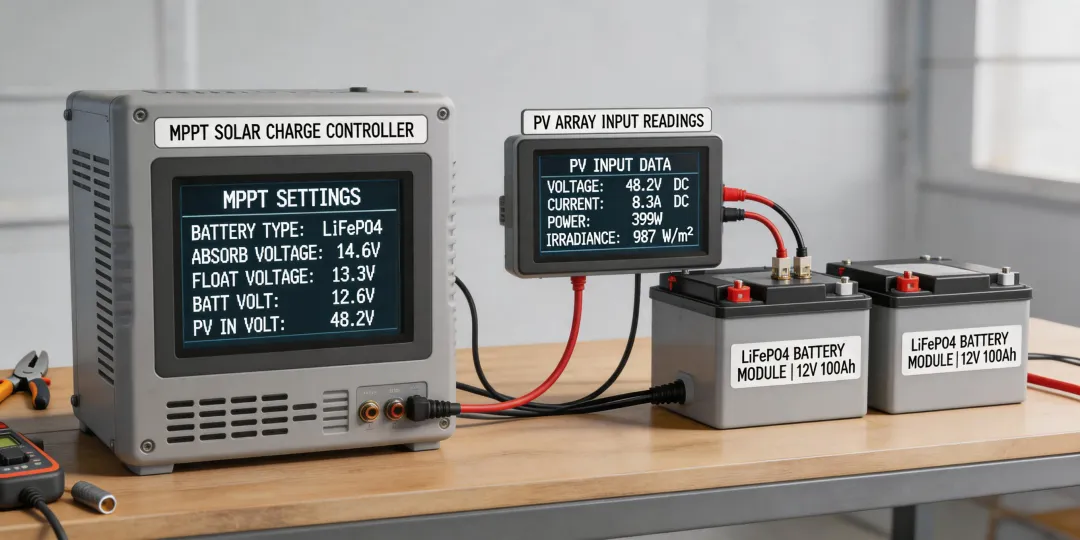
There is no single best EPEVER charge controller. That is not a marketing line—it's the conclusion I've reached after six years of helping B2B customers—system integrators, installers, and distributors—order solar components for off-grid systems. The controller that makes sense for a cargo trailer is not the same one I would specify for a 3kW off-grid cabin, and the cheapest option in our catalog is worse than useless if it can't handle your battery chemistry.
I have personally documented 30-plus mistakes in my career, totaling roughly $24,000 in wasted budget. In my first year (2017), I made the classic mistake of skipping battery settings verification. That mistake alone cost us a lithium battery pack and a client relationship. I still maintain our team's pre-order checklist, mostly because I know what happens when you skip it.
So let's split this into the three scenarios I actually see in orders: RV/van mobile systems, off-grid cabins or homes, and basic backup setups. Find your closest match, then go from there.
The Three Setups: Which One Is Yours?
The question isn't 'which EPEVER solar controller is the best?' The question is 'which setup are you building?' Here's a quick breakdown:
- Scenario A: Mobile / RV / van. 12V battery bank, loads under 1kW, limited roof space. You need a controller that communicates well with lithium batteries.
- Scenario B: Off-grid cabin or home. 24V or 48V bank, more than 1kW of loads, future expansion likely. You need a larger MPPT controller and panels that fit a specific voltage window.
- Scenario C: Basic backup. A few lights, a fan, a phone charger, maybe a TV. You may not need MPPT at all.
I'll go through each one. If you're not sure which one you're in, skip to the checklist at the end.
Scenario A: Mobile / RV / Van Systems
If you're running a 12V system in a van or RV, the biggest issue I see is people buying a solar controller before thinking about their battery profile. EPEVER's Tracer line—their MPPT series—has different settings than the LS PWM series. If you're using a LiFePO4 battery, factory defaults are usually designed for lead-acid. You have to go into the settings and change the battery type to lithium, or the battery will cut out at an annoying time.
I learned this the hard way. In September 2022, I shipped a small order for a van conversion with an EPEVER charge controller and a LiFePO4 battery. I approved the setup with factory defaults because the distributor said it 'should work.' The customer's battery went into protection mode on the third night. I checked the manual after the angry phone call, and there it was: you need to set the charging profile manually for LFP. The fix took 4 minutes. The embarrassment lasted months.
So if you're in this scenario: pick an EPEVER MPPT controller (the Tracer line is a good place to start), set the battery type to LFP, and verify your float and absorption voltages with your battery manufacturer. That's not optional.
Do you need MPPT at all? If your solar array is less than 150W or so, a PWM controller like EPEVER's LS series might save you money. But for most vans, modern high-voltage panels are cheaper per watt than low-voltage panels, and MPPT is what lets you use those panels without oversizing your wiring.
Scenario B: Off-Grid Cabin or Home With Phono Solar Modules
For off-grid homes, I usually spec 24V or 48V battery banks and MPPT charge controllers sized for future expansion. This is where the 'value over price' conversation starts. The cheapest controller quote is rarely the cheapest total cost if it fails in two years and kills a battery bank. When I say value over price, I'm not being philosophical. In my experience managing procurement for these systems, the lowest quote has cost us more in about 60% of cases.
One of the most common projects I've reviewed involves Phono Solar modules. I want to say the Phono Solar 60-cell mono modules we used had a 25-year warranty, but don't quote me on the exact generation—my point is the modules are usually fine. The bigger problem I see is people pairing decent modules with an EPEVER controller that doesn't have enough PV input voltage headroom.
Here's a mistake that cost us a controller and a two-week delay:
In January 2023, we installed two 72-cell modules in series on a 100V EPEVER MPPT controller. I had skimmed the warning about cold-weather Voc. I didn't think it applied to us. Everything looked fine on paper until a cold, sunny morning. The open-circuit voltage shot above the controller's 100V limit. The controller died. That was around $580 down the drain, plus travel time and a very cold customer.
If you're using Phono Solar modules or any other 72-cell panels, do this calculation before you order:
Take the panel's Voc (open-circuit voltage) from the datasheet, multiply it by a cold-weather factor—I use 1.2 for most climates, higher if you're in northern areas—then multiply by the number of panels in series. That number must stay below the controller's maximum PV input voltage. If it's close, you're not done: you need a controller with a higher max voltage.
In my experience, the EPEVER Tracer-BN series handles a lot of these installations well, but you need to select the exact model based on your panel string, not just the controller's amp rating. I've caught 47 potential errors using our checklist in the past 18 months. The Voc check is the item you never skip.
Another piece of advice: read the warranty on the modules. Per FTC Green Guides, environmental claims like 'green' have to be substantiated, so if a supplier calls a panel 'eco-friendly' without documentation, I ask for evidence. More importantly, a solar module warranty is a financial promise. If a distributor says '25-year warranty,' get it in writing. I've seen too many verbal promises disappear when a company restructures.
Scenario C: Backup / Small Systems: Jupiter Modified Sine Wave Power Inverter
Now let me say something that sometimes gets me into trouble: not every off-grid system needs the most expensive equipment. For a small backup unit—think lights, a phone charger, a laptop, a ceiling fan—the most honest recommendation might be a PWM charge controller and a Jupiter modified sine wave power inverter.
I know 'modified sine wave' has a bad reputation, and for good reason. It's not suitable for some equipment: induction motors, certain medical devices, audio gear, and anything with a large transformer can hum, run hot, or fail. But for resistive loads and simple electronics, a Jupiter modified sine wave power inverter can work perfectly well. I've used one in a client's tool shed for two years without an issue.
The most frustrating part of inverter shopping is the marketing: everyone advertises watts, but nobody tells you what loads care about waveform. You'd think 'modified sine wave' printed on the box would be enough, but people still install them on well pumps and then blame the inverter. That's not the inverter's fault—it's a matching problem. At least, that's been my experience with backup systems under 1kW.
So here's my rule for this scenario: If your biggest loads are a fridge motor, a well pump, or a compressor, skip the modified sine wave inverter and budget for a pure sine wave inverter instead. If your loads are lighting and electronics, the Jupiter modified sine wave power inverter is probably fine, and the money you save can go toward better batteries. That's the opposite of what most forum threads say, but it's what I've seen work in practice.
Where Is Jackery Solar Generator Made?
This question comes up more than you might think. When I search for 'where is jackery solar generator made' myself, the answer is surprisingly hard to pin down. Here's what I can tell you from my research and client conversations:
Jackery is a Chinese-founded company, and its manufacturing is generally in China. If I remember correctly, Jackery's U.S. office is in Fremont, California, but that's a headquarters and product-development presence, not necessarily a factory. I'm not aware of Jackery publicly listing every manufacturing location, and I don't want to pretend to know details I haven't verified. If anyone gives you a precise factory name without a source, treat it with skepticism.
For B2B buyers, the more useful question might be: 'Do you need an integrated brand like Jackery, or do you need components that you can configure yourself?' A Jackery solar generator is easy, tested, and convenient. But it's not the same as a custom system with an EPEVER solar controller, a separate battery, and an inverter that matches your specific loads.
If your goal is a plug-and-play backup unit, the country of origin probably doesn't matter as much as your return policy and warranty. If your goal is a long-term off-grid system, then component-level control matters more. I've seen plenty of clients buy a Jackery-like all-in-one unit, then realize they need a bigger battery at 2 a.m., and they're stuck. With an EPEVER charge controller and a separate lithium battery, at least you can replace one component at a time.
How to Figure Out Which Scenario You're In
Still unsure? That's normal. Here's a short checklist I walk through with every B2B client:
- List your loads in watts, and estimate how many hours per day each one runs.
- Decide your battery voltage: 12V for small systems, 24V or 48V for larger ones.
- Check your solar array's Voc at your coldest expected temperature.
- Then choose the controller size. Buy for the total system you plan to have, not the panel you can afford today.
- Set the battery profile before connecting the battery. Seriously.
If you're still torn between an EPEVER Tracer MPPT controller and a cheaper PWM option, do the math on total cost of ownership. The upcharge for MPPT usually pays for itself in harvest efficiency, especially in colder climates. But for a tiny backup system with a small budget, the PWM controller plus a Jupiter modified sine wave power inverter might be the right call. It's not 'lazy' advice; it's scenario-based.
One more thing: I'm not a licensed electrical engineer, so I can't speak to the code requirements in your jurisdiction. What I can tell you, from a procurement and system integration perspective, is that the cheapest option is rarely the cheapest option. I'd rather spend a little more on a controller with proper settings and documentation than eat the cost of a fried battery bank again.
So glad I've been using the checklist since that 2023 failure. We almost shipped a 48V system with a reverse-polarity battery connection a few months ago—one click away from ruining another inverter. The checklist caught it. That's the entire point.