If you Googled solar system in order from the sun expecting Mercury, Venus, Earth, Mars, Jupiter, Saturn, Uranus, Neptune—this is not that article (though Mercury is easy to skip). But if you are building an off-grid or backup solar system, there is a solar system order that matters more: solar panels → charge controller → battery bank → inverter → loads. Skip that order, and everything after it gets ugly.
I have been ordering and installing solar equipment for seven years. I have sized maybe 300 systems. Maybe 250, I would have to check the spreadsheets. I have also documented 14 significant mistakes—somewhere around $30K in wasted budget. Now I maintain our team's checklist so other people do not have to repeat my errors.
The short version: there is no single best EPEver charge controller. It depends on your loads, your battery voltage, and how much sun you actually get. Let me walk you through the three scenarios I see most often.
First, Understand the Order From the Sun
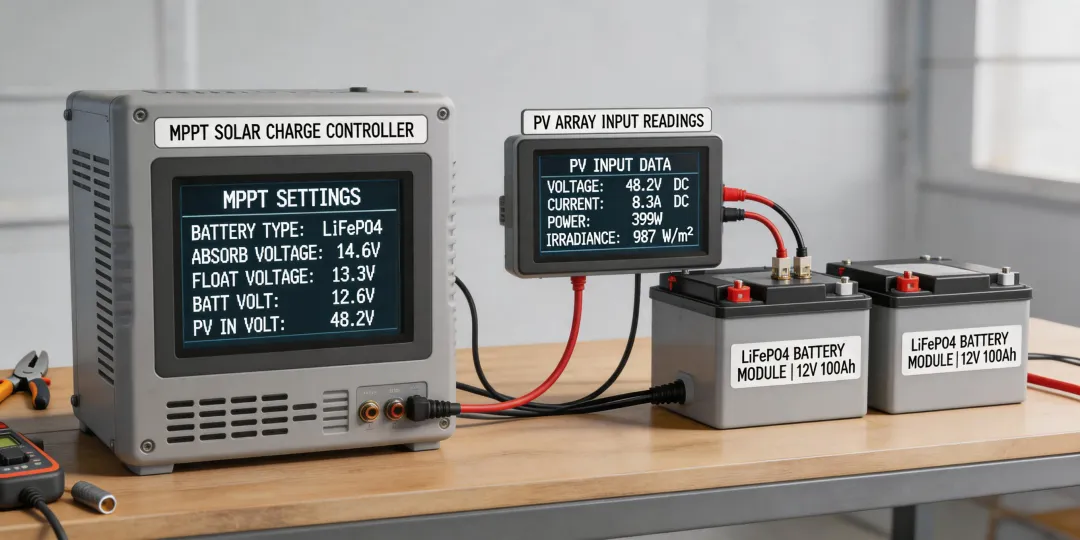
Your EPEver MPPT solar charge controller sits between the panel and the battery. It does not power loads directly. The current flows like this:
PV panel → charge controller → battery → inverter → AC loads
That is why 'I have a 30A controller' does not tell you whether the system can run a fridge. The controller only manages how fast the battery charges. If the battery is too small, the fridge still kills it. If the battery is large and the controller is undersized, the battery takes days to fill. Both are common mistakes.
The Three Scenarios
In my experience, most people fall into one of three camps:
- Scenario A: Small 12V setup - cabin, trailer, lights, phone charging.
- Scenario B: Home backup + light EV trickle charging - fridge, router, maybe a plug-in hybrid.
- Scenario C: Whole-house off-grid + serious EV charging.
The right EPEver controller for you depends on which camp you are in.
Scenario A: The 12V Camp
If you just want to keep a cooler cold, charge phones, and run a few LED lights, the EPEver 12V 24V MPPT 30A controller everyone searches for is usually enough. I have used the Solar Tracer EPEver line in dozens of these builds.
For a 12V battery bank with 200-400W of panels, a 30A MPPT controller is a good fit. The charge current is limited to 30A, so you are looking at roughly 360W max from a 12V battery. At 24V, the same controller can manage about 720W of charging. That is a real advantage to going 24V, even for small systems.
According to the EPEver Tracer AN user manual, the 30A model has a 100V max PV input. But check the manual—EPEver has released revisions, and I am not staring at one right now. On a cold, sunny morning, panel voltage rises, so do not get cute with series strings. I once put two 300W panels in series on a 12V system, caught a frosty sunrise, and saw 105V for a split second. The controller survived. That is what we call luck, not design.
Cost for this scenario:
- EPEver Tracer AN 30A: around $70-110 (based on online EPEver dealer quotes, January 2025; verify current pricing).
- 300W panel: $150-250.
- 12V 100Ah LiFePO4 battery: $400-700.
- Wiring, fuses, busbars: $100-200.
- Total DIY: roughly $800-1,500.
That system runs lights, a small load, and some USB gadgets. It will not power a full-size fridge all night.
Scenario B: Home Backup Plus a Plug-In Hybrid
This is where people get overconfident, and it is where the Audi Q7 TFSI e EV charger question keeps coming up. A customer asked me recently, 'Can I charge my Audi Q7 TFSI e from solar with an EPEver controller?' The answer is yes, but not the way he imagined.
The EPEver charge controller charges your battery bank. It does not plug into the car. To charge an EV, including the Audi Q7 TFSI e plug-in hybrid, you need a battery bank, an inverter, and a Level 1 or Level 2 EV charger—sometimes called EVSE. In North America, the EVSE side follows the SAE J1772 standard for most cars. The Audi's onboard charger handles the actual AC-to-DC conversion. The EPEver controller is on the DC side and does not know the car exists.
The Audi Q7 TFSI e has roughly an 18 kWh battery. If you try to fill that from a 12V system with a 30A controller, it is not going to happen overnight. The solar array cannot push enough energy into the battery during the day, and the battery bank is not big enough. A Level 2 EVSE at 16A/240V is 3.8 kW. A 12V 100Ah battery stores only 1.2 kWh. The math does not work.
For this scenario, I would recommend a 24V or 48V system with at least a 5 kWh LiFePO4 battery, a 3kW inverter, and enough solar to replace what you use. If you only want to add 10-15 miles of range to the Q7 overnight, a 24V system with 800-1,200W of panels and a 30A EPEver controller can do it—if you are patient and you do not also run a full house.
Here is a mistake I made: I told a customer their 12V EPEver 30A would handle a 'few extra kWh' for an EV. It did, technically. But the controller clipped at 360W, the battery was dead by 2 a.m., and the car did not gain enough range to make it to work. That was a $1,200 battery plus one very unhappy email. Lesson: define the charging goal in miles per overnight, not 'I want to charge my car.'
Cost for scenario B:
- EPEver 30A MPPT (24V version): $80-120.
- 5 kWh LiFePO4 battery: $1,200-1,800.
- 3kW pure sine wave inverter: $600-1,200.
- Panel array (1,000W): $500-800.
- EVSE (Level 1 or 2): $200-800.
- Total DIY: roughly $3,500-5,500.
If you need professional installation, add $1,500-3,000 in labor and permits. That is not the whole-home price; that is the 'keep the fridge on and give the Q7 a few miles' price.
Scenario C: Whole-House Off-Grid
This is the 48V world. If you want to run a normal house, a deep freezer, an electric water pump, and charge a full EV at home, you need a 48V battery bank and a much larger EPEver controller—or two controllers in parallel.
I would look at a larger EPEver Tracer controller (60A or 100A) or parallel 30A controllers if you already own them. At 48V, a 100A controller can manage 4,800W of charging. Add 5-10 kW of panels and 15-30 kWh of LiFePO4 storage, and you are in true backup territory.
People assume 48V is more expensive because you need several batteries in series. The reality is the cabling, inverter, and breakers can be smaller because current is lower. Higher voltage is not a luxury; it is how you move meaningful power without overheating wires. After about 2 kW, 12V starts becoming a bad idea.
From the outside, a 48V system looks like overkill. What you do not see is the cost of oversized copper cables and voltage drop losses in a 12V system at high load.
Cost for scenario C:
- EPEver Tracer 60A/100A: around $250-500.
- 15 kWh LiFePO4 battery bank: $3,500-6,000.
- 6kW inverter (48V): $1,500-3,000.
- Panel array 4-6 kW: $2,500-5,000.
- Racking, wiring, disconnects, permits: $2,000-4,000.
- Total: roughly $10,000-20,000 DIY; $20,000-35,000 installed.
These are planning numbers, not quotes. Prices change and regional labor varies. Get local bids before you believe any internet article.
How to Tell Which Scenario You Are In
Do not buy a controller until you answer these five questions:
- What loads must always work? Add up the watt-hours per day. A fridge is about 1.5 kWh/day. A router is about 0.05 kWh/day. An overnight EV charge is 10+ kWh/day.
- Do you need AC at all? If you do not, you save the inverter cost. If you do, you need the battery and inverter before you can plug in an EV charger.
- What battery voltage are you committing to? 12V is fine for small builds. 24V helps with 1-2 kW loads. 48V is the right answer for 2 kW+.
- How much winter sun do you get? Your panel array needs to produce enough in the worst months, not just July.
- Are you using LiFePO4? Then your controller must have an adjustable charge setting or a lithium preset. The EPEver Tracer AN has one. If you leave it on the wrong gel setting, the BMS can disconnect, and you will think the controller died.
I would rather spend 10 minutes explaining this than deal with mismatched expectations later. At least, that has been my experience with residential and cabin projects. If you are doing a marine 12V setup or a utility-scale site, this may not apply.
Before you scale up, check local electrical code requirements (NEC 690 in the US) for grounding, disconnect, and rapid shutdown. Regulatory information is for general guidance only; verify current rules for your area.
The Order of the Solar System, Again
The solar system you are building has a specific order from the sun to your outlet:
Sunlight → panels → EPEver MPPT charge controller → battery → inverter → your devices.
If you are asking how much does a solar battery backup system cost, the answer depends on which scenario matches your life. A small cabin system can cost $1,000. A system that keeps a house alive and charges an Audi Q7 TFSI e is closer to $20,000+. And yes, if you meant the planets, they are Mercury, Venus, Earth, Mars, Jupiter, Saturn, Uranus, Neptune. But in a solar-powered home, the order above will get you through a blackout.