I manage purchasing for a 22-person solar installation company. Roughly $700,000 a year in parts across nine vendors, and I report to both operations and finance. I'm not an engineer. I'm the person who makes sure the equipment arrives, matches the paperwork, and doesn't create a compliance headache. That distinction matters more than you'd think.
In November 2024, we were building an off-grid system around an EPEver 100A MPPT solar charge controller. The controller was fine. The problem was a lithium battery dangerous goods shipment sitting at a freight forwarder for six days because no one had filed the Shipper's Declaration for Dangerous Goods. The field team finished the racking, wiring, and inverter connection. Then we had to send them back a week later to connect the battery. That delay changed how I think about buying solar equipment.
From the outside, this looks like a spec-sheet problem
Almost every sales rep starts the same way: What's your system voltage? What's your load? They assume that if the numbers line up, the project will work. In my experience, the numbers are the easy part. The hard part is what sits in between the components—settings, shipping rules, battery chemistry, and a dozen assumptions that never make it onto a spec sheet.
People assume the lowest quote means the vendor is more efficient. What they don't see is which costs are being hidden. A controller might be $40 cheaper and still cost you three hours of setup because the default charging profile doesn't match lithium. A battery might be $200 cheaper and then require a hazmat surcharge that eats the savings.
It's tempting to focus on the controller model. I do not remember the last time a project failed because the MPPT was 10 amps too small. I do remember exactly when it failed because a battery couldn't legally move.
The deeper cause: you're buying a system, not a part
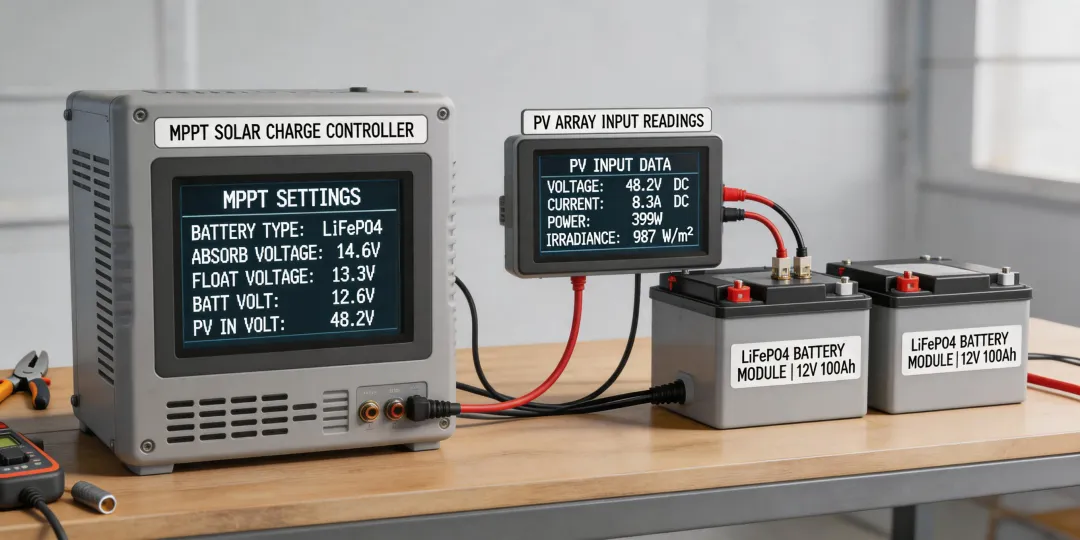
Take MPPT controllers. We buy both the EPEver 30A MPPT and the EPEver 100A MPPT, depending on the array. The 30A unit handles smaller 12V/24V systems (in our setup, usually RV charge bays and small backup buildings). The 100A unit is for larger setups with more PV input. But the controller selection doesn't stop at amperage. It needs to support the battery chemistry you plan to use, and it needs charging profiles you can actually adjust.
If you set a lithium battery to a lead-acid profile, you get undercharging. If you set a flooded battery to a lithium profile, you get overcharging. The hardware isn't broken. The settings are wrong. In 2023, we had a job where the panels were producing great voltage, but the batteries were sitting at 80% every night. The installer had left the controller on the default gel profile. The customer thought the controller was defective. It wasn't.
Battery chemistry also changes the physical side of the transaction. A 12V 100Ah LiFePO4 battery stores 1,280Wh. Under the International Air Transport Association Dangerous Goods Regulations (IATA DGR) in effect as of January 2025, that falls well above the 100Wh threshold for lithium-ion batteries shipped in air cargo. That means UN3480, Class 9 labels, packaging that meets UN38.3 requirements, and a Shipper's Declaration if you're moving it commercially. I've seen quote calls turn into emergency calls when someone realized the free freight didn't include dangerous goods handling. Verify current requirements at the IATA website—rules change.
This is where the industry has changed. What was best practice in 2020 doesn't cover 2025. Five years ago, most off-grid systems we installed were lead-acid. Now, most are LiFePO4. That changes controller settings, the shipping process, and customer expectations. The fundamentals—proper wire sizing, overcurrent protection, correct system voltage—haven't changed. The execution has.
A word about the Enphase battery vs Powerwall debate
I get asked this constantly: Which is better, Enphase battery vs Powerwall? It's a fair question, but it's usually the wrong one. We've installed both. Both are good products. The problem is that the comparison makes people think the answer is a brand. It isn't. The answer depends on load profile, available space, grid conditions, and whether the customer needs whole-home backup or just a few protected circuits.
If you don't know what loads you're backing up, you're comparing marketing brochures, not engineering. That's not a criticism of Enphase or Tesla. It's a criticism of the way we talk about storage.
What a misstep actually costs
On that November job, we absorbed roughly $1,800 in extra freight, reprocessing, and labor because the battery shipment was delayed. The supplier gave us a discount, but the schedule slip was never paid for. Operations had to reassign a crew. Finance had to rebook the invoice. I had to explain to the project manager why in transit didn't mean it would show up.
The same logic applies to undersized inverters. A 1kVA solar inverter is not a whole-home inverter. It's appropriate for a small list of loads: a modem, a router, a couple of LED lights, maybe a laptop charger—as long as the starting surge stays manageable. I've seen customers insist on 1kVA because that's what they used at their old place. Then they add a mini fridge and the inverter can't start the compressor. The inverter didn't fail. It was the wrong tool.
The lowest quoted price is not the lowest total cost. The total cost includes the rework, the return shipping, the dangerous goods surcharge, the customs broker's delay fee, and the second truck roll. One of those can wipe out the savings on a whole pallet of controllers.
In my opinion, the cost of a misstep is rarely the component price. It's:
- The rework labor that wasn't budgeted
- The return shipping and restocking fees that eat any initial savings
- The dangerous goods or customs brokerage charges that appear after the quote
- The customer trust that disappears when you show up twice
The fix isn't exotic
The fix is not to buy a better brand. It's to buy components that can be configured, from a vendor who understands how they fit together. For charge controllers, that means MPPT units with adjustable battery profiles. The EPEver 30A and 100A both support LiFePO4, and we change absorption parameters at commissioning. For batteries, verify the current UN38.3 test reports, confirm the dangerous goods classification, and make sure your forwarder handles lithium shipping. At minimum, look for UL 1973 on stationary battery banks and IEC 62109-1 on inverters and charge controllers.
For inverters, size from real loads. A 1kVA solar inverter is for a modem, a few lights, and a laptop charger—not for a whole house. If the customer has a mini fridge or a well pump, that changes the math completely.
And before anyone asks me about Enphase battery vs Powerwall, I ask them to define the outage. What do you want to keep alive, and for how long? Once those two answers are on the table, the brand choice gets much easier.
The biggest risk in solar procurement isn't a cheap charge controller. It's a system that hasn't been thought about as a system.
I still can't predict every delay. But I've stopped assuming that compatible means automatic. The controller, battery, inverter, and dangerous goods paperwork need to be bought as one working package. The spec sheet gets you to the table. The system integration is what keeps the lights on.