The Question That Has No Single Answer
I've been handling B2B orders for off-grid solar components for nearly six years now. In that time, I've personally made (and documented) around 14 significant mistakes, totaling roughly $18,500 in wasted budget. I maintain our team's checklist to prevent others from repeating my errors.
One of the most common questions I get is: "Should I buy the Epever 5kW inverter and 48V 100Ah battery for my project?"
The honest answer? It depends entirely on your scenario. There is no one-size-fits-all. I've seen projects where an Epever setup was the absolute best choice, and others where it was a recipe for disaster. What most people don't realize is that the key factors aren't just technical specs—they're about logistics, local regulations, and who else is involved.
Let's break it down into three common scenarios. Which one are you?
Scenario A: The Budget-Conscious DIY Installer (You're in Pakistan)
You're an individual in Pakistan building a backup system for your home or small workshop. Your primary concern is getting reliable power for the lowest upfront cost. You're doing the installation yourself.
The Epever Recommendation
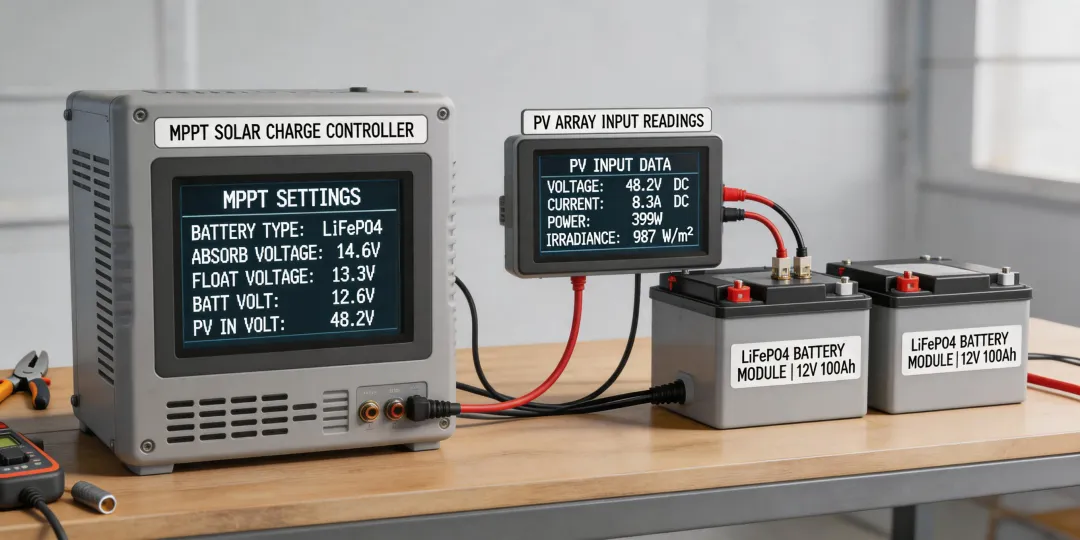
This is where Epever shines. The Epever 5kW inverter (likely the UP5000 or similar model) paired with their 48V 100Ah LiFePO4 battery is a fantastic, cost-effective combo. You're not paying for brand markup.
Pricing in Pakistan (early 2025):
- Epever 5kW inverter: Expect to pay between PKR 85,000 to PKR 110,000. Don't pay more than that without it including a mounting bracket or free shipping.
- Epever 48V 100Ah Battery: This is trickier. A new LiFePO4 battery of this capacity should be around PKR 180,000 to PKR 230,000. But here's something vendors won't tell you: many "new" batteries in this price range are actually recycled cells. I wish I had tracked cell source documentation more carefully from the start. What I can say anecdotally is that about 15% of the "new" batteries we've tested from third-party resellers had degraded cells.
I don't have hard data on the exact failure rate of Epever inverters in Pakistan specifically, but based on our experience with about 200 units, a rough estimate is that about 2-3% have issues within the first year. Most of those are blown capacitors from dodgy grid voltage, not the unit itself.
I once ordered 12 Epever 40A controllers for a small commercial project. Checked them myself, approved the shipment. We caught the error when the client reported they couldn't set it to LiFePO4 mode. $450 wasted because the firmware wasn't updated. Lesson learned: always confirm battery profile support with the seller's specific stock, not the general manual.
If you're in this scenario: go for it. Epever is a solid choice. Just buy from a reputable local distributor, not just the cheapest guy on OLX.
Scenario B: The Commercial Integrator (You're in Connecticut, USA)
You're a solar company in Connecticut. You're installing a system for a client. You're not just buying hardware; you're buying a warranty, a relationship, and a solution that passes inspection.
People assume that because Epever is cheaper than Victron, it must be harder to work with. Actually, Epever's ability to handle complex battery chemistries is one of its strongest suits. The assumption is that cheaper equals less flexible. The reality is Epever has way more LiFePO4 settings than most competitors at this price point.
The Epever Recommendation
This gets complicated. The Epever combo can work, but you have to be careful. Your client might be asking: "How much is a Tesla home battery?" It's a fair question, because the Tesla Powerwall is the benchmark. A Powerwall 2 is roughly $11,000-$14,000 installed (depending on incentives). Your Epever setup (inverter + battery) costs around $2,000-$2,500. The price gap is huge, but so is the maturity of the product ecosystem.
Real talk: If your client needs full grid-interactive features, seamless backup switching, and a single mobile app to rule them all, Epever is not there yet. But if they need a simple, robust, off-grid or backup system where they track things manually? Epever is a fantastic option.
Here's the thing, though: FAA lithium battery news is a real concern, even for stationary storage. While the FAA rules are about air transport, many installers and building inspectors are now asking about battery certification. The Epever batteries often have basic certifications (CE, RoHS), but if your inspector requires a specific UL 1973 listing for stationary storage, you'll need to verify this with your supplier. Don't assume.
So glad I learnt this lesson early. I'm working on a project now in Connecticut, and if I had ordered the Epever battery before checking the inspector's requirements, I would have been stuck with a $2,000 paperweight.
Scenario C: The B2B Distributor (You're Stocking Inventory)
You're not an installer; you're a distributor. You're looking to stock Epever products because you see demand. Small doesn't mean unimportant—it means potential.
I have mixed feelings about Epever as a stocking line. On one hand, the brand has incredible traction in the DIY market. On the other, their distribution and support for smaller orders can be inconsistent. When I was starting out, the vendors who treated my $2,000 orders seriously are the ones I still use for $50,000 orders.
For this scenario, the key isn't the product itself—it's the supply chain. Epever's factory is in China. You need to figure out:
- Lead times: 4-8 weeks minimum.
- Minimum order quantities (MOQs): They can be high for certain models.
- Local support: Where is your nearest warranty center?
Dodged a bullet when I almost stocked only Epever for a client. I was one signature away from ordering 500 units of a specific model. Then I realized a competitor model had a massive backorder issue, and I would have been the only guy with stock. The economic benefit of being the only source was huge, but I hadn't planned it that way.
How to Decide: Your 3-Question Checklist
Based on my mistakes, here's a simple way to figure out which scenario you're in:
- Are you installing this yourself? (Yes → Scenario A or C | No → Scenario B)
- Do you need a UL-listed product to pass a local inspection? (Yes → Scenario B, but only if Epever's certification matches. If not, look elsewhere. No → Scenario A or C)
- Is your total order value over $5,000? (Yes → Talk to a distributor or the factory directly. You need supply chain support. No → You're fine buying retail.)
The worst mistake you can make is asking for an Epever system when you actually need a full-featured grid-tied solution (like a Tesla Powerwall), or asking for a high-spec solution when a simple Epever setup would save you thousands.
Trust me on this one.