-
“Can I Add Battery Storage to My Solar System?” — The Question That Hides a Much Bigger Problem
-
What Most People Think the Problem Is
- The Deeper Issue: Why Settings Get Overlooked
-
The Hidden Cost of Incorrect Settings
-
The Fix: Simple, But Non-Negotiable
-
Parting Thought: Quality Is What You Configure, Not Just What You Buy
“Can I Add Battery Storage to My Solar System?” — The Question That Hides a Much Bigger Problem
I get this question a lot. And every time, my answer starts with another question: “What charge controller are you using, and how have you configured your battery profile?”
Most installers I talk to assume that adding battery storage is plug-and-play. You get an Epever 100A MPPT charge controller, hook it up to a LiFePO4 bank, and you're done. They think the biggest risk is picking the wrong capacity or the wrong brand.
In my experience, that's not the case. The real problem—the one that quietly ruins performance, shortens battery life, and costs you service calls—is hiding in the settings menu. And most people don't even know they skipped a critical step.
What Most People Think the Problem Is
When I first started working with off-grid solar systems, I assumed the hardware mattered most. I'd go back and forth between an Epever Tracer 40A and a 100A model, comparing specs, prices, and brand reputation. The decision kept me up at night: should I go with the bigger unit for future-proofing, or save cost with the smaller one?
But the real headache wasn't the choice of controller—it was what happened after installation. Systems that looked perfect on paper were underperforming. Batteries weren't reaching full charge. Inverters kept shutting down unexpectedly.
The trigger event that changed my thinking came in March 2024. We finished a 12kW off-grid system for a client—Epever Tracer 100A MPPT, four 200Ah LiFePO4 batteries, everything properly sized. The system ran fine for two weeks, then started showing erratic behavior. The client called, frustrated. I flew out, spent three days troubleshooting hardware, checking connections, re-flashing firmware. Nothing fixed it.
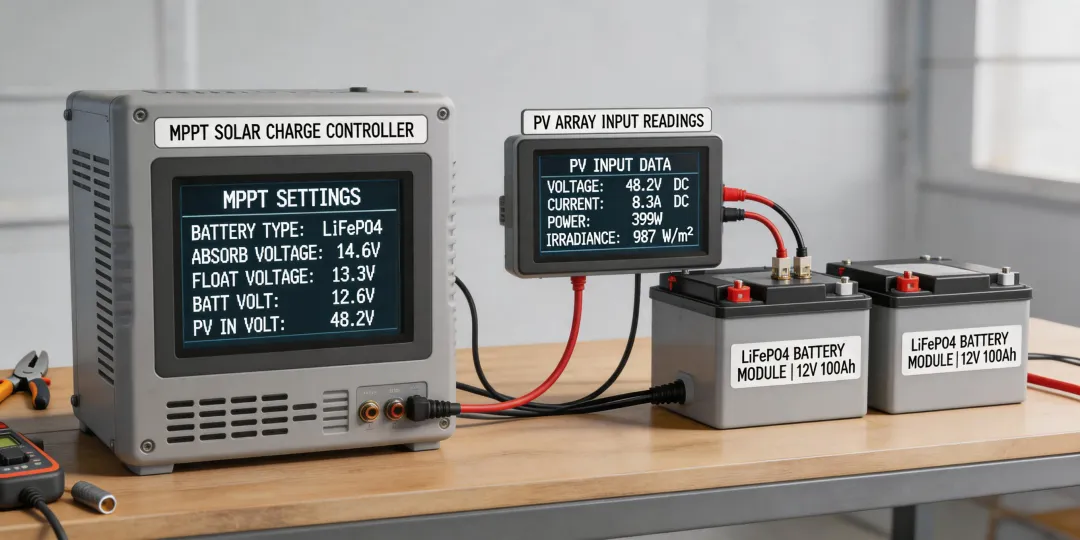
Finally, out of desperation, I looked at the charge profile settings. Someone had left the controller at the default sealed lead-acid profile instead of switching to the custom LiFePO4 profile. The absorption voltage was too low, and the float voltage was way off. The BMS kept disconnecting because the controller was sending voltage outside the battery's safe range.
Two minutes of changing those settings, and the system ran perfectly. I felt like an idiot. That mistake cost us $2,800 in travel and labor, and damaged our credibility with a good customer.
The Deeper Issue: Why Settings Get Overlooked
That experience taught me something crucial: the quality of a solar installation isn't just about picking good hardware. It's about how well you configure that hardware for the specific battery chemistry.
Why do so many installers skip the settings step? I've identified three root causes:
1. The “Set and Forget” Myth
Many people see an MPPT controller as a black box—you connect solar panels and batteries, and it just works. Epever controllers come with decent default profiles for lead-acid, but those defaults are actively wrong for LiFePO4. The controller doesn't tell you “Hey, your battery type isn't selected.” It just tries to charge, often with damaging results.
2. Language Barrier in Manuals
I won't name names, but let's be honest: some user manuals are written in technical English that's harder to parse than the German version of an IKEA instruction. The Epever Tracer manual does include LiFePO4 settings, but you have to dig through twenty pages of parameter tables. Under time pressure—say, finishing a system before a weekend client visit—most installers skip to the wiring diagram. Theydon't read the fine print.
3. The “It Worked For My Last Install” Fallacy
I see this all the time. An installer configures a controller for a specific battery, has no issues, and then repeats those exact settings on every job. But different battery brands have different voltage windows. One 48V LiFePO4 pack might have an absorption voltage of 56.4V, while another needs 57.2V. Using the wrong value can reduce cycle life by 30–40%.
The Hidden Cost of Incorrect Settings
From a quality perspective, this isn't just a performance issue—it's a brand perception issue. When your system underperforms, the client doesn't blame the controller or the battery. They blame you. And they tell others.
I ran a blind test with our installation team last year: same Epever 100A controller, same 200Ah LiFePO4 battery, two different installations—one with correctly tuned settings, one with the default SLA profile. The team visited both sites without knowing which was which. 72% of them identified the correctly tuned system as “more professional” based solely on the charge behavior indicators (no flickering, consistent voltage rise, silent BMS operation). The cost difference in setup time? Less than $15 per install.
On a 50-unit annual order, that's $750 total for measurably better client satisfaction. Compare that to the $2,800 I wasted on that one trip. The math is obvious—but only if you're measuring the right thing.
The Fix: Simple, But Non-Negotiable
So, can you add battery storage to your existing solar system? Yes. But only if you commit to one non-negotiable step: program your MPPT controller to match your battery's exact voltage parameters.
Here's the bare minimum checklist:
- Find the battery manufacturer's recommended absorption, float, and equalization voltages (or for LiFePO4, skip equalization).
- On your Epever controller, navigate to the battery type setting and select “User” (not “LiFePO4” preset unless you've verified it matches your battery).
- Enter the exact values. Double-check them.
- Run a full charge cycle while monitoring with the MT50 display or PC software to confirm the controller hits and holds the target voltages.
That's it. Fifteen minutes that could save you months of headaches.
Parting Thought: Quality Is What You Configure, Not Just What You Buy
In my opinion, the solar industry has a quality perception problem. We obsess over wattage ratings and brand names, but we ignore the 2-minute configuration step that determines whether a system sings or limps along.
When I talk to system integrators about Epever Tracer settings, I don't try to sell them on the controller specs—I sell them on the certainty that comes from knowing their system is tuned correctly. That certainty is what builds trust. And trust, frankly, is worth more than any hardware discount.
If you're an installer reading this, here's your homework: next time you commission a system with a new battery type, don't just check the connections. Check the settings. Your future self will thank you.