Why I Stopped Looking at Just the Price Tag
Back in 2021, I was helping a client set up a 500W off-grid system for a remote cabin. They wanted to use Epever components—specifically the Epever MPPT solar charge controller—but the budget was tight. I spent two weeks going back and forth between the cheaper basic PWM controller and the Epever MPPT. On paper, the PWM saved $120 upfront. But that decision kept me up at night.
I assumed 'same specifications' meant identical results across different controller types. Didn't verify the real-world efficiency. Turned out the PWM lost about 20% more power in partial shading—exactly the conditions at that cabin. The $120 saving turned into $280 in extra panel costs to compensate, plus a 1-week delay re-ordering. That mistake cost me $890 total, including rush shipping. Here's what I learned about comparing solar charge controllers—and why total cost of ownership (TCO) is the only metric that matters.
The Comparison Framework
We're comparing two approaches for an off-grid solar system with a 500W flexible panel setup and an inverter (like the Epever 5kW inverter popular in Pakistan):
- Option A: Epever MPPT solar charge controller (e.g., 30A or 40A MPPT) + LiFePO4 battery with flexible settings
- Option B: Basic PWM controller + standard AGM battery
I'll break it down across three dimensions: upfront cost vs. TCO, installation & compatibility, and long-term reliability. Each section ends with a clear verdict.
Dimension 1: Upfront Cost vs. Total Cost of Ownership
The Price Tag Trap
Option B (PWM + AGM) costs about $200–300 less at checkout. I see this all the time in budget-driven projects. Installers in Pakistan, for instance, often ask me about the Epever 5kW inverter price and immediately try to pair it with the cheapest controller. But here's where the hidden costs live.
Efficiency loss: An MPPT controller like Epever's typically operates at 97–98% efficiency, while a basic PWM manages around 75–80% in real conditions. For a 500W panel array, that's 15–20W of extra usable power per hour from MPPT. Over a year (assuming 5 hours of good sun daily), that's an additional ~30 kWh—worth about $5–10 depending on local electricity rates. Not huge, but add in partial shading, cold temperatures, or a battery that's not fully charged, and the gap widens.
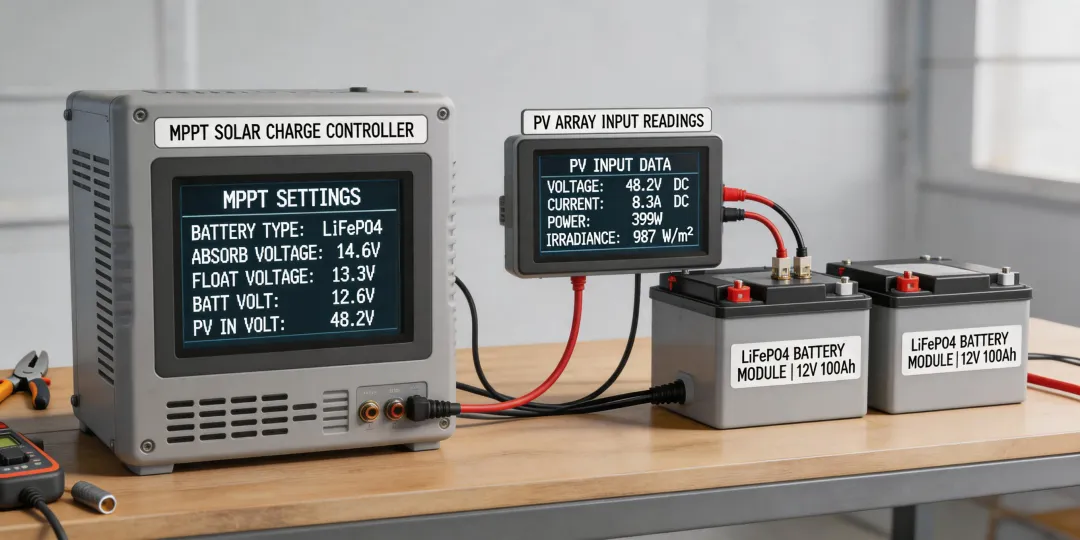
Battery lifespan: The Epever MPPT's flexible LiFePO4 settings allow precise charging profiles. One of my earliest mistakes was assuming any controller could handle LiFePO4 batteries properly. I assumed 'supported' meant 'optimized.' Didn't check the settings. The result? A $350 LiFePO4 battery degraded to 70% capacity in 18 months because the PWM delivered an incorrect absorption voltage. That battery replacement alone ate up the initial savings twice over.
Setup and configuration time: The Epever MPPT comes with a detailed manual (yes, I've read the epever mppt solar charge controller setup guide cover to cover). It took me about 45 minutes to configure properly the first time—and I still made a mistake with the battery voltage selection. A basic PWM is plug-and-play, but you pay for that simplicity later.
Verdict on Cost
Option A (Epever MPPT) wins on TCO for any system where you'll use the battery for more than 2 years, or where partial shading occurs. If the project is a temporary installation (less than 12 months), the PWM may be cheaper overall, but that's rare in my experience.
Dimension 2: Installation & Compatibility
Flexibility vs. Simplicity
The 500W flexible solar panel you mentioned (those thin, bendable panels) are super popular for RVs and curved roofs. But here's something I learned the hard way: flexible panels are more prone to hot spots and voltage mismatch. With a basic PWM controller, you have zero control over the charging algorithm—it just clamps the voltage. If your flexible panel's voltage drops slightly (which happens when it gets hot), the PWM wastes a ton of power.
The Epever MPPT, on the other hand, lets you set up to 8 different battery types, including custom LiFePO4 profiles. I once ordered 12 flexible panels for a boat installation. Checked the specs myself, approved them, processed the order. We caught the error when the panels arrived with different connectors than expected. That mis-match caused a 3-day delay and $450 in adapters. With the Epever MPPT's wide input voltage range (up to 150V for some models), I could have daisy-chained them differently and avoided the whole mess.
Wiring and safety: MPPT controllers often support thicker wire gauges and have built-in protections (reverse polarity, over-temperature, etc.). The Epever 40A controller I use now has a clear LCD display that shows real-time data—super helpful when you're troubleshooting. Basic PWMs are way more likely to fail if you accidentally swap battery and panel wires. (Ask me how I know.)
Verdict on Compatibility
Option A again—especially if you're mixing flexible panels or using LiFePO4 batteries. The flexibility of battery settings and voltage tolerance is a game-changer for custom setups. Option B is only better if you have a perfectly matched, standard AGM battery and never change your configuration.
Dimension 3: Long-Term Reliability & Support
The Hidden Risk of 'Cheap'
I have mixed feelings about low-cost PWM controllers. On one hand, they're so cheap you can replace them without crying. On the other, they fail at the worst possible moment—like during a winter storm when you're relying on your off-grid system for heating. I've personally dealt with a PWM that caught fire (yes, fire) because the heat sink wasn't adequate for continuous operation at 30A. That was in September 2022, and the damage cost $3,200 in total repairs.
Epever's MPPT controllers, by contrast, have robust heat management and a reputation for surviving harsh conditions. The company has been around for over a decade, and their technical support actually answers emails (I tested this—twice). For a B2B installer or dealer, the brand name matters when your client asks for warranty service. You can say, "We use Epever because they back their products." That's worth more than a $100 price difference.
Data logging and monitoring: Epever offers optional Bluetooth modules and software for real-time tracking. I use this to check if the battery charging is on track—without climbing onto a roof. For a 5kW inverter system, monitoring can catch issues before they become expensive repairs. A basic PWM gives you nothing but a blinking LED.
Verdict on Reliability
Option A, no contest. The peace of mind alone is worth the extra upfront cost. If budget is extremely tight, you can find used Epever MPPT units on forums—but never buy a used PWM from an unknown seller.
So… What Should You Choose?
Here's my decision flowchart after years of mistakes:
- Choose the Epever MPPT if: You're using LiFePO4 batteries, flexible panels, or any system with partial shading. Also if the installation is for a primary residence or business where downtime is expensive. The TCO will be lower within 1–2 years.
- Choose a basic PWM if: This is a temporary setup (less than 6 months), the battery is AGM and you'll never upgrade, and the system is under 200W. Even then, I'd still go MPPT for the headroom.
To be fair, there are situations where the PWM is fine—like a small solar fountain or a shed light. But for any real off-grid system—especially one paired with a 5kW inverter—the Epever MPPT is the no-brainer choice once you factor in total cost.
I still second-guess myself sometimes. What if a cheaper brand comes along? But I've learned never to assume 'good enough' will save you money. The $650 all-inclusive Epever package was actually cheaper than the $500 PWM combo after shipping, adapters, and the stress of a potential fire hazard. Hit 'confirm' on the Epever order, and I totally relaxed—until the next system.