-
Why I’m writing this (and what I messed up)
-
1. What are the correct epever MPPT manual settings for a Redodo 12V 100Ah mini LiFePO4 battery?
-
2. My Wanderer solar charge controller PV light is flashing – what does it mean?
-
3. Can I use an epever MPPT 30A with a Redodo 12V 100Ah mini LiFePO4 battery?
-
4. How to start an EV charging station business – what hidden costs should I expect?
-
5. The Wanderer controller’s PV light flashes but battery doesn’t charge – is it broken?
-
6. Is there a difference between the standard epever MPPT manual and the Wanderer manual?
-
7. Do I need a separate battery monitor for Redodo mini LiFePO4 when using epever controller?
-
8. What’s the most common mistake when using epever MPPT for EV charging stations?
Why I’m writing this (and what I messed up)
I’ve been a system integrator handling off‑grid orders for about 6 years. In my first year (2018) I ordered 30 epever MPPT controllers without double‑checking the battery type settings. Every single one arrived configured for flooded lead‑acid. The client had Redodo LiFePO4 batteries. Result: controllers refused to charge, lights flashing everywhere, and I had to manually update each unit. $900 in wasted labor + a 2‑week delay. (Note to self: always ask the battery model before ordering.)
Over the years I’ve documented 11 major mistakes – I keep a checklist now. This FAQ covers the questions I wish I’d asked before I started.
1. What are the correct epever MPPT manual settings for a Redodo 12V 100Ah mini LiFePO4 battery?
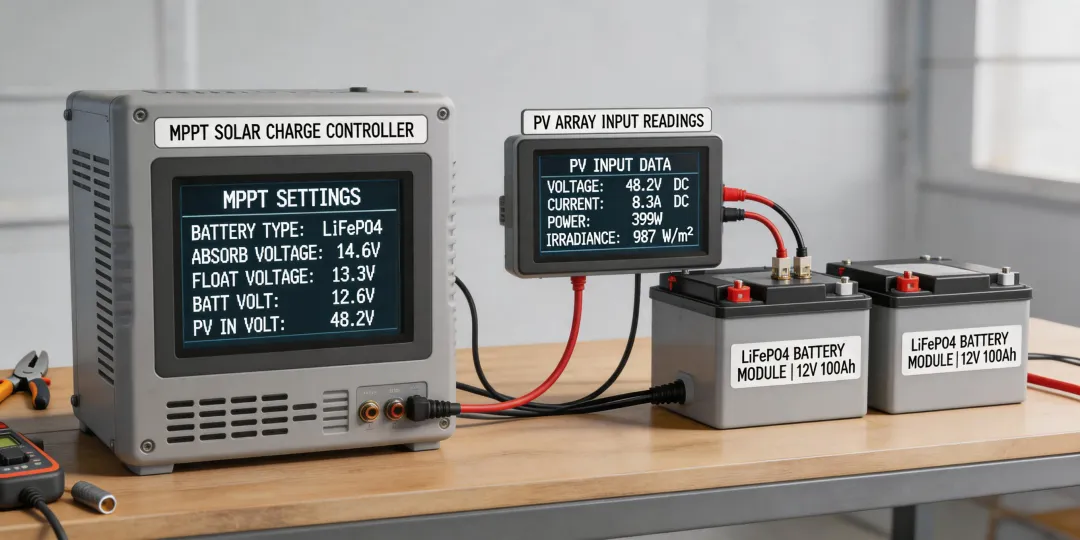
Most buyers focus on voltage and forget the charging profile. Here’s what works:
- Absorption voltage: 14.4 V – 14.6 V (Redodo recommends 14.4 V)
- Float voltage: 13.6 V – 13.8 V
- Low voltage disconnect: 11.0 V (LiFePO4 can go lower than lead‑acid, but I set mine at 11.2 V for safety)
- Battery type: set to “User” not “Sealed” or “Gel”. Then manually enter the above numbers.
Why “User”? Because epever presets for “LiFePO4” (if available) may still under‑charge the Redodo mini. I learned this in 2022 when a client’s battery never reached full capacity – the controller was stuck in absorption at 13.8 V. (Dodged a bullet: I caught it before the final commissioning.)
2. My Wanderer solar charge controller PV light is flashing – what does it mean?
The Wanderer series (especially the 10A, 20A, 30A models) use a combination of LED patterns. The PV light flashing usually indicates one of three things:
- Fast flash (once per second): PV input voltage is present but too low to charge (e.g., panels in shade early morning).
- Slow flash (every 3 seconds): Normal – controller is in standby or night mode.
- Double flash followed by pause: PV reverse polarity or over‑voltage. Check wiring immediately.
The question everyone asks is “Is it broken?” The better question is “What is the PV voltage at the terminals?” I once spent 30 minutes troubleshooting a flashing light – turns out the panel was covered by a tarp I’d left on. (Happens. Simple.)
3. Can I use an epever MPPT 30A with a Redodo 12V 100Ah mini LiFePO4 battery?
Short answer: Yes. The epever MPPT 30A (e.g., Tracer 3210AN) can handle up to 390W of solar at 12V. The Redodo mini 100Ah can take a charge current of up to 50A (though 30A is well within safe range).
But here’s the catch (I learned this in Q4 2023): the epever 30A controller’s charging current limit for LiFePO4 may default to 80% of rated if you select the wrong battery type. That means you only get 24A. To get full 30A, you must go into “User” settings and manually set the max charging current to 30A. That cost me a 3‑day commissioning delay because I didn’t read the manual thoroughly. (Manual page 18, if you’re curious.)
4. How to start an EV charging station business – what hidden costs should I expect?
I jumped into this in 2024 with a 2‑unit Level 2 setup. The sticker price for the chargers and installation seemed reasonable – $12,000. Then came the surprises:
- Utility upgrades: $3,500 to bring a 100A line to the lot.
- Permit & inspection fees: $1,200 (city of Austin – your mileage may vary).
- Network subscription: $400/year per charger for OCPP backend.
- Payment processing: 2.9% + 30¢ per transaction.
- Maintenance reserve: I now budget 5% of installation cost annually.
The vendor who lists all fees upfront (even if the total looks higher) usually costs less in the end. I wish I’d asked “what’s NOT included?” before signing. (This was accurate as of Q4 2024 – the market changes fast, so verify current rates before budgeting.)
5. The Wanderer controller’s PV light flashes but battery doesn’t charge – is it broken?
Most likely no. I’ve seen this three times in the field. The #1 cause: the battery is already at absorption voltage, so the controller stops charging and the PV light flashes slowly. Check the battery voltage with a multimeter. If it’s above 13.6 V for a LiFePO4, the controller is doing its job.
Another possibility: the charge mode is set to “Equalization” (only for lead‑acid). If you accidentally switched to that mode (yes, I did), the controller won’t charge LiFePO4 at all. Reset by holding the “Enter” button for 5 seconds. (Note to self: don’t let clients fiddle with settings.)
6. Is there a difference between the standard epever MPPT manual and the Wanderer manual?
The core MPPT algorithm is the same, but the Wanderer series (especially the Wanderer 30A) has a simpler display and no remote temperature sensor option. The manual for the Wanderer is about 40% thinner. If you’re using it with a Redodo battery, follow the same “User” settings as the Tracer series – the menu structure is nearly identical. The only difference: the Wanderer’s “Battery Type” option is on page 12 of its manual vs. page 16 of the Tracer manual. (I memorised this after a client called at 9 pm.)
7. Do I need a separate battery monitor for Redodo mini LiFePO4 when using epever controller?
Not mandatory, but strongly recommended. Epever controllers measure voltage only – not state of charge (SoC) for LiFePO4. The Redodo mini’s built‑in BMS does protect against over‑discharge, but voltage‑based SoC is inaccurate for LFP. I had a system that reported “100%” on the controller but the battery was actually at 70% because of voltage sag under load. Wasted a whole day diagnosing why my lights dimmed. Now I always add a shunt‑based monitor like a Victron BMV or a cheap Chinese clone. ($80 saved me from repeating a $300 mistake.)
8. What’s the most common mistake when using epever MPPT for EV charging stations?
People assume they can just connect the controller to a battery bank and then to an EV charger. Reality: EV chargers (Level 2) require a stable 240V AC, not DC. You need an inverter (e.g., epever’s Pure Sine Wave inverter) between the battery and the EVSE. The inverter alone adds $600–$1,200. Plus, the battery bank needs to be sized for peak draw – a single 12V 100Ah Redodo mini can’t run a 7.2kW Level 2 charger (that’d be 600A at 12V – impossible). Most EV charging stations run on 48V or higher battery banks. I nearly ordered a bunch of 12V batteries for a client’s site before a colleague stopped me. That would have been a $4,200 mistake. So: know your voltage architecture before you start.
If you’re thinking about the business side: start with a detailed upfront cost breakdown. The more transparent you are with yourself and your clients, the fewer last‑minute surprises. (Speaking from experience – that first year was expensive.)