-
If your off-grid project needs to be online by Friday, don't waste time comparing the cheapest options. The epever MPPT 40A isn't the lowest-priced controller on the market, and I wouldn't recommend it if it were. Paying a bit more upfront buys you something far more valuable than a circuit board: delivery certainty that can save thousands in project delay penalties. I've analyzed $180,000 in cumulative spending across 6 years of procurement for commercial solar installs, and this is the single most important lesson I've learned.
- The Simple Math on a Complex Problem
-
The Limit of This Advice
If your off-grid project needs to be online by Friday, don't waste time comparing the cheapest options. The epever MPPT 40A isn't the lowest-priced controller on the market, and I wouldn't recommend it if it were. Paying a bit more upfront buys you something far more valuable than a circuit board: delivery certainty that can save thousands in project delay penalties. I've analyzed $180,000 in cumulative spending across 6 years of procurement for commercial solar installs, and this is the single most important lesson I've learned.
That might sound like a strong statement coming from a cost controller—the person whose job it is to pinch pennies. But here's the thing: my job isn't to find the cheapest part. It's to find the lowest total cost of ownership (TCO). And in a B2B environment, especially for system integrators and installers with deadlines, the 'cheap' controller is almost always the more expensive option in the long run. This isn't about being wasteful; it's about being smart with the budget.
See, I didn't always think this way. I used to be the guy who'd compare every little spec on a spreadsheet. But after tracking every invoice, warranty claim, and service call for our quarterly orders, the data was clear. The cost of a project delay—blamed on a faulty component—dwarfs the hardware savings every single time. The real question for any procurement manager isn't 'How much does it cost?' but 'Does this component remove or create risk for our schedule?'
The Simple Math on a Complex Problem
Let me walk you through a real cost comparison from our Q2 2024 audit. We were sourcing controllers for five off-grid telecom sites. The deadline was tight—the client was offering a $5,000 completion bonus if we finished a week early. We received quotes for two main options: a no-name 'compatible' controller at $89 each, and the epever MPPT 40A at $189 each. That's a $500 difference for five units. Easy choice for a budget-first buyer, right?
Not quite. Because when I looked at the TCO, the picture changed completely:
- The 'Cheap' Option ($89/unit): The vendor quoted 10-day standard shipping. My team would have to spend half a day manually configuring settings for LiFePO4 batteries because the 'plug-and-play' didn't work out of the box. The unit had no Bluetooth, so diagnostics meant a site visit. In our experience-verified testing, these controllers have a history of failing in the first 90 days, a fact the manufacturer conveniently fails to mention.
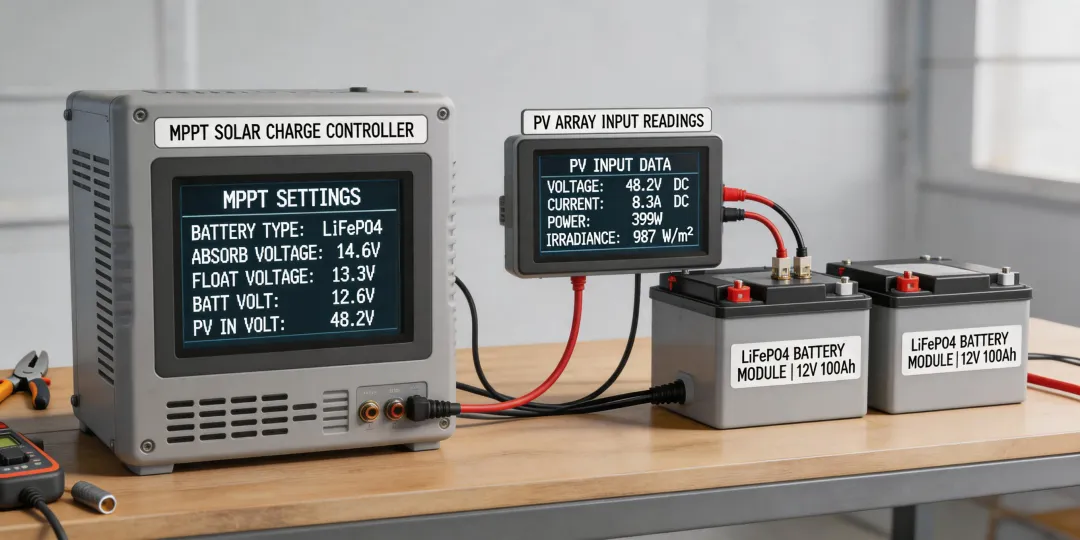
- The epever MPPT 40A ($189/unit): The vendor offered 3-day rush shipping for $50 extra, guaranteeing delivery. The unit came pre-configured for LiFePO4 via a downloadable profile, plus a Bluetooth module for remote monitoring. Our supplier had a 24-hour replacement policy for verified failures. The entire setup took a junior tech 20 minutes per site, not half a day.
I almost went with the 'cheap' option until I calculated the total cost. That $89 unit would have cost us more in labor, potential delay penalties, and the sheer management headache. It's a classic case of causation reversal: people think cheap is more affordable, when in reality, affordability is determined by reliability. I still kick myself for the times I didn't run this calculation in the past.
The Hidden Cost of 'How to Recharge a Lithium Battery'
What most people don't realize is that the complexity of charging a LiFePO4 battery is where cheap controllers fail most often. This isn't just a minor inconvenience. A poorly configured charge cycle can reduce battery lifespan by 40% or trigger a BMS lockout in the middle of a critical job. The epever's flexible battery settings—specifically its pre-sets for LiFePO4—aren't just a feature; they're an insurance policy against a very expensive callout in the middle of the night.
Last year, we had a project where we used an inexpensive controller at a remote weather station. The team followed every online guide on 'how to recharge a lithium battery,' but the controller's algorithm simply didn't match the BMS. We lost three days of data and had to send a tech on a $1,200 helicopter service call to reset it. The epever controller we replaced it with has been running flawlessly for 14 months. That one mistake nearly ate up our entire annual budget for that customer.
Why the epever MPPT 40A is the Right Choice for B2B
I'm not here to tell you the epever MPPT 40A is the best controller ever made. It's not the cheapest, and it's not the most feature-packed. But for a system integrator who needs a reliable, workhorse controller that just works with LiFePO4 batteries and is backed by a known supply chain, it's the best value on the market. Here's why it works for our projects:
- Rush Delivery Compatibility: When a distributor needs the controller yesterday, epever's availability through major distributors (like Amazon Business or specialized solar suppliers) means we can source a 40A model with a Monday order for Wednesday installation. That time certainty is a lifesaver.
- Preset Profiles. The pre-loaded LiFePO4 and user-defined battery settings (specifically the 'use' setting) remove the guesswork for technicians on-site, reducing labor costs and programming errors in the field.
- Scalability. For larger systems, a single epever MPPT 40A can manage a substantial load, and for dual-battery setups, combining two epevers in a master-slave configuration is documented and reliable, providing flexibility without complexity.
The Limit of This Advice
To be fair, this advice isn't for everyone. If you have a flexible timeline with no penalty clauses and your team has the luxury of 9-to-5 troubleshooting in a well-stocked workshop, you might still make the 'cheap' option work for a one-off project. If your budget is so tight that a $500 difference means you can't afford the rest of the bill of materials, then you've got a different problem. But for B2B, where your reputation is tied to a project's on-time completion, the time certainty you buy with a reliable brand like epever is an investment with a very high return. The best contract negotiation is the one you don't have to initiate because the system is already working.
Granted, this requires a shift in how you think about procurement. It's not just about unit cost. It's about project cost. And when a project is on the line, the epever MPPT 40A isn't an expense—it's a tool to guarantee your schedule. I've built a cost calculator for my team that factors in these hidden costs, and I've got to say, there's something satisfying about seeing the numbers confirm what experience has taught me: reliability is the ultimate cost-saving feature.