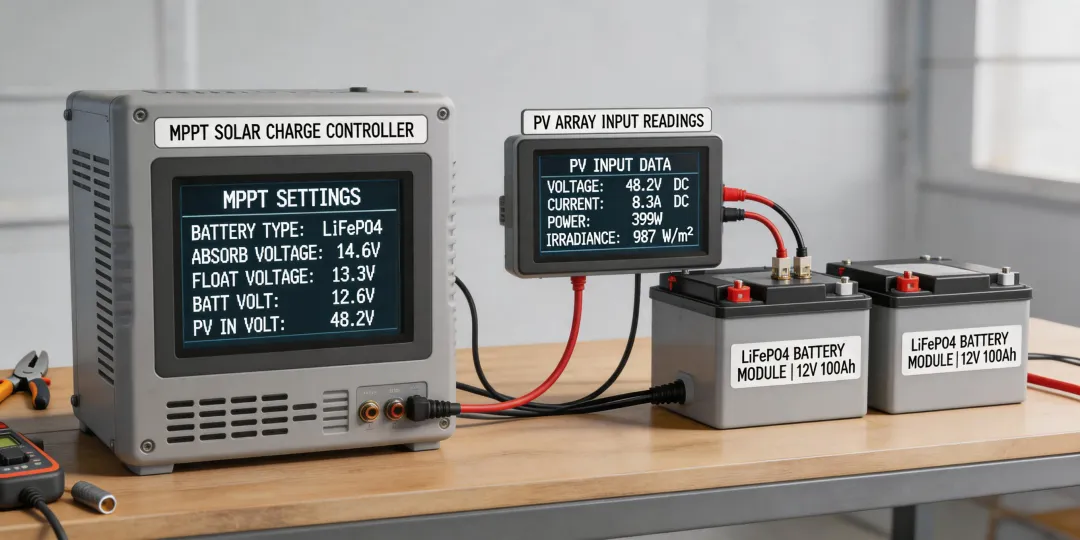
When you need an Epever MPPT 20A or a 30A solar charge controller fast, paying an extra $50-100 for guaranteed delivery isn't an upsell—it's the cheapest insurance you'll ever buy. I say this after coordinating over 200 emergency shipments for system integrators and installers. I've seen the $400 invoice for rush shipping, and I've also seen the $15,000 penalty for missing a project deadline. The first one stings. The second one ends careers.
In my role coordinating logistics for a renewable energy distributor, I'm the guy who gets the 3 AM call. The one where an installer needs an Epever 100A controller by the afternoon because the one they had on the shelf? It was dead on arrival. Or worse—they just realized their job site is missing a critical solar inverter rack, and the client's site prep is done.
This isn't about saving a few bucks. It's about understanding the true cost of uncertainty.
The Hidden Math of Emergency Buying
Let's break down the real calculation. Most people think, 'I'll just order the cheapest Epever controller I can find, and if it's late, I'll figure it out.' Figure it out. Those three words are the most expensive phrase in project management.
Here's a real scenario from March 2024. A client called at 9 AM needing two Epever 30A MPPT solar charge controllers for an off-grid cabin installation that was supposed to be live by noon the next day. Their normal supplier had a 5-day turnaround. They had 27 hours.
The numbers: The controllers themselves were $185 each. Standard ground shipping from their regular vendor: $12. But they couldn't wait 5 days. They found a supplier who had them in stock locally. That local supplier charged a 40% premium on the controllers AND $80 for same-day courier delivery. Total cost: $598, versus $382 if they'd planned ahead.
They paid $216 more. Sounds painful, right? But the alternative was missing the deadline. That contract had a $2,000 late-completion penalty for every day beyond the agreed date. And the client? They wouldn't use that installer again. The lost future business was probably worth $10,000+. So $216 saved a $12,000+ relationship. That's a 5,500% return on investment.
The question isn't, 'Can I afford the rush fee?' The question is, 'Can I afford the penalty for being wrong?'
What Goes Wrong When You Try to Save at the Last Minute
I've seen three main ways people try to cheap out on time-critical Epever orders. All of them backfire.
- The 'I'll find a cheaper vendor' trap. You search for the lowest price on an epever MPPT 20a. You find a listing for $50 less. You order it. But you don't check the return policy or the inventory status. It was drop-shipped from a warehouse 2,000 miles away. The 'in stock' was a lie. Real cost: $50 saved, three days lost, project delayed.
- The used market gamble. You find a used solar inverter rack or a 'like new' Epever 40a controller. Half price. You buy it, install it, and it fails on day two. Your labor cost is already sunk. Ripping it out and replacing it costs more than buying new in the first place. And you're twice as late.
- The partial order mistake. You're in a panic. You order the charge controller but forget you need the specific battery temperature sensor for your LiFePO4 setup. That sensor costs $15. Ground shipping adds another $10. Rookie mistake, but it happens constantly. (I should add: we didn't have a formal verification checklist for years. The third time we got an incomplete order, I finally made one. Should have done it after the first time.)
How I Learned the Value of Guaranteed Delivery
Honestly, it wasn't the theoretical math that convinced me. It was getting burned by my own frugality.
In 2023, my company lost a $24,000 contract. The client needed a full off-grid system including Epever inverters and battery banks. Delivery was needed in 6 days. My job was to source the parts. I wanted to save our client some money. I found a distributor who was $600 cheaper on the total package. Their delivery window was '5-7 business days.' It was a coin flip.
I took the gamble. The parts didn't arrive until day 8. The client had to postpone their scheduled installation crew. The $600 savings cost my company a $24,000 sale—and the $2,500 in revenue we would have made on that job. The owner was not happy. That's when we implemented our 'Guaranteed Transit' policy: for any project with a hard deadline, we only use vendors who can guarantee a delivery date in writing, even if it costs more.
There's something satisfying about a perfectly executed emergency order. After all the stress and coordination, seeing it delivered on time and correct—that's the payoff. But it only happens when you accept the cost of certainty upfront.
Portable Power Station vs Solar Generator: A Relevant Distraction?
People often ask me whether they should buy a portable power station vs solar generator when they're in a rush. Their thinking is usually: 'A power station is simpler. I can just buy it at a big box store. No need to wait for a custom solar generator.'
I have mixed feelings about that logic. On one hand, yes, a portable power station like a Jackery or Bluetti is plug-and-play. You can literally buy it off the shelf in Clearwater, Florida, and maybe even get help with the ev charger installation at a local shop. The time certainty is high.
But on the other hand, they are often not a true replacement for a custom solar generator that uses quality components like an Epever MPPT controller. A power station typically has a built-in, non-upgradeable MPPT. If it fails, you're stuck. With a real solar generator (solar panel + a quality MPPT charge controller + battery + inverter), you can fix and upgrade each part. The time savings of a portable station can be a trap if it means sacrificing long-term reliability and scalability.
For a quick emergency, the power station wins on time. For a real off-grid system you want to last for a decade, Epever is the play. But you have to plan for it.
When It's Okay to Ignore This Advice
Look, I'm not saying you should always pay extra for rush shipping on every single Epever 20A controller you buy. That would be stupid. Here's where the 'pay for certainty' rule applies and where it doesn't.
APPLIES:
- When there's a documented penalty for lateness.
- When the project has a fixed end date (like a grant deadline or a vacation rental opening).
- When you have no backup inventory. If you only have one charge controller and it fails, your project stops.
DOESN'T APPLY:
- When you're stocking your warehouse with routine inventory. Standard delivery is fine here.
- When you have a local supplier with a proven track record. If you know the guy at the electrical supply house, you don't need to pay for a guarantee on his word.
- When the project is purely speculative. If you're just building a system for a client who hasn't committed, you don't need to burn money on speed.
Bottom line: Know your project's true time sensitivity. The cost of a rushed Epever MPPT 30a controller isn't really $200. It's the peace of mind that your project will finish on time. And in this business, peace of mind is worth every penny.