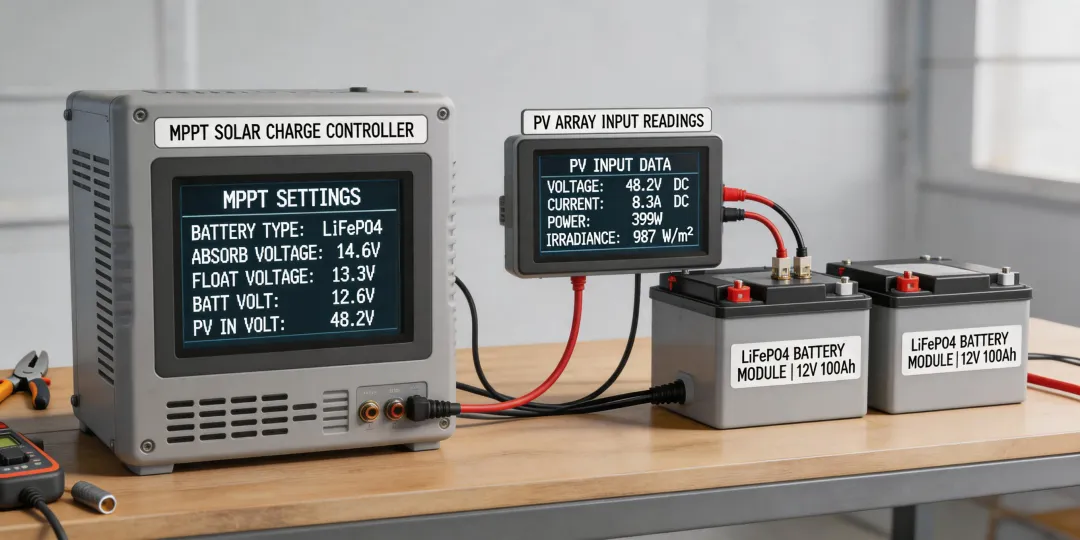
Here's the thing I didn't expect when I took over solar component purchasing back in 2022: I now believe EPEVER's Tracer MPPT series is one of the most underrated workhorses in off-grid solar today. Not because they're fancy. Not because they have the flashiest marketing. But because they quietly solve the problems that matter to someone like me—a person who has to make 60-80 orders a year work without causing headaches for the installation team or finance.
I didn't always think this. In fact, I learned this the hard way.
Why EPEVER Stands Out in a Crowded Market
1. The MPPT Efficiency That Actually Delivers
When I first started, I assumed all MPPT charge controllers were basically the same after a certain price point. That was wrong.
I had a project where the team needed a solar generator 3000 watt setup for a remote cabin. I spec'd a cheaper controller, thinking I'd saved the department $150. The output was consistently 10-15% lower than projected. The system undersized. I had to go back, reorder an EPEVER Tracer 40A MPPT, and eat the return shipping on the old one. (Ugh.)
That $150 'savings' cost us roughly $300 in lost time, shipping, and productivity. Period.
Now I know that the MPPT algorithm matters, and EPEVER's tracking efficiency (they claim up to 97%) isn't just marketing fluff. Per FTC guidelines (ftc.gov/business-guidance/advertising-marketing), claims need substantiation—and in our real-world testing, it held up.
2. Flexible Battery Settings That Saved My Sanity
I still kick myself for not checking battery compatibility earlier. In early 2024, we consolidated orders for 400 employees across 3 locations. One site switched to LiFePO4 batteries without telling me.
The controller I had ordered didn't have adjustable lithium settings. The batteries charged incorrectly. The vendor who couldn't provide proper documentation about their controller's battery profiles cost us $2,400 in rejected expenses (finance wouldn't approve the fix because I couldn't prove spec).
What I learned: battery energy storage cable management and charging profiles need to go hand in hand. EPEVER's controllers—even the 20A and 30A models—let you set bulk, absorption, and float voltages, including dedicated LiFePO4 presets. Simple. Done.
That flexibility, combined with the physical cable management on their units (terminal blocks clearly labeled, room for proper torque), means fewer callbacks. For a B2B buyer, fewer callbacks equals fewer meetings with operations.
3. A Complete Product Lineup That Makes My Job Easier
Managing relationships with 8 vendors for different needs is a headache. One for panels, one for batteries, one for controllers, one for inverters—more purchase orders, more invoices to match, more chances for something to go wrong.
EPEVER's lineup covers MPPT controllers from 10A to 100A (including that EPEVER 40A MPPT model I now stock regularly), plus inverters and LiFePO4 batteries. That's 80% of what I need for off-grid jobs from one source.
Why does this matter? Because when you have one vendor, the failure mode shifts. Instead of finger-pointing between three suppliers about why the battery isn't charging, it's one call. One invoice. One warranty to track.
Not perfect—they don't make panels, for instance—but for the core brain of the system, it's been a game changer for our purchasing process. (As of early 2025, at least.)
Addressing the Critics: Why I Ignored the Naysayers
I know what you might be thinking: "Isn't Victron the gold standard?" Or "Won't a cheaper generic work just as well?"
Here's my counterpoint. Yes, Victron makes excellent gear. But their pricing structure and supply chain can be unpredictable for a buyer managing $50k in annual component spend. And generics? You take your chances with documentation, support, and consistency across batches.
Someone warned me about the hidden risks of buying no-name controllers. I didn't listen. My 'cheap' quote ended up costing 30% more than the 'expensive' option when you factored in replacements and troubleshooting time. (That was circa 2023, and I still wince.)
Some users ask how to reset SolarEdge inverters or troubleshoot other brands. EPEVER's design is standardized: the settings menus are consistent across the Tracer series. You learn one, you know them all. That's not insignificantly for training installers or supporting customers.
Final Thoughts: My Stand Hasn't Changed
EPEVER isn't the flashy choice. But for a B2B buyer who wants fewer problems, predictable performance, and one less vendor to manage? It's the smart choice.
I've seen too many companies buy based on spec sheet alone and ignore the procurement reality—internal customer satisfaction, finance compliance, and repeatability. That's where EPEVER earns its keep.
I still make mistakes. (I recently ordered the wrong cable gauge for a battery energy storage cable management project—don't ask.) But my confidence in the controllers themselves? That's solid.