It was a Tuesday in November when the order arrived on my desk. A 12V off-grid system for a residential retrofit in Glasgow. Nothing unusual there. We get a lot of solar battery storage Glasgow requests this time of year—people planning for the darker months. But the spec sheet had a problem I see more often than I'd like.
I'm the quality compliance manager at an off-grid solar equipment company. I review every system before it ships—roughly 200 systems a year. I've rejected about 9% of first deliveries in 2024, and the most common reason isn't the panel or the charge controller. It's the battery.
It started with a spec sheet that didn't add up
The system called for a 200Ah AGM battery in a daily-discharge setup. The customer's consumption pattern showed they would routinely take the battery down to around 30% state of charge. Maybe lower in January. The EPEver MPPT 40A charge controller was correct for the array size. The wiring looked fine. But the battery was wrong.
I didn't say "AGM is bad." I said "this duty cycle is bad for AGM." A lead-acid battery is usually happiest when you're taking 30-50% of its capacity and then recharging fully. If you cycle an AGM deeper than that, its cycle life drops hard. The math is brutal: a decent AGM might give 600 cycles at 50% depth of discharge. The same bank at 70% DoD can fall below 400 cycles. That's barely three years in a system designed for ten.
In my experience, this is where a lot of solar battery storage Glasgow installers get stuck. They see the AGM price tag and stop there. But the cost per cycle tells a different story. LiFePO4 is more expensive upfront, yes. But with thousands of cycles at 80% DoD, it often ends up cheaper over the life of the system. That's not a marketing line—that's arithmetic.
So I flagged the order. The project manager asked if we could just ship it and let the customer "upgrade later." I've done that before, in 2019, and it cost us a redo. I was not doing that again.
The turning point: LiFePO4 vs AGM battery trade-offs
The customer had chosen the AGM because a supplier down the road said it would "do the same job" for less money. I needed to explain the difference without sounding like I was talking down to them. I've learned that people in Glasgow—and everywhere else—don't want a lecture. They want enough detail to feel confident making the call.
So I put it in terms of the discharge profile:
- AGM: lower upfront cost, heavy, and prefers gentle cycling. With a typical lead-acid bank, you don't want to plan on using more than 50% of the rated capacity.
- LiFePO4: higher upfront cost, lighter, and accepts deeper cycling. LiFePO4 can often be cycled to 80-90% DoD without the same cycle-life penalty.
There are exceptions. If the customer only needed backup for rare outages, AGM might have made sense. If the system was going to run every single day, LiFePO4 was the better fit. This was a home with a heat pump, an EV, and a battery that would work hard all winter. It was not a rare-outage system.
The client also asked about the federal credit for EV charger installations—more on that in a minute. But the battery conversation caused a bit of a pause. The quote from the other installer was lower, and the customer wanted to understand why we were recommending the more expensive battery.
That's when I opened the EPEver MPPT 40A manual and showed them something that surprised me.
What the EPEver MPPT 40A manual said about charging profiles
I'm not a battery chemist. I can't speak to the internal physics of lithium iron phosphate versus lead-acid in the same way a cell engineer can. What I can tell you from a system design and quality control perspective is how important it is to set the charging algorithm correctly.
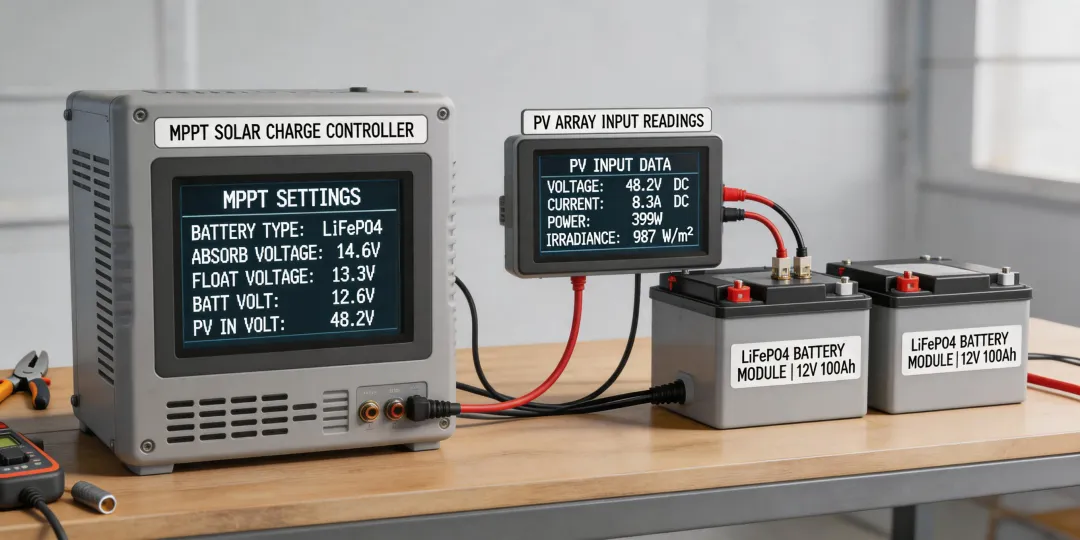
The EPEver MPPT 40A manual has a battery type setting that matters a lot here. In the "User" setting, you can change the absorb voltage, float voltage, and equalization voltage manually. For a 12V LiFePO4 bank, we set the absorb voltage to 14.4V and float to 13.8V as a starting point. But we always check the battery manufacturer's spec before locking that in. Some LiFePO4 cells want 14.2V, some want 14.6V. The manual can't tell you which cell your customer bought—it just gives you the range.
This is also where a lot of AGM installations go wrong. People assume the default lead-acid profile works for every battery. It doesn't. If you leave equalization on for a LiFePO4 bank, you can damage the cells. That one mistake has caused more than one call to our support line.
In my opinion, the EPEver controller is well suited for this. It has a 40A rating that matched the array, and the ability to configure the charge stages made the LiFePO4 swap straightforward. But the controller doesn't know what you're doing. It follows the settings you enter. That's why the manual is not optional reading.
The side question that reminded me of my boundaries
During the handover call, the customer asked about the federal credit for EV charger installations. They had seen something online about a credit and wanted to know if this system's wiring would count.
I had to stop there. I'm not a tax advisor, so I can't speak to eligibility. What I can tell you from a hardware perspective is that the EV charger needs a dedicated circuit and an appropriate breaker, and the battery storage system should be sized so it doesn't get overloaded when the charger kicks in. But the credit itself? That's a conversation for someone with a tax background.
For what it's worth, I know the U.S. federal credit for EV charger installations is usually tied to IRS Form 8911. Through 2032, eligible residential installations can get 30% of the cost, up to $1,000. But that is not an offer of tax advice, and it may change. And since this job was in Scotland, it wasn't even the right jurisdiction. I said so.
That moment of "I don't know" ended up earning more trust than any lengthy spec explanation. The vendor who says "this isn't our strength—here's who does it better" has always earned my trust for everything else. I try to be that vendor.
What I'd do differently next time
The system ended up working well. We shipped the LiFePO4 bank, configured the EPEver MPPT 40A using the manual's user profile, and the customer reported that the battery held up through a week of Glasgow drizzle. But I made a mistake in the process: I didn't challenge the AGM spec on the first review form as strongly as I should have. I wrote "consider alternative battery technology" instead of "reject: battery chemistry not suitable for daily deep cycling." The project manager almost shipped it.
Now, when I write a quality note, I use the clearest language I can. "Consider" is a suggestion. "Reject" is a decision. If you're in a quality role, you need to know which one you're making.
My experience is based on about 200 mid-sized residential and commercial system reviews. If you're designing a utility-scale storage plant, your experience might be different. But the underlying lesson is the same: choose the battery chemistry to fit the actual duty cycle, not just the upfront price. And if you're not sure what the EPEver manual says about a specific setting, read it before you need it.
That's the honest version. The LiFePO4 vs AGM battery question doesn't have a single right answer for every situation. But for a solar battery storage Glasgow system that will be cycled daily, I know which one I'd choose.