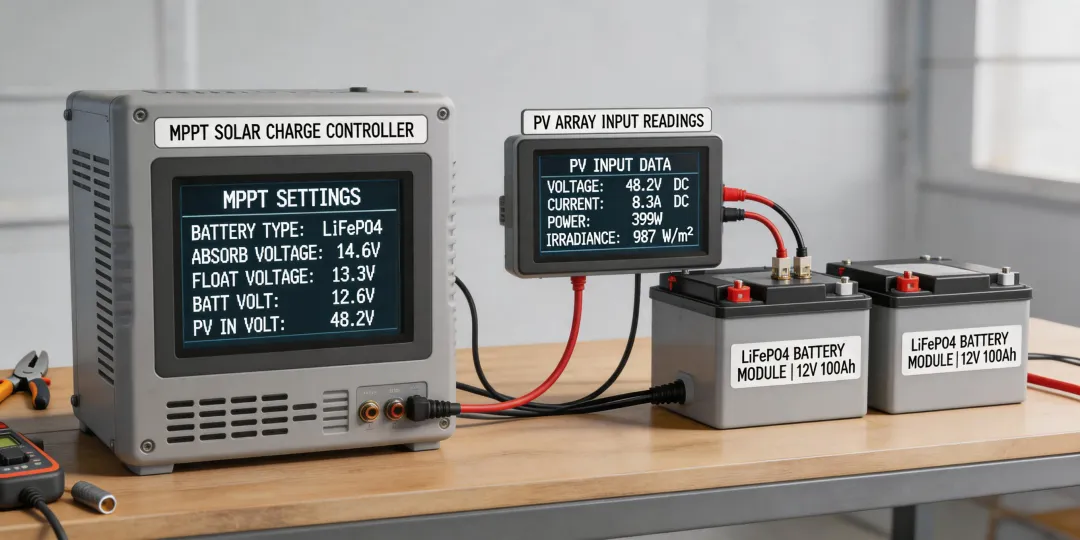
For most residential off‑grid systems under 800W (12V), the Epever 40A MPPT is the sweet spot – but not because bigger is better. After three expensive mistakes and over $2,800 in wasted gear, I've learned that the right size controller isn't about maxing out current; it's about matching your panel string voltage and battery bank. Here's what the spec sheets don't tell you.
The Short Answer: 40A for 12V, 20A for 24V – but Only if Your Panels Play Along
I'm a system integrator handling off‑grid orders for six years. I've personally made (and documented) four significant mistakes, totaling roughly $2,800 in wasted budget. The biggest one? Ordered ten Epever 60A MPPT controllers for a pole‑mount kit project in Livermore because I thought "more amps = more safety." Big mistake. The controllers never got above 40% utilization, and the extra capacity just meant more heat and a higher price tag.
Here's the rule of thumb I now follow:
• 12V battery bank – Epever 40A MPPT, good for up to ~560W of solar (assuming 12V nominal panel Voc).
• 24V battery bank – Epever 20A MPPT (or 30A if you want headroom), good for up to ~720W.
• 48V bank – 10A to 20A, depending on array size.
But that's only half the story. The real trap? Voltage.
What Most People Don't Realize: The 150V Limit Is Easier to Hit Than You Think
Epever's MPPT controllers (like the 40A model) have a max PV input voltage of 150V (or 100V on some older versions). Sounds generous, right? I thought so too. Until I wired three 60‑cell panels in series for a Livermore customer, and on a cold morning the Voc jumped to 152V. The controller didn't blow, but it shut down – and the customer's battery sat empty for two days while I scrambled to rewire.
Here's something vendors won't tell you: the Voc rating on the label is at 25°C. In Livermore winters (or anywhere below 0°C), Voc can rise 10–15%. That 150V limit suddenly becomes 135V safe margin. If you're installing a pole‑mount kit with three panels in series, always check the temperature‑adjusted Voc against the controller's absolute max.
My Checklist: 5 Minutes of Calculation vs 5 Days of Rework
After the third rejection in Q1 2024, I created a pre‑check list that's saved us an estimated $8,000 in potential rework. Here it is:
- Battery voltage – 12V? 24V? 48V? The controller's rated current is on the battery side. A 40A MPPT at 12V = ~520W max panel input. At 24V = ~1040W. Don't mix them up.
- Panel Voc string – Sum your panel's Voc (at STC), then multiply by 1.15 for cold weather. Must be below controller's PV input voltage rating.
- Controller current rating – Divide total panel wattage by battery voltage. That's the max charge current. Select controller with rating ≥ that number. If you're close (e.g., 38A on a 40A controller), add 20% headroom.
- Wire gauge & connectors – Pole‑mount kits often come with MC4 connectors and pre‑sized wire. Check if they match the controller's input terminals (Epever 40A typically accepts up to 10 AWG).
I knew I should always check the cold‑weather Voc beforehand, but thought "what are the odds?" Well, the odds caught up with me when that 150V limit got exceeded. Skipped the voltage check because it 'never matters.' That was the one time it mattered.
Edge Cases: When the 40A Doesn't Fit
This approach worked for us, but we're a residential installer in California with mostly 12V systems and 300W–800W arrays. If you're dealing with a 48V battery bank or a large off‑grid workshop pulling 2000W+ of solar, the calculus is different. The Epever 60A or 100A models make sense there – but only if your panel voltage stays within limits.
Also, if you're using a pole‑mount kit that already includes wiring and a combiner box, check the system voltage rating. Some kits are designed for 24V arrays and include a charge controller that's already matched. In that case, swapping to an Epever might require modifying the wiring. Don't assume compatibility.
One more thing: I should add that Epever's newer models (like the Tracer AN series) now support up to 200V input. If you're starting fresh, that extra headroom can save headaches. But the old 150V limit still applies to the widely available XTRA and VS series – check the model number before ordering.
Final Perspective
Picking the right Epever MPPT size isn't hard – it's just easy to screw up if you ignore voltage. My advice: start with the battery voltage and panel wattage, then sanity‑check the Voc with a cold‑weather factor. The 40A model is perfect for most 12V residential setups, but if you're in Livermore or similar climates where winter temps drop below freezing, give yourself 20% voltage headroom. Your controller – and your battery – will thank you.
This sizing guideline was accurate as of early 2025. Panel efficiencies and controller specs evolve, so verify current product datasheets before purchasing. I learned these lessons the hard way in 2022–2024; your mileage may vary if your system configuration differs significantly.