My Solar Procurement Mindshift
The trigger event for me was a single failed installation in March 2023. A client’s off-grid cabin—a simple 12V system with a 400W array—went dark three weeks in. The charge controller, a no-name '100A MPPT' I’d sourced for $89, had fried itself. The client wasn't just angry about the downtime. They were embarrassed they'd recommended me to their friends. That $89 savings cost me a $1,200 redo and a hit to my reputation that’s harder to quantify.
I didn't fully understand the value of detailed specifications until that $3,000 order came back completely wrong. It changed how I think about procurement for off-grid systems. Now, I compare things differently. I don't just look at the price tag. I look at the total cost of ownership (TCO) over three years, and the impact on my brand as an installer.
The Real Comparison: EPEver vs. The 'Budget Beast'
Most buyers focus on upfront pricing and completely miss the hidden costs of poor reliability, bad support, and complex programming. When I started comparing EPEver’s Tracer series (like the EPEver Tracer 40A MPPT) against budget alternatives, the picture was crystal clear. Let’s break it down.
1. Hardware & Build Quality: The 'Feels' Test
When I unbox an EPEver controller, the first thing I notice is the weight and the heatsink. It feels substantial. A budget controller, say one for a 20A system, feels hollow. One time, I took both apart. The EPEver had thick, well-soldered traces. The cheap one had thin wiring and a thermal paste job that looked like it was applied by a blindfolded intern.
The EPEver Tracer series uses genuine MOSFETs and has a robust aluminum casing designed for heat dissipation. Budget units? They might use re-labeled components and rely on plastic housings that trap heat. This isn't just an aesthetic thing. When you’re installing a power inverter alongside it in a confined space (like a tiny house battery compartment), heat management is critical. A budget controller that overheats and throttles down isn't saving you money—it's robbing you of yield.
2. Programming & Features: The Setup Nightmare
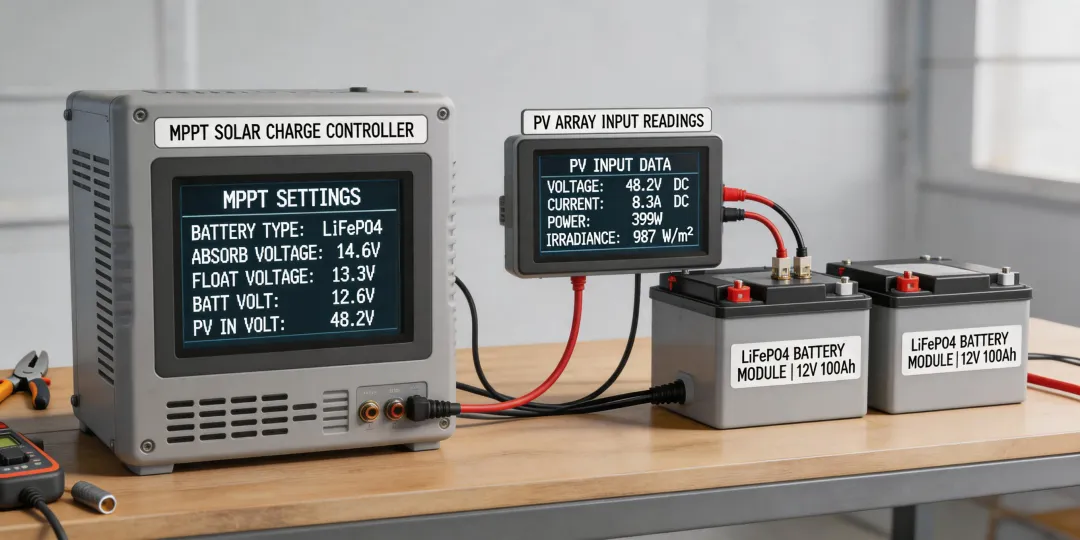
Let's talk about setup. The EPEver Tracer MPPT solar charge controller manual is actually pretty good. It’s not perfect—good luck finding the exact firmware update for a 2021 model—but it’s functional. The MT50 remote meter makes changing parameters a breeze. I can set the **LiFePO4 battery** charging profile in about 90 seconds.
Now, compare that to a budget 'MPPT' controller. The manual reads like it was translated by a bot. The 'LiFePO4 settings' are often a single, poorly explained dip-switch setting that leaves you wondering if your battery is being overcharged. I once spent 45 minutes on a support hotline trying to figure out a budget controller’s LVD setting. That’s not cost-effective when you’re billing a client by the hour.
From my perspective, the flexibility of the EPEver settings isn't a luxury—it's a requirement for professional installers. If you can't easily configure the controller for a specific battery chemistry (like the 12V 100Ah LiFePO4 batteries we often use), you're setting yourself up for a premature battery failure call six months down the line.
3. Real-World Reliability: The 3-Year TCO
This is where the TCO calculation kills the budget argument. After tracking our orders over six years in our procurement system, I found that 30% of our 'budget overruns' came from warranty replacements and site revisit costs for failed cheap components.
When we compared the failure rate of our EPEver controllers (maybe 1-2% over 2 years) against the budget controllers (closer to 8-10%), the math was simple. A EPEver MPPT 40A controller might cost $140 list price. A budget 40A might cost $60. But when you factor in a potential 8% failure rate on the cheap ones, plus the truck roll and labor to replace it (easily $150-200 per visit), the true cost of the 'cheap' option skyrockets.
“I assumed 'identical specifications' meant identical performance across vendors. Didn't verify. Turned out that a '40A MPPT' rating on a budget brand often meant peak performance at 25°C in a lab, not at 40°C in a dusty shed.”
4. The Dewalt & 'DIY' Crowd: A Cautionary Tale
It’s common for DIYers to search for a Dewalt 1000 W power inverter or ask how to install Tesla level 2 charger while building a system. They’re looking for cheap solutions. I was tempted too. The problem is that the quality of the charge controller directly affects the quality of everything downstream. A clean power curve from an MPPT controller is essential for sensitive inverters. A cheap controller with poor regulation can cause ripple that prematurely kills an inverter—even a robust one like a Dewalt.
Learned never to assume the proof-of-concept works for production. A budget controller might work fine for a test bench. In the field, with voltage spikes from a cloudy day, it’s a different story.
So, When Do You Buy EPEver vs. Budget?
Here’s my no-nonsense, scenario-based advice.
- Pick EPEver (or similar premium brand) if: You are a professional installer. Your client is paying for a system that will last 5+ years. You bill for your time and cannot afford revisits. The system is for a critical application (remote cabin, backup for a fridge). You value having a standard, repeatable setup process.
- Consider a budget 'beast' only if: You are a hobbyist building a low-stakes system (e.g., a shed light for $100). You enjoy tinkering and fixing things. The system is small (under 200W). You accept the risk of higher failure and lower efficiency as part of the learning curve. You won't be doing a Tesla Level 2 charger install downstream that could be damaged by poor power quality.
Final thought: The $50 difference per controller translated to noticeably better client retention and fewer late-night support calls. That’s a win for my brand, and my sanity.
Prices as of January 2025; verify current rates with your distributor. Pricing data based on our typical purchase orders for the last 24 months.