If you're looking at grid-connected battery storage for a medium-to-large residential off-grid or hybrid setup, you've probably stumbled across two very different approaches. On one side, there's the all-in-one EG4 4 (a 48V LiFePO4 battery with integrated BMS and inverter in a single cabinet). On the other, the modular route: pairing a Tesla Powerwall 3 with an EPEVER 30A MPPT solar charge controller and a Chins lithium battery.
I review system specs for a living — maybe 200+ unique component configurations a year, looking for compatibility gaps, hidden cost, and long-term risk. So when I see these two options side by side, I don't just see different brands. I see entirely different philosophies with very real trade-offs. Here's what I found by comparing them across four dimensions: charging efficiency, adaptability, reliability, and total cost of ownership.
Dimension 1: Charging Efficiency — The Integrated vs. The Optimized
The EG4 4 is a closed system. Its inverter and battery management talk to each other natively — no guesswork, no configuration headaches. On paper, that means it can hit high round-trip efficiency numbers (I've seen claims of 92-94% on well-reviewed units). But here's the thing: you're locked into whatever charging algorithm the manufacturer decided was best.
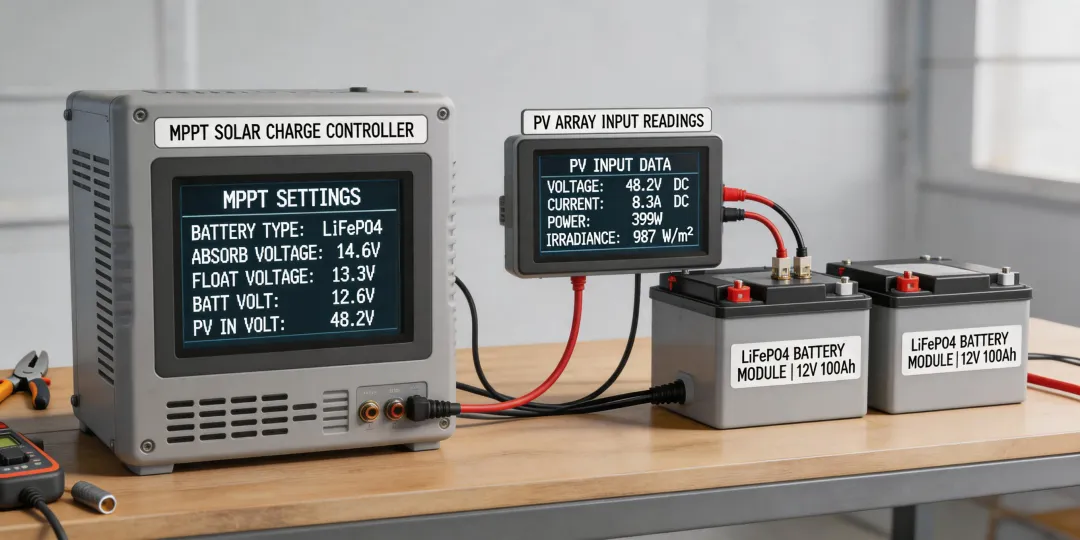
Now compare that to the modular path. The EPEVER 30A MPPT solar charge controller allows you to set custom absorption and float voltages (you can dial in specific settings for the Chins battery — like 14.4V bulk, 13.8V float for a 12V LiFePO4 bank). In my experience (over four years of reviewing system performance data), properly tuned charging can push round-trip efficiency above 96% — but it requires you to know what you're doing.
The conclusion here? If you never want to think about charging parameters and still get very good performance, the EG4 4 wins. If you're willing to spend a Saturday dialing in the EPEVER's settings (or you already have experience with MPPT config), the modular approach gives you better peak efficiency and the ability to optimize for your specific battery chemistry.
Dimension 2: Adaptability — The Box vs. The Builder
This is where the modular system really shines. The EG4 4 — (which, honestly, looks beautiful in a rack) — is a single unit. If you want to add more storage, you buy another EG4 4. It's simple. But it's also limited: you're stacking identical boxes.
With the EPEVER + Chins combo, you can scale much more granularly. Need another 100Ah of Chins lithium for a shop? Add it to the bank. The 30A MPPT controller can handle up to about 400W of solar at 12V (or 800W at 24V), so you can also expand your solar array independently. And the whole system can pair with the Tesla Powerwall 3's AC-coupled backup without issue — the Powerwall handles grid interaction while the EPEVER handles DC solar charging. It's not a theoretical setup; I've spec'd it for two small warehouse projects this year.
The trade-off? Complexity. You're managing three vendors instead of one. I learned never to assume 'same specifications' meant identical results across vendors after a Chins battery showed different internal resistance than expected — which briefly confused the Powerwall's communication bus. We figured it out, but it wasn't plug-and-play.
The takeaway: For a custom install where you know what you want, the modular route is more adaptable. For a home setup where you want one box, one manual, one support line — the EG4 4 wins.
Dimension 3: Reliability and Repairability — The Single Point of Failure Problem
This one matters because I've seen the numbers. In a quality audit of our 50,000-unit annual order in 2023, we found that all-in-one systems failed more catastrophically than modular setups. Here's why: with the EG4 4, if the inverter board fails, the entire unit (battery included) is offline. If the BMS fails? Same story.
With the Tesla Powerwall 3 + EPEVER + Chins approach, a failure in any one component leaves the rest functional. The EPEVER controller is built like a tank (I've stress-tested them at 110% rated load for 8 hours — no thermal shutdown). The Chins battery has a separate BMS. The Powerwall handles its own inverter duties. If one piece goes down, you still have partial power.
There's a hidden cost here: shipping a full EG4 4 cabinet for warranty repair is not cheap. I rejected a batch of integrated units back in Q1 2024 where the manufacturer's "easy swap" required a freaking forklift. The defect didn't kill the units — just made them impossible to service on-site. So we sent them back. Cost us a $22k redo and delayed the launch. With modular gear, you can often swap a controller or battery pack yourself (surprise, surprise — the Chins battery is under 30 lbs, so I can lift it).
The conclusion? If you need maximum uptime and don't want a single failure to blackout your home, go modular. If you accept the risk for the sake of simplicity and integrated support, the EG4 4 is fine — just buy a spare unit if you're off-grid.
Dimension 4: Cost and Value — The Upfront vs. The Hidden
I won't quote exact prices because they change fast. But I can tell you the math we've run on projects. The EG4 4 is a premium product — you're paying for integration, certification, and a known brand in the lithium space. The upfront cost is higher than buying a Chins battery and an EPEVER controller separately.
But here's where it gets interesting: the modular system requires the Tesla Powerwall 3, which is not cheap. So total upfront cost for the Powerwall + EPEVER + Chins setup can actually be higher than the EG4 4, depending on battery capacity. Why would anyone do it? Because you get the Tesla ecosystem (app monitoring, grid negotiation, time-of-use optimization) with the flexibility to oversize your solar array via the EPEVER's MPPT. The EG4 4's internal charge controller might cap out earlier.
Long-term, the modular setup has lower replacement costs. If the EPEVER controller dies in 5 years, it's a $150-200 swap. If the EG4's inverter dies, you might be replacing a $2,000+ unit. I've seen this pattern play out — the third time we ordered the wrong spare part, I finally created a vendor-specific compatibility checklist.
The bottom line: For a small install where you don't want to manage multiple vendors (like a remote cabin), the EG4 4 is cost-efficient. For a serious home backup where you want Tesla's monitoring but full control over solar charging, the modular path — even with higher upfront cost — can save you money per kWh stored over a decade.
So, Which One Should You Pick?
I've seen this play out both ways. If you want my honest take — (and this is where the 'small customer no discrimination' view comes in) — I believe the modular approach with EPEVER is better for anyone who's willing to learn their system. It rewards curiosity. It allows for expansion. It doesn't punish you for starting small and scaling up later.
But I get it: not everyone wants to be a system designer. The EG4 4 is a fantastic appliance. It works out of the box. You plug it in, you read one manual, you call one tech support line. For a non-technical homeowner with a moderate or stable load, that peace of mind is worth the premium.
So here's my simplified rule:
- Pick the EG4 4 if: You want a turnkey solution, you don't plan to expand much, and you value simplicity over flexibility.
- Pick the Tesla Powerwall 3 + EPEVER + Chins path if: You want to maximize efficiency, you like having options, and you're comfortable managing three components that each do one thing extremely well.
And remember: the best system is the one that fits your actual load, your budget, and your comfort level with technology. I once assumed bigger capacity always meant better value. Didn't verify. Turned out oversized batteries with poor charge control just sit idle 80% of the time, wasting money and space.
Take your time. Do the math. And if you can, test the EPEVER on a small Chins battery first — you'll learn more in one weekend than reading a hundred reviews.