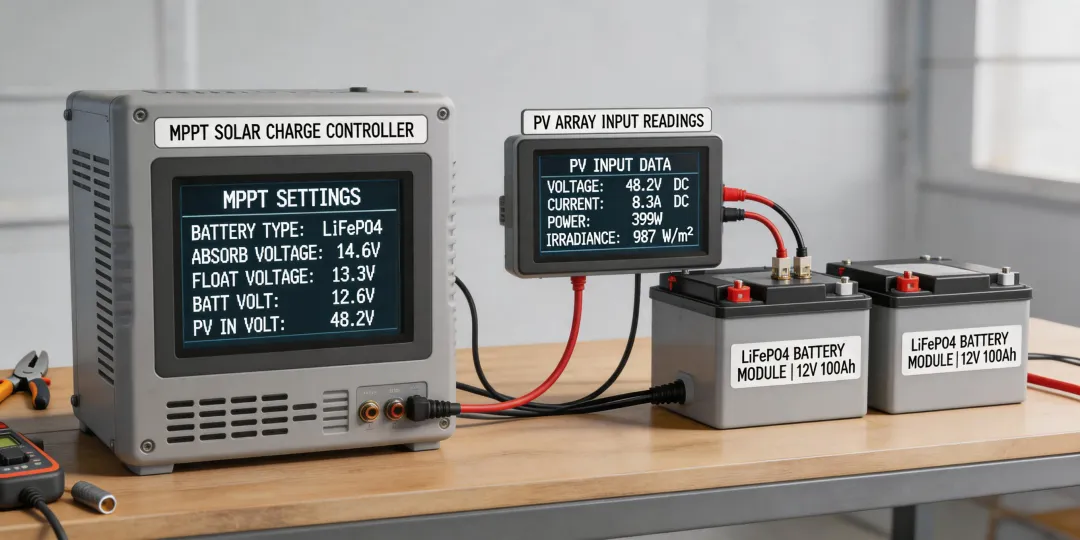
Some installs go wrong so early you can see it coming from the first site photo. This one didn't. I spent two days wiring a hunting cabin in western Montana, and the system looked perfect. On day three, at 6:40 in the morning, the client called to say the power was out. The charge controller's screen was blank.
I've been installing off-grid solar systems since 2016 — nine years now. In that time, I've personally made (and documented) twelve significant mistakes, totaling roughly $9,400 in wasted budget. This epever job sits at the top of the list. It's also the reason I now maintain our team's pre-install checklist, and why line one of that checklist reads: read the manual before you touch the settings.
The Install That Looked Fine
In February 2018, a client hired me to give a hunting cabin a proper off-grid setup. LED lights, a small fridge, a shallow-well pump. No gas generator, and no lead-acid batteries — he was firm on that. So I put together a system I'd built a dozen times before, just upgraded the power source:
- epever Tracer MPPT solar charge controller — the 40A version
- Battle Born 12V 100Ah LiFePO4 battery
- 1000W high-frequency power inverter
- Two 200W panels, with headroom on the controller for a third later
Day one, the numbers looked great. PV voltage steady, charging current right where it should be, inverter test load passed without a hiccup. I closed the enclosure, left the epever manual in the truck, and drove home satisfied.
One moment from that visit stuck with me. The client asked, “So this is basically a solar generator, right?”
I gave him a hand-wavy answer — panels make DC, the controller regulates it, the battery stores it, the inverter turns it into AC. But I didn't have a clean definition of what a “solar generator” actually was. I thought of it as one of those all-in-one boxes, not as a pile of separate parts working together. I'd learn the connection soon enough.
Here's the part I still cringe about. I remember telling myself: “I should double-check the battery settings before I leave.” Then I didn't. What are the odds a “maintenance-free” lithium battery needs something special? Well, the odds caught up with me on day three.
The 6:40 AM Call
Day three. Phone rings at 6:40 AM. “Cabin's dark,” the client says. “Controller screen is blank. The inverter is beeping.” In off-grid, that combo usually means the battery got disconnected.
I drove up, opened the battery compartment, and saw the Battle Born's indicator LEDs dark. The BMS had tripped. My first instinct: defective battery. My second instinct, and the first useful one: read the epever MPPT 40A manual. Actually, read it for real — not just the terminal diagrams.
The answer wasn't flattering.
The controller was running on the gel battery profile. I'd chosen it during setup, figuring “sealed” was close enough to “maintenance-free lithium.” It isn't.
Gel and other lead-acid profiles include temperature compensation. The battery temperature sensor in that unheated cabin was telling the controller it was cold — below freezing by morning — so the controller did what it was designed to do: it raised the charge voltage to keep a lead-acid battery healthy in the cold. But a LiFePO4 battery doesn't want that curve. It wants a flat, predictable range: roughly 14.4V bulk, 13.6V float. No compensation.
So the BMS on the Battle Born battery did exactly what it was supposed to do. It saw voltages outside the safe window and disconnected the cells from the system. No battery, no inverter, no lights. The controller screen goes blank because there's no battery voltage to power it.
Not the controller. Not the inverter. Not the battery. Me.
What the Manual Actually Said
The epever Tracer MPPT solar charge controller has a User-defined battery mode. That's the setting for LiFePO4. Instead of using the factory lead-acid charge curves, you enter the exact voltages from your battery's spec sheet.
Once I pulled up the Battle Born 12V 100Ah LiFePO4 battery specs, the correct numbers were obvious:
- Nominal voltage: 12.8V
- Recommended bulk/absorb voltage: 14.4V
- Recommended float voltage: 13.6V
- Max continuous discharge: 100A — which is why I paired it with a 1000W inverter, not a bigger one
I switched the controller to User mode, entered 14.4V bulk and 13.6V float, and reset the system. Charging came back within minutes. The battery reached a true full state by midday and held through the night. No beeping. No blank screens.
To be fair, the epever manual does include a clear table of battery types and voltage ranges. I'd skimmed it. I just hadn't read the pages that mattered.
What This Taught Me (the Checklist)
Every install I've done since February 2018 follows one rule: set the battery profile before connecting power, and verify it against the battery manufacturer's spec sheet. Not the charge controller's defaults — the battery's own numbers.
- If you're using LiFePO4, don't use sealed, gel, or flooded profiles. They might look close, but they're based on a different chemistry with different voltage behavior.
- Use the controller's User-defined mode. Enter the bulk and float voltages exactly as the battery datasheet specifies. That goes for epever's own LiFePO4 batteries too — check the datasheet, don't guess.
- Check the BMS specs, not just the chemistry. The Battle Born BMS is there to protect cells — and it'll shut the whole system down in an instant if the charge profile is wrong.
- Know what the temperature sensor does in each profile. For LiFePO4, you usually want lead-acid temperature compensation disabled.
- Keep the manual accessible. I keep PDFs of every component manual in a folder on my phone. Sounds boring. Saves days.
Using that checklist, our team has caught 47 potential errors in the last 18 months — most of them battery-configuration issues like this one. That will probably sound obvious to experienced installers. That's exactly the point: it was obvious, and I skipped the step anyway.
So, What Is a Solar Generator, Actually?
Remember the client's question? “This is basically a solar generator, right?” After this job, I can finally answer it properly: yes, it is. And that's a useful way to understand off-grid solar.
A solar generator works like this: solar panels convert sunlight into DC electricity, a charge controller regulates that power into a battery, the battery stores it, and an inverter converts stored DC into AC for your appliances. Packaged “solar generators” put all of those pieces into one enclosure. My epever system did the same job — it just used separate components. It's kinda like a laptop vs. a desktop: same internal parts, but a desktop is easier to repair when something fails.
That's the trade-off. Packaged solar generators are easier to set up but harder to troubleshoot; if one part fails, you might replace the whole unit. Modular systems take more knowledge upfront, but you can swap one component independently. For a cabin that needs to keep running, that flexibility matters.
The Honest Limits of This Setup
I recommend the epever Tracer MPPT solar charge controller every week — it's a solid piece of hardware, and the 40A model fits small 12V/24V cabins really well. But I don't recommend this exact setup for everyone.
If you're trying to run a full-time household with an electric water heater or a big induction stove, a 40A controller, a single 100Ah battery, and a 1000W high-frequency inverter won't cut it. You'd want a bigger battery bank, a 24V or 48V architecture, and likely a low-frequency inverter for heavy motor loads. The high-frequency inverter is great for efficiency, weight, and price — which is why I chose it here — but it doesn't have the same surge headroom as a low-frequency unit. That's a trade-off, not a flaw.
Also worth saying clearly: LiFePO4 batteries aren't literally “drop-in.” The mounting holes align and the terminals match, but the charging profile has to match too. I learned that the hard way. It cost me a long drive and a client's morning.
One more thought. The FTC advertising guidelines (ftc.gov) say performance claims should be truthful, substantiated, and clear. I think that standard applies to installers as much as to manufacturers. So instead of telling clients a system “just works,” I show them the numbers: battery capacity, inverter surge rating, controller setpoints. Verifiable claims are the only ones that survive a 6:40 AM phone call.
That epever job taught me more than any training course. The product didn't fail — my process did. Now the first thing in my bag isn't a multimeter. It's the manual.