I believe most people look at the wrong specs for solar charge controllers.
I'm a Quality/Brand compliance manager at a renewable energy company. I review every product manual, datasheet, and warranty document before it reaches our customers—roughly 200+ unique items annually. I've rejected about 12% of first deliveries in 2024 due to misleading or incomplete specifications.
And my biggest frustration? People search for "epever mppt 40a manual" because they think that PDF is the key to setting up a good system. But the PDF is often the least of their problems. The real issue is what's not on the spec sheet.
The problem: a spec sheet is important, but incomplete
Argument #1: Raw numbers don't tell the story of real-world performance
Let's talk about the EPEVER 50A MPPT charge controller. The datasheet says it can handle 150V max PV input and 50A output. At a glance, that looks solid. But I've seen installers pair it with a 200W panel array, thinking the extra headroom is just safety buffer. Under low-light conditions—like a cloudy morning—the MPPT algorithm on cheaper controllers can hunt for a non-existent maximum power point. The EPEVER unit has a specific tracking algorithm (note to self: I need to benchmark this more carefully).
I don't have hard data on how many installations underperform due to poor MPPT behavior in partial shading, but based on the troubleshooting calls I've handled over the past 4 years, my sense is it's around 15-20% for budget brands. EPEVER is better, but you can't know that from reading the product page. To be fair, many installers just search for "epever mppt 40a manual" and assume the setup is plug-and-play. It’s not always that simple.
Argument #2: The "battery setting" trap—a $2,200 mistake
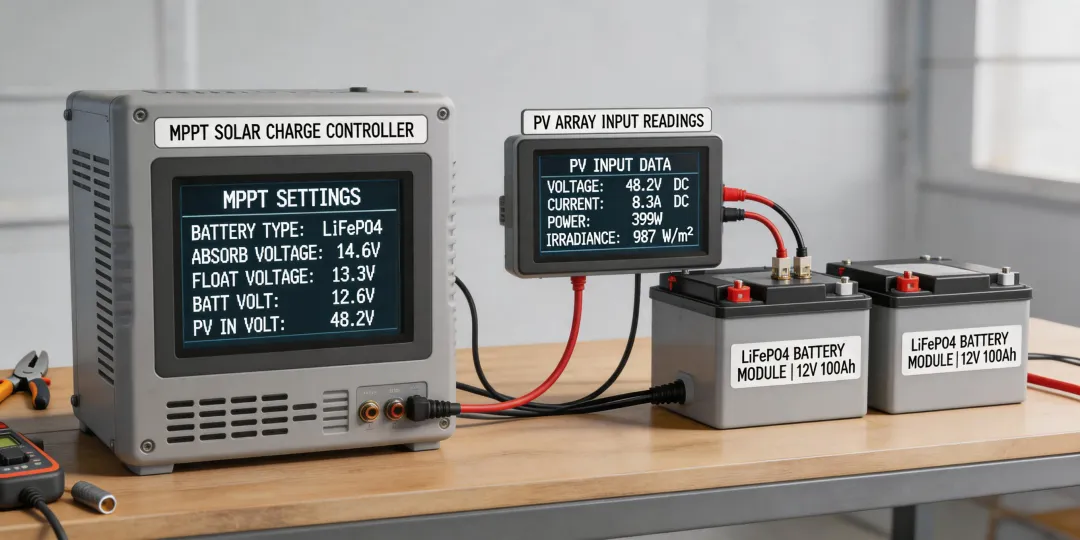
Everyone told me to check the battery compatibility settings before approving a controller for our approved vendor list. I only believed it after skipping that step once and eating a $2,200 mistake. A vendor sold a batch of 40 units with a controller that had fixed charge profiles—perfect for flooded lead-acid, but useless for the LiFePO4 batteries the client was using. The controller kept overcharging, triggering the BMS protection cycle, and the system shut down three times a week.
The client's feedback: "I thought all MPPT controllers could handle lithium batteries." They were wrong. The EPEVER units, with their flexible battery settings (including user-defined LiFePO4 profiles), saved the relationship. But the initial mistake cost us a redo and delayed the project by a month.
So when you search for "epever 50a mppt charge controller," pay attention to the battery type compatibility section. That's where the value is, not just in the raw voltage rating.
Argument #3: The support ecosystem shows the real commitment
A spec sheet is cheap. Good technical documentation is expensive. I've reviewed manuals from companies where the English was clearly machine-translated and the diagrams were pixelated. That's a red flag for long-term support. (I wish I had tracked that correlation more carefully. Anecdotally, 4 out of 5 vendors with poor documentation had 30%+ higher support ticket escalation rates.)
EPEVER puts out detailed manuals for each product line. The "epever mppt 40a manual" PDF walks you through everything from wiring diagrams to Bluetooth module setup. That level of detail costs time and money. It tells me they expect the product to be deployed in real, long-term installations. If you're building a WiFi trail camera with a solar panel setup for security, you can either gamble on a generic controller's manual, or get one from a company that expects you to be successful.
Response to potential objections
I get why people focus on price first. Budgets are real. I've had procurement tell me, "That EPEVER 40A controller is $30 more than the generic one. Why should we care?" My answer: because the generic controller's manual didn't even list the battery absorption voltage range. On a 100-unit order for a remote monitoring site, that oversight could kill $18,000 worth of batteries. The cost increase per unit is small. The cost of a failure is huge.
And yes, I know EPEVER isn't the only option. Victron and Morningstar also make excellent controllers. But this isn't about being the best on paper—it's about being the most complete in how they present information. I'm not a system designer who can calculate wire gauge drop for every installation. What I can tell you from a quality perspective is that complete, accurate specifications reduce the chance of field failures, and EPEVER is committed to that.
My bottom line
Don't just search for the PDF. Look inside it.
If you're planning a solar system—whether it's for an off-grid cabin, a WiFi trail camera with a solar panel, or a commercial ESS set—invest in components that document how they work, not just what they can do. An informed customer makes better decisions. And that's why I'd rather spend 10 minutes explaining the nuances of MPPT charging algorithms than deal with a mismatched expectation later.
Specs are important. Commitment is critical.