The Decision Isn't as Simple as 'Buy the Most Expensive'
A few months ago, I was reviewing a batch of 50 EPEver MPPT controllers slated for a large off-grid installation. The specs were perfect on paper—40A, 100V max input, full lithium battery support. But as I walked through the warehouse, something bugged me.
Every single controller was overkill for the panels they were being paired with. The installer had gone straight for the premium option because 'more expensive means better.'
That's not how it works.
So here's the real question: how do you decide between a PWM and an MPPT controller for your specific setup?
The honest answer? It depends on three things: your panel voltage, your battery voltage, and your budget. Let me break it down by scenario.
Scenario 1: Small Systems with Matched Voltages
If your solar panel's nominal voltage matches your battery bank voltage—say, a 12V panel charging a 12V battery—PWM is often the more practical choice.
"I'm not saying PWM is better. I'm saying it's the right tool for a specific job."
Why? Because in this setup, an MPPT controller's efficiency advantage shrinks significantly. The voltage conversion gain is minimal, so you're paying for capability you'll barely use. A quality 20A PWM controller from EPEver will handle this perfectly, and the $40-60 you save compared to a 20A MPPT can be better spent elsewhere—like on a higher-capacity battery.
Bottom line: PWM is the right call when your panel and battery voltages are in the same ballpark (12V/24V matched systems). Don't let anyone upsell you an MPPT unless the numbers justify it.
Scenario 2: Mismatched Voltage Systems
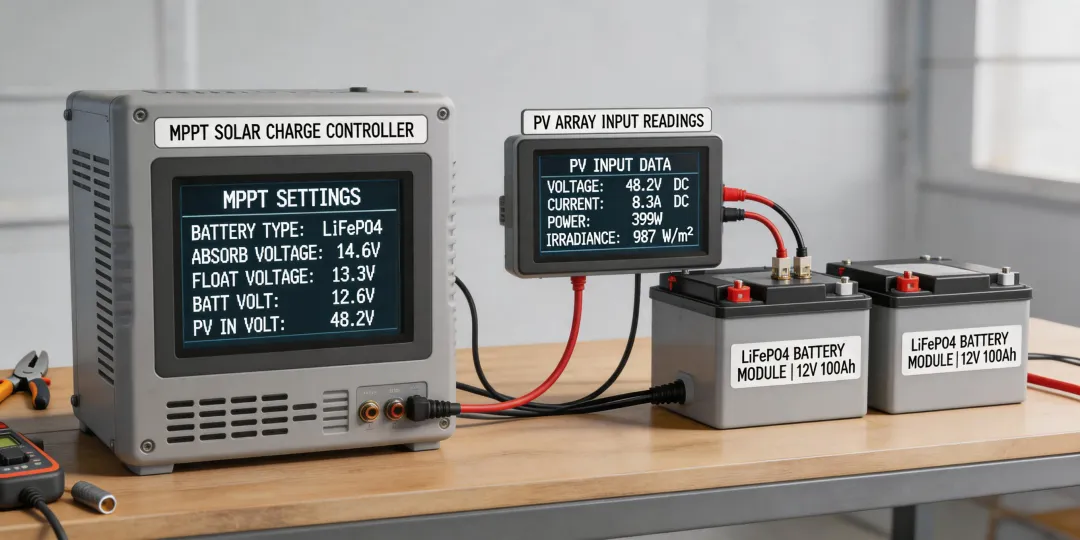
This is where MPPT shines. If you're using a 24V or 48V panel array to charge a 12V battery bank—or if you have higher-voltage panels (like 60-cell or 72-cell modules) that output 30-45V—MPPT's ability to down-convert voltage while boosting current becomes a genuine advantage.
Let me give you a real example from our Q1 2024 quality audit:
- Setup: Two 330W 72-cell panels (~40V each) wired in series for 800W total. Battery bank: 24V LiFePO4.
- With MPPT: We consistently saw 780-800W peak input, with the controller tracking the maximum power point and converting efficiently down to 24V charging. Average harvest: 95% of rated panel capacity.
- With PWM (same panels): The high-voltage panels were basically throttled. The PWM controller dumped excess voltage as heat. Average harvest: 75-80% of rated capacity.
The cost gap was significant. Over a year, the PWM system lost roughly 150-200 kWh of potential harvest. At a conservative $0.12/kWh, that's $18-24 lost annually. The MPPT controller's $70 premium paid for itself in under three years.
If you're mixing panel and battery voltages, go MPPT. Simple.
Scenario 3: Large Off-Grid Systems and the 'Better Safe Than Sorry' Trap
Now, here's the scenario where I see the most mistakes—and wasted money.
I've reviewed proposals for 3kW+ off-grid systems where the spec called for a single 100A MPPT controller. In my opinion, that's often overkill. A better approach is splitting the array across two 60A MPPT controllers. Here's why:
- Redundancy: If one controller fails, you still have partial power (vs. total darkness).
- Better MPPT tracking: Two controllers can independently track maximum power points for panels facing different directions or experiencing partial shading.
- Cabling economics: Two parallel controllers mean smaller gauge cable runs, saving money on copper.
"We saved $600 by specifying two 60A controllers instead of one 100A, and got better performance and redundancy."
The lesson? Don't assume bigger is better. Sometimes the smart choice is splitting the load.
How to Figure Out Which Scenario You're In
Here's a quick checklist I use when reviewing system designs:
- Check your panel voltage. If it's within 15% of your battery voltage, PWM is probably fine. If it's >20% higher, MPPT pays off.
- Check total capacity. Over 1kW of panels? Splitting across multiple MPPT controllers might be smarter than one large one.
- Run the numbers. Calculate the annual energy harvest difference. If MPPT's premium pays back in <4 years, it's a no-brainer.
Personally, I'd argue that most installers would benefit from keeping both PWM and MPPT controllers in their toolkit. Having only one option means you're either over-paying for small jobs or under-building large ones.
That's the honest truth. Not every system needs the Rolls-Royce option. And that's okay.
Pricing as of January 2025; verify current EPEver product specs.