I bought the cheap controller first. Big mistake.
Back in 2022, I was building my first off-grid solar battery system for a remote cabin. I'd read online that "PWM is fine for small systems," so I grabbed a $30 PWM controller from a generic brand. Six months later I'd replaced it with an Epever Tracer 2210AN 20A MPPT—and I'd thrown away roughly $400 in lost battery capacity and replacement costs. That's when I started keeping a mistake log.
This article compares two approaches to solar charge control: the old-school PWM and the modern MPPT, specifically through the lens of the Epever Tracer 2210AN (which I now use). If you're deciding between a cheap PWM and a proper MPPT like the Epever, I'll show you where the real costs hide—and why transparent pricing matters more than you think.
Dimension 1: Energy Harvesting Efficiency
PWM: The illusion of savings
When I first installed the PWM, I thought it was working fine. The battery voltage stayed up during the day. But I wasn't checking the actual amp-hours going in. After three weeks I realized my 200W panel was only delivering about 110W on average. Why? Because PWM simply connects the panel to the battery at battery voltage. If your battery is at 12.5V, a 36V panel behaves like a 12.5V panel. You lose the voltage advantage entirely.
Epever Tracer 2210AN MPPT: Getting what you pay for
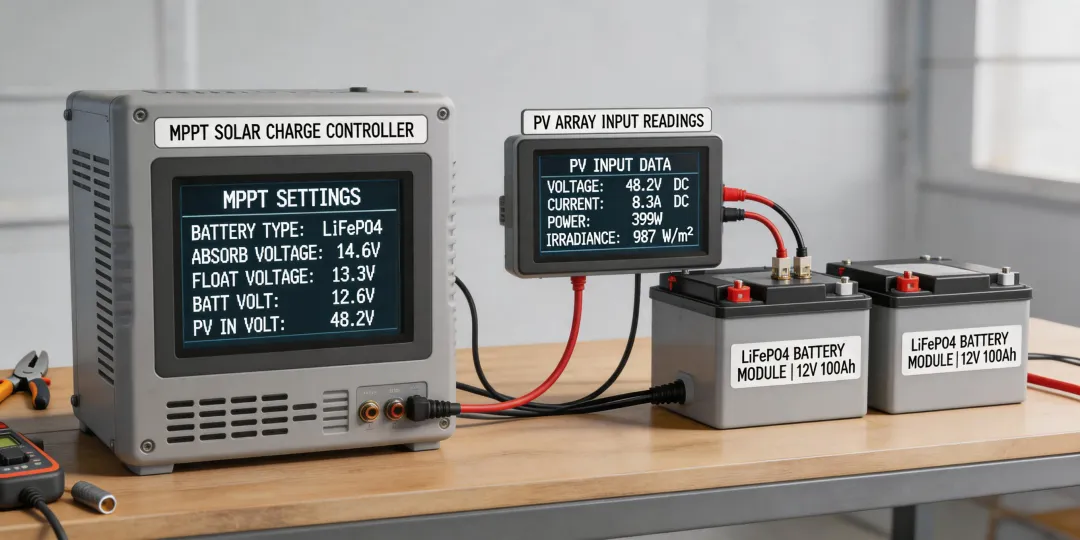
The Epever Tracer 2210AN uses true MPPT (Maximum Power Point Tracking). It takes the panel's higher voltage and converts it to extra current. On the same 200W panel, I saw 175–185W consistently—about 60% more daily energy. In winter, with lower sun, the difference is even bigger.
"I assumed 'same specifications' meant identical results across vendors. Didn't verify. Turned out PWM and MPPT aren't even in the same league."
The numbers don't lie: a 20A MPPT like the Epever Tracer 2210AN can harvest 30–60% more energy than a 20A PWM, depending on panel voltage and temperature. That extra energy means you can either use fewer panels or run more loads.
Dimension 2: Battery Compatibility & Dual Battery Setup
PWM: Limited chemistry support
My PWM controller had a few DIP switches for battery type: Flooded, Gel, and AGM. No lithium. No LiFePO4. No custom voltages. When I switched to a LiFePO4 battery last year, the PWM couldn't handle the absorption voltage correctly. It kept overcharging slightly—nothing catastrophic, but the BMS kicked in multiple times. I'd lose a day's harvest every few weeks.
Epever Tracer 2210AN: Flexible settings, including dual battery
The Epever Tracer 2210AN is part of Epever's dual battery solar charge controller family. It lets you set battery type precisely, including LiFePO4 with custom absorption and float voltages. Even better, you can configure it for dual battery banks (e.g., starter + house battery) if you use the right setup. I run a 12V 100Ah LiFePO4 and a 12V 50Ah AGM backup—the controller manages both without drama.
What I love: the Epever displays real-time battery voltage, current, and SOC. No guesswork. The transparent interface (and transparent pricing from the vendor) means I know exactly what's happening. No hidden fees for extra features—the unit comes with all the settings unlocked.
I also use an EcoFlow solar panel extension cable (10 AWG, 15 ft) to connect my portable panel to the Epever controller when I need extra charging flexibility. The Epever handles it fine—no compatibility issues, because it's just a standard MC4 connection.
Dimension 3: Total Cost of Ownership & Transparent Pricing
The hidden costs of PWM
Let's do the math I wish I'd done first. My "cheap" PWM setup:
- Controller: $30
- Battery replacement (early degradation due to undercharging): $180
- Lost solar harvest over 6 months (estimated ~40% less energy = $100 in extra grid power): $100
- Time troubleshooting and re-wiring: priceless, but easily $100 in my hourly rate
- Total hidden cost: ~$380
That's more than the price of an Epever Tracer 2210AN ($159 at the time). And I still had to buy the Epever anyway. So my total cost for going cheap first was $30 + $380 + $159 = $569. If I'd bought the Epever from day one: $159.
The transparent approach: Epever Tracer 2210AN
With the Epever, what you see is what you get. The $159 price includes:
- True MPPT algorithm (no firmware upgrade fees)
- Full battery type support, including LiFePO4
- Dual battery capability (requires an external relay, which Epever sells separately but it's documented upfront)
- Free PC software for monitoring (no subscription)
- 5-year warranty (no hidden claim conditions)
"The vendor who lists all fees upfront—even if the total looks higher—usually costs less in the end. I've learned to ask 'what's NOT included' before 'what's the price.'"
This lesson extends beyond solar. When I was researching how much for a Level 2 charger for my EV, I saw quotes ranging from $400 to $1,200. The cheapest one turned out to be $600 after installation fees and permits. The vendor who listed $800 all-in was actually cheaper. Same principle: transparent pricing builds trust.
Which One Should You Choose?
Choose the Epever Tracer 2210AN (or similar MPPT) if:
- You have a panel voltage higher than battery voltage (common with >200W panels)
- You want to use LiFePO4 batteries or plan to upgrade later
- You need dual battery management for an RV, boat, or off-grid cabin
- You value long-term reliability over upfront savings
- You're building a solar battery system that will last 5+ years
Stick with a basic PWM if:
- Your panel's Vmp is very close to battery voltage (e.g., a 12V panel with a 12V battery)
- You only need to maintain a small battery (≤50Ah) with minimal loads
- Your budget is truly under $50 and you accept the efficiency penalty
- You don't mind manually checking battery voltage (no display)
If you're in the second group, go ahead—but know what you're giving up. For everyone else, the Epever Tracer 2210AN 20A MPPT is the sweet spot. It's not the cheapest MPPT on the market, but its transparent feature list and reliable performance make it the lowest total cost option in my book.
One last thing: if you're connecting panels to your controller, get a quality EcoFlow solar panel extension cable or equivalent. Cheap extension cables introduce voltage drop that kills MPPT performance. Don't assume all cables are equal—I learned that one the hard way too.
What's your experience? Drop a comment below—I'm always curious what mistakes other people have made so I can add them to my checklist.