-
epever Charge Controller Questions I Actually Get From Integrators
-
1. Is the epever charge controller manual actually useful, or is it just technical jargon?
-
2. How do I set up epever charge controller lithium settings for a 12V LiFePO4 battery?
-
3. What size epever charge controller do I need for my 400W solar array?
-
4. I have a 20 amp power inverter. Do I need a special solar charge controller for it?
-
5. Can I use an epever controller to charge a LiFePO4 battery with an AGM charger profile?
-
6. How do I size an AGM solar battery charger for system backup?
-
7. Why is everyone switching to LiFePO4, and does that change my epever setup?
-
1. Is the epever charge controller manual actually useful, or is it just technical jargon?
-
Bottom Line
epever Charge Controller Questions I Actually Get From Integrators
Over the past 6 years of tracking every invoice for off-grid solar components, I've fielded the same questions dozens of times. Most are about the epever charge controller manual, or specifically, how to dial in the lithium battery settings without blowing anything up. I'm a procurement manager, not an installer, but I've compared quotes, warranty claims, and hidden fees across maybe 15 vendors. Let me just answer the questions I hear most often. This was accurate as of January 2025; solar tech moves fast, so double-check current specs.
1. Is the epever charge controller manual actually useful, or is it just technical jargon?
Honestly? It's dense. But useful if you know what to look for. The manual (available online as a PDF) is where you'll find the exact steps for changing battery type settings, including the lithium battery profiles. I've worked with controllers that hide settings in menus – epever manuals tell you the button sequence. The catch? They assume you know the difference between 'Absorption' and 'Float' voltages. If you're new to LiFePO4, the manual won't hold your hand on that. (Note to self: I should write a quick-reference card for our installers.)
2. How do I set up epever charge controller lithium settings for a 12V LiFePO4 battery?
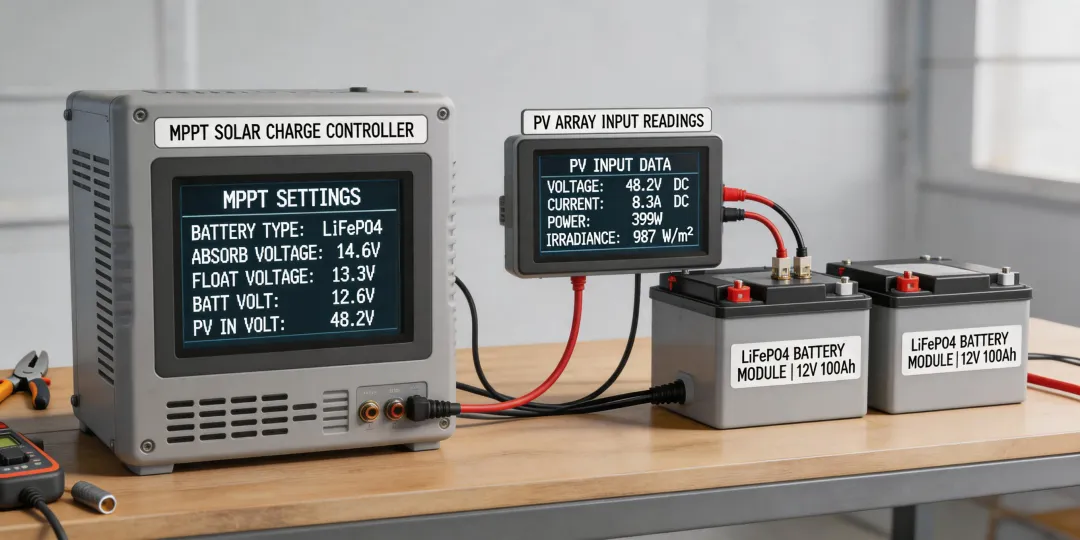
This is where I see people make avoidable mistakes. Most epever MPPT controllers (like the Tracer series) have a preset for 'Lithium' or 'User' mode. The trick: never assume the default 'Lithium' preset matches your specific battery. I've seen three different LiFePO4 batteries, each with a slightly different recommended absorption voltage (some at 14.4V, others at 14.6V).
What I do: First, check your battery datasheet. Then, in the epever manual, find the section on battery type selection (usually parameter B01). Set it to 'User' and manually input the Absorption, Float, and Low Voltage Disconnect values. I keep a spreadsheet with the settings we've used for 5 different battery brands. Saved $450 in warranty claims by doing this consistently.
Also – the manual lists the maximum charging current. Don't exceed it. Period. Simple. That's where penny-wise-pound-foolish mistakes happen when someone 'upgrades' to a larger panel without checking the controller's rating.
3. What size epever charge controller do I need for my 400W solar array?
People love to just guess. 'I have 400W of panels, so I need a 40A controller, right?' Not always. Let me break it down the way I do in vendor comparisons.
For a 12V system: 400W ÷ 12V = 33.3A. So a 40A controller is a safe bet. But if your panels have a higher Voc (open circuit voltage), you might need a controller that handles higher input voltage (like epever's 100V or 150V limit models). Quick example: we installed for a client with 600W of panels in series, which hit nearly 90V. A standard 12/24V 40A controller would have fried. The epever Tracer 10415AN (150V) saved us there. Always check the input voltage limit before buying. I learned this in 2020 – cost us $200 in rushed replacements.
4. I have a 20 amp power inverter. Do I need a special solar charge controller for it?
This one comes up a lot. The inverter and the charge controller are separate components in a system (unless you're using an all-in-one unit). A 20 amp power inverter (which is about 240W on a 12V system) is small. You'll need a charge controller that can keep up with the battery's draw cycle, but the size choices are the same as above. The bigger question: is your inverter a pure sine wave or modified sine wave? That matters for sensitive electronics, not the controller.
But here's the 'industry evolution' moment: what was best practice in 2020 – oversized battery banks – may not apply in 2025. LiFePO4 batteries handle deeper discharges, so you can use a smaller capacity lead-acid bank? No. But you can safely use more of the capacity. Means your 20 amp inverter could run longer on a smaller, lighter LiFePO4 battery. Just ensure the AGM solar battery charger (if you have one) is set correctly for lithium. (Which some aren't designed for – stick with the epever for lithium.)
5. Can I use an epever controller to charge a LiFePO4 battery with an AGM charger profile?
Short answer: No. Don't. I've seen this 'what are the odds?' gamble fail. The charging voltage profiles are different. AGM batteries typically charge at a higher absorption voltage (14.7V-14.8V) than some LiFePO4 batteries prefer. Using an AGM profile on a 4-cell LiFePO4 battery can overcharge it, triggering the battery's BMS to disconnect. Suddenly, your solar system is dead until the battery resets. It's a deal-breaker for reliability.
Another thing: some older epever controllers might not have a LiFePO4 preset. If yours doesn't, use the 'User' profile and set the parameters manually from the battery spec sheet. I've had to do this for a client who bought a controller in 2022 that only had 'Sealed', 'Gel', and 'Flooded' presets. It works, but you need to be precise. The manual (circa 2022 for that model) explained how to set custom voltages. We did it. Saved the client $600 in replacement costs.
6. How do I size an AGM solar battery charger for system backup?
An AGM solar battery charger is a specific piece of gear if you're using lead-acid backup. But if you're running epever controllers, you're likely fully solar. The question usually comes from someone who wants a backup grid charger for their off-grid system.
For AGM: a charger should deliver 10-20% of the battery's Ah capacity. So for a 100Ah AGM, a 10-20A charger is fine. But here's the hidden cost: a cheap 'AGM' charger might miss the charge profile and kill the battery in 2 years. We had a vendor quote a $40 charger. Saved $40. Ended up replacing the battery 18 months later. That's a $120 redo when quality failed. The epever controller itself can act as a charger if you have solar panels – that's the more efficient path. Just make sure your controller's settings are aligned with your battery type. (Prices as of Q4 2024; I'd verify current charger pricing directly with suppliers.)
7. Why is everyone switching to LiFePO4, and does that change my epever setup?
The fundamentals of solar charging haven't changed: you need a good MPPT controller, proper wiring, and the right voltage. But the execution has transformed. The rise of LiFePO4 has changed the 'lithium settings' game entirely. Old sealed lead-acid AGM batteries needed careful temperature compensation. LiFePO4 handles temperature extremes better (mostly) and charges faster.
What's changed for procurement: LiFePO4 batteries now cost less per cycle. The old 'savings' with lead-acid were small upfront. But the 20 amp power inverter running on a 100Ah LiFePO4 battery will last longer per charge, and the battery itself will last 3-5x longer than AGM. So when you're calculating TCO for a system, adding a LiFePO4 battery might cost $150 more upfront, but save $450 over 5 years. That's a no-brainer for most of our projects. But (and this is the cost controller's voice) make sure your epever controller has the right lithium profile. Some older models (before 2021) didn't. Check the manual version.
Bottom Line
Choosing an epever charge controller is mostly about matching the voltage and current to your battery and panels. The manual is your friend, but for lithium settings, take it slow and double-check against your battery's specs. That's the approach that's saved me from expensive mistakes. The 20 amp inverter question is simpler than people think – it's a load question, not a charging question. And the industry is moving toward LiFePO4. Embrace it, but respect the fundamentals.