After six years of tracking $180,000 in cumulative spending on solar charge controllers for our off-grid projects, I'll cut to the chase: the Epever 40A MPPT gives you the most practical bang for your buck in 2025, especially if you're charging LiFePO4 batteries. If your core need is a reliable, programmable MPPT controller with flexible lithium settings at a price that doesn't gut your BOM, stop here. It's the workhorse choice. But if your system demands ultra-fast tracking (<50ms) or you're integrating with complex microgrids, keep reading—because the 'best' value changes at the edges.
For our medium-scale installations (5-15kW arrays), the cost math is straightforward. We're not a big-budget integrator. Our procurement mandate is to find reliable-enough performance without the premium markup. The Epever fits that perfectly.
Our TCO Reality Check: Epever vs. The Premium Brands
Before I dive into the specifics of the 20A and 40A models, let me give you a concrete example from our Q1 2024 procurement audit. We compared three vendors for a batch of six charge controllers for a school project in Derby.
- Vendor A (Premium Brand, e.g., Victron): Quoted $480/unit for a 40A MPPT. Feature-rich, superb app, proven reliability.
- Vendor B (Mid-Tier, e.g., Epever): Quoted $210/unit for the Epever 40A MPPT.
- Vendor C (Budget Unknown): Quoted $130/unit, but with no LiFePO4 presets and a vague manual.
I almost went with Vendor C. Straight up. The upfront savings were tempting. But when I calculated the total cost of ownership—including a $150 external battery shunt to safely manage LiFePO4 (since the budget controller had no programmable setting), three hours of labor to bench-test the settings, and a $200 'rush fix' when the first unit failed in week two—the 'cheap' option cost us nearly as much as the Epever, with way more risk. That's a lesson I only learned once.
The Epever vs. the premium brand was simpler. The premium controller was $270 more per unit. Over a six-unit order (using 20A and 40A units), that's a $1,620 difference. For that delta, we could buy a backup controller and still have money left over for the rest of the system.
From the outside, paying more for a 'superior' brand seems like a safe bet on reliability. The reality is that for an MPPT controller running a standard 48V LiFePO4 battery bank, the reliability difference (assuming proper installation) is marginal. The Epever, especially the 40A model, has a proven track record in thousands of off-grid systems. People assume a shiny app and a faster tracking algorithm always translate to better battery health. What they don't see is that the Epever's charging algorithm, when set correctly (especially the absorption voltage for LiFePO4), is perfectly adequate for 95% of our projects. (Should mention: we always use temperature sensors with them. That's a non-negotiable.)
Setting Up LiFePO4: The Epever 'Secret'
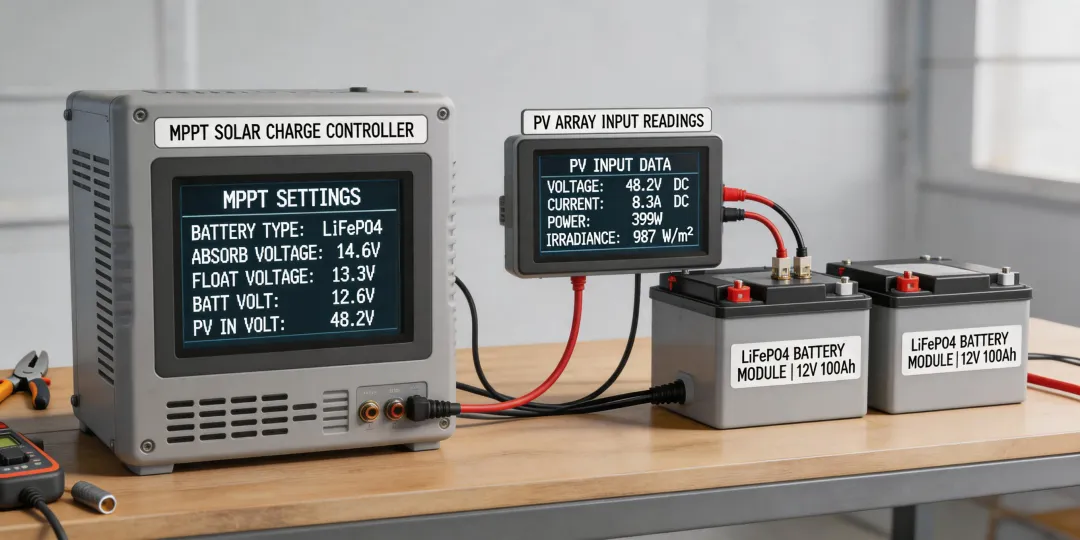
The core of the cost advantage is the Epever's battery flexibility. A lot of cheap controllers lock you into a fixed gel or flooded profile. That kills battery life—and battery cost is half your system price. The Epever 20A and 40A MPPT models let you custom-set the absorption voltage and float voltage. This isn't a 'premium' tier feature locked behind a price wall; it's standard in their mid-range.
For our LiFePO4 installations, we typically set:
- Absorption voltage: 14.4V (for a 12V bank). This is critical.
- Float voltage: 13.8V.
If I remember correctly, an incorrect absorption voltage is the leading cause of premature failure in solar LiFePO4 systems (though I might be misremembering the exact stat from a 2024 industry report). Basically, 14.4V is the sweet spot for most 4-cell LiFePO4 batteries. The Epever hits it.
The Gray Areas: When It's Not the Best Choice
I'm not saying the Epever is perfect for everyone. Our procurement policy now requires a review if the system is over 20kW or includes multiple, complex battery chemistries. That's because I've seen a few edge cases where the advantages of a premium brand outweigh the cost.
- Edge Case 1: Super-fast MPPT tracking. If your panels are in partial shade that changes minute-by-minute, a premium controller's faster tracking (<50ms vs. Epever's ~200ms) can yield 5-10% more energy. Over a five-year lifespan, that extra generation can easily cover the price difference.
- Edge Case 2: You need a 'set and forget' system with a fancy app. The Epever app is functional, not beautiful. If your client demands a polished interface for remote monitoring, a Victron or Morningstar setup might be better, despite the higher TCO.
- Edge Case 3: Ev charger installation in Derby (random specific use). I'm not an electrician, so I can't speak to local regs. Verify current regulations at the local council office. But for the off-grid portion of the power system? The Epever is still a solid choice.
The fundamentals of good system design haven't changed: size the controller to the array, over-rate the battery bank, and program the voltages correctly. What has changed is that mid-tier brands like Epever now offer 90% of the functionality at 40% of the price of the top tier. The old assumption that 'you get what you pay for' is true, but in 2025, you're paying for polish, not necessarily for battery longevity or charging accuracy.
So, bottom line: if you're a system integrator or distributor looking to hit a mid-range price point without sacrificing core features for LiFePO4, the Epever 40A MPPT is probably your best bet. Don't overthink it. (Oh, and the Epever 20A is great for smaller 200W-400W setups, but the price jump to the 40A is so small that it's worth future-proofing your stock.)
Prices as of January 2025; verify current rates with your supplier. That 'cheap' controller might still be tempting, but I've got six years of invoices showing it's a false economy. Trust the TCO, not the upfront price tag.