-
1. What's the real difference between the epever Tracer 2210AN (20A) and the 40A MPPT?
-
2. How do I correctly connect a solar panel to a battery with an epever controller?
-
3. Can I use an epever charge controller with a lithium battery for a camera system?
-
4. Where should I buy a solar battery? (And what they don't tell you)
-
5. Why does my epever controller show incorrect battery voltage?
-
6. Is the epever Tracer 2210AN worth the extra cost over a PWM controller?
-
7. What's the most common sizing mistake people make?
Here's a collection of questions I've been asked repeatedly (and a few I wish I'd asked myself) about epever solar charge controllers and batteries. I'm a system integrator who's personally made about $4,000 worth of dumb errors over the past 3 years. This is everything I learned the hard way.
1. What's the real difference between the epever Tracer 2210AN (20A) and the 40A MPPT?
Short answer: It's not just about current capacity. I learned that the hard way.
Back in 2022, I ordered a 40A unit for a 12V system with a 300W panel. I thought, 'bigger is better.' What I didn't check: the 40A model's minimum battery voltage. That thing won't even start charging if the battery is below 8V. My 20A Tracer 2210AN? It handles down to 7V. Bottom line: If you're using old or deeply discharged batteries, the 2210AN might be a better fit. I wasted $180 on a controller I couldn't use.
2. How do I correctly connect a solar panel to a battery with an epever controller?
The mistake I made: Connecting the panel first, then the battery. The controller didn't power up properly and I fried a fuse. According to the epever manual (which I now actually read), you must connect the battery first, then the panel. The controller needs to detect battery voltage before it sees solar power.
I ignored this advice once—or rather, I assumed it didn't matter—and spent a Saturday troubleshooting a dead system. Ever since, I've taped a note to every controller: 'BATTERY FIRST, THEN PANEL. REVERSE ORDER = SMOKE.'
3. Can I use an epever charge controller with a lithium battery for a camera system?
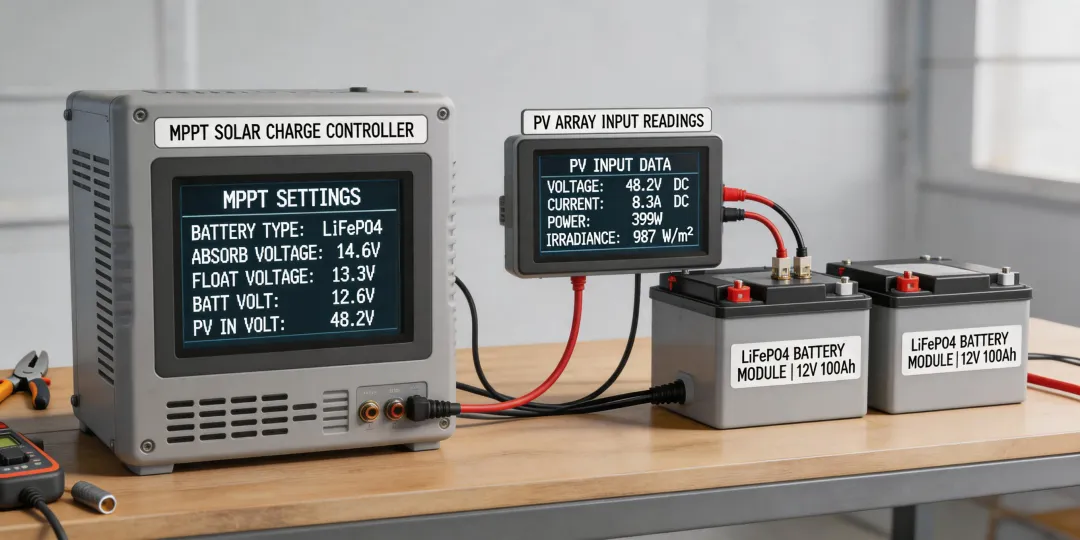
Yes, absolutely—if you set the parameters correctly. Most epever controllers (including the Tracer AN series) have a dedicated lithium battery profile. But here's the catch: I once set it to 'Lithium' and assumed it'd automatically match my LiFePO4 pack. Nope. The default lithium profile was for different chemistry. My battery kept shutting down due to over-voltage protection.
After three cycles of frustration, I figured out I needed to enter the custom battery settings menu and input my battery's exact absorption voltage (14.4V for my 12V LiFePO4). If I remember correctly, the default was 14.6V—too high. That mistake cost me a $40 BMS replacement. Pro tip: Always verify the battery manufacturer's recommended voltages.
4. Where should I buy a solar battery? (And what they don't tell you)
I've got mixed feelings on this one. On one hand, Amazon has unbeatable convenience and often the lowest upfront price. On the other, I've seen multiple buyers get LiFePO4 batteries with hidden delivery fees or 'free shipping' that actually cost more than a local supplier's price.
What I now do: I ask every vendor three questions before buying: 1) What's the total delivered price? 2) Are there any core charges or restocking fees? 3) What's the return policy if the battery arrives below spec?
The vendor who lists all fees upfront—even if the total looks higher—usually costs less in the end. I learned this after a 'cheap' quote from an online store ended up 30% higher after shipping and a mandatory pallet fee.
5. Why does my epever controller show incorrect battery voltage?
This one drove me nuts. I spent two hours checking wiring before realizing: the controller measures voltage at its own terminals, not at the battery. If you have long wires or undersized cables, voltage drop can make the controller think the battery is lower (or higher) than it actually is.
I had a 6-foot run of 10 AWG wire. The controller showed 12.1V, but the actual battery was 12.6V. After I switched to 6 AWG and shortened the run, readings matched within 0.1V. That was a $90 lesson in voltage drop calculations.
6. Is the epever Tracer 2210AN worth the extra cost over a PWM controller?
Short answer: for almost any off-grid setup, yes. But I was skeptical at first.
I bought a $30 PWM controller first, thinking MPPT was overpriced. It worked okay on sunny days but efficiency tanked when panels were partially shaded or the battery was low. After three weeks of poor performance, I bit the bullet and bought the Tracer 2210AN. The difference: On a 200W panel, my daily watt-hour harvest went from ~600Wh to ~850Wh—a 40% improvement. The MPPT paid for itself in about 4 months.
Even after choosing the MPPT, I kept second-guessing. What if I could have gotten the same gain by adding another panel? The three weeks until I installed the meter were stressful. But the data didn't lie.
7. What's the most common sizing mistake people make?
They size for average sunlight, not the worst case. I sure did.
I designed a 12V system for a remote camera using a single 100W panel and a 50Ah battery. During summer it was fine. But in December with overcast days, the battery dropped below cutoff every third day. I had to drive out there twice to jump-start it. The most frustrating part: I had the budget for a 150W panel and a 100Ah battery—I was just trying to save $70. You'd think I'd have known better, but I convinced myself 'it'll be fine.'
Here's what I'd tell my past self: Calculate using the month with the least sun (December for most of North America). Then double the battery capacity. That's your real minimum.