Who This Checklist Is For (and When to Use It)
If you're an installer, system integrator, or wholesaler sourcing solar charge controllers for off-grid systems—and you're tired of comparing specs on a spreadsheet only to get blindsided by hidden costs—this checklist is for you.
I manage procurement for a mid-sized renewable energy distributor. We order roughly $180,000 in components annually, and charge controllers account for about 35% of that. Over the past 6 years, I've audited every invoice from 8+ vendors, negotiated contracts with brands like epever and others, and documented every mistake in our cost tracking system.
This isn't a theoretical guide. It's a 5-step checklist I built after getting burned twice—once by a vendor who quoted a low unit price but tacked on a $450 'custom integration fee' for a standard MPPT controller, and once by spec'ing a controller that met the voltage requirements but didn't handle our load profile.
Step 1: Define the System Voltage and Current Budget First
Don't start by comparing brands. Start with your load.
What to do:
- Calculate the total wattage of your panels (e.g., 2,000W).
- Determine your battery bank voltage (12V, 24V, or 48V).
- Use the formula: Charge Current (A) = Panel Wattage / Battery Voltage
Example: 2,000W / 24V = 83.3A. You'd need a controller rated for at least 85A, but I'd go to 100A for buffer.
Why most people skip this: They pick a controller based on the panel wattage alone. But a 100A controller on a 12V system handles only around 1,200W. On a 48V system, it handles 4,800W. The same controller, different context.
“This worked for us in our standard residential installs. If you're dealing with a commercial array over 5kW, you probably need to step up to higher voltage controllers or parallel units. Your mileage may vary.”
Step 2: Decide Between PWM and MPPT—But Don't Assume MPPT Is Always Better
From the outside, MPPT controllers seem superior: higher efficiency, more energy harvest. The reality is that MPPT is only worth the premium if the system voltage mismatch is significant.
Here's how I evaluate it:
- PWM: Cheap (typically $40-80 for 30A), simple, and works fine if your panel Vmp is close to battery voltage. I've used these for small 12V systems with a single 100W panel. Total cost: around $120.
- MPPT: More expensive ($100-250 for 30A), but the 20-30% efficiency gain pays for itself when you're running higher voltage panels into a lower voltage battery (e.g., 60-cell panel into 12V bank).
Cut to the chase: If your panel voltage is more than 50% higher than battery voltage, MPPT pays for itself within a year. If not, PWM is fine. I've seen buyers pay a $150 premium for MPPT on a system where the gain was negligible. That's money wasted.
Step 3: Check the Fine Print—Especially Voltage Ratings and Temperature Derating
This is where I got burned.
Vendor A quoted $220 for a 60A MPPT controller. Vendor B quoted $180 for a 60A MPPT controller from epever—good brand, known for reliable MPPT technology. I almost went with B until I checked the specs more carefully.
What I found: The epever controller had a max PV input voltage of 150V. Vendor A's controller had 200V. In our climate (desert, high solar irradiance), voltage spikes in winter mornings can push a 'nominal' 120V string to 160V. The epever controller would have fried.
Also check:
- Temperature derating: Controllers lose capacity in heat. A controller rated for 60A at 40°C might only deliver 50A at 60°C. Look for the temperature derating curve in the datasheet.
- Terminal size: Some budget controllers use small screw terminals that can't handle thick battery cables. That's a $50 problem you'll discover during installation.
The vendor who lists all these specs upfront—even if their total price looks higher—usually costs less in the end. I've learned to ask 'what's NOT included?' before 'what's the price?'
Step 4: Calculate Total Cost of Ownership (TCO), Not Just Unit Price
Unit price is a trap. I track every order in our system, and over 6 years, I've found that the 'cheap' controller costs 30% more in total.
My TCO formula for charge controllers:
- Unit price: $X
- Shipping: $Y (some vendors include it, some don't—adds up quickly)
- Setup/integration fees: $Z (rare for charge controllers, but some require custom cabling)
- Expected lifespan: 5 years for PWM, 8-10 for quality MPPT
- Warranty support: If a controller fails, the labor to replace it is often 2x the controller cost
Example from my spreadsheet:
Controller A: $150 unit + $30 shipping + $0 setup = $180 total. Lifespan: 5 years. TCO: $36/year.
Controller B: $200 unit + $0 shipping + $50 terminal adapter kit = $250 total. Lifespan: 10 years. TCO: $25/year.
Controller B is actually cheaper per year, even though it cost $70 more upfront. I made this calculation after comparing quotes for a 50A MPPT controller from three vendors in Q2 2024.
Step 5: Verify Compatibility With Your Battery Type (Before You Buy)
This sounds obvious, but I've seen it go wrong three times in our warehouse alone.
Most modern MPPT controllers support lead-acid and lithium. But parameters vary:
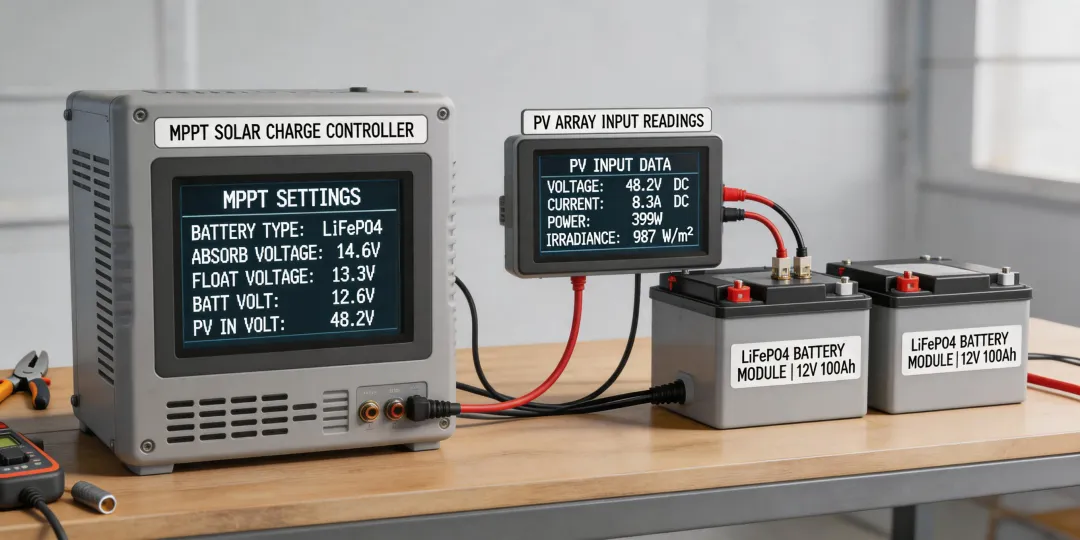
- Lithium: Needs correct absorption and float voltage settings. Some controllers have preset profiles that might not match your battery's BMS.
- Lead-acid: More forgiving, but the charge algorithm needs to match (bulk, absorption, float stages).
My rule: Before placing a PO, download the controller's manual and check if your battery's voltage parameters are in the supported list. If not, ask the vendor if they can customize. If they can't, don't buy it. We don't accept products that don't exactly match our battery specs—not worth the risk.
We didn't have a formal compatibility check process. Cost us when a batch of 20 controllers didn't charge the client's lithium batteries properly. Had to RMA them, pay return shipping, and cover a week of lost project time. I created a verification checklist after that—should have done it after the first time.
Common Mistakes and Red Flags
- Assuming all 60A controllers are equal. They're not. Check max input voltage, derating, and terminal size.
- Ignoring environmental specs. IP rating matters if it's outdoor. Some cheap controllers are IP20 (indoor only).
- Skipping warranty documentation. I've seen vendors offer 'lifetime warranty' but the fine print says it's only for the original buyer. Resellers lose coverage.
- Not asking about firmware updates. Some MPPT controllers need updates for new battery profiles. If the vendor doesn't offer updates, you might be stuck with obsolete firmware.
Honestly, selecting a solar charge controller isn't rocket science. It's about having a process and checking your assumptions. Use this checklist for your next order—it'll save you from the hidden costs that ate my budget the first time around.